-
EEVblog #84 – High Energy Multimeter Destruction
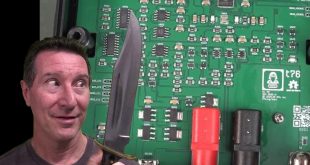
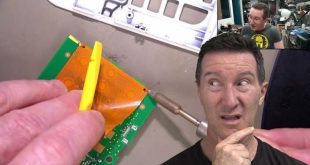
Posted on May 5th, 2010 27 commentsLet’s destroy some multimeters and shoot some metal with Doug’s high energy 4KV capacitor discharge unit.
Visit Doug at www.dfad.com.au
27 responses to “EEVblog #84 – High Energy Multimeter Destruction”

-
I can’t believe I’m the first to comment on this.
Spectacular! I suppose once I’m gainfully employed again I’ll probably pickup a Fluke based on your testing recommendations. But for now the throw-away meters work great.
The EMF launches were great too! Wish we got the 300FPS for that.
And I’m going to share this to my FB page. I love seeing electric current used to blow things up.
-
Ouch! I have seen the magic smoke let out of lots of components but this is the first time I have seen a meter explode!
-
Too bad you missed the knob shooting fluke. I’m sure it was hilarious. But wow i didn’t think a cheep meter can explode like that(like it was filled with gunpowder or something)
-
Phew, I’m lucky there isn’t anything near 4KV around my cheap multimeters.
Dave, what about using Doug’s device on exhausted cellphone lithium batteries? An overcharge or even a short circuit is often enough to let them explode like incendiary bombs.
http://www.youtube.com/watch?v=z3o_2mwRPdw
http://dailymotion.virgilio.it/video/x1ratv_notebook-pc-explosion-lithium_fun-
Going from memory I believe that in the UK would expect to see a 4kV transient on the mains about 3 times a year.
A CAT III meter should be tested with the transient superimposed on the mains with a low source impedance.
All meters in Europe should be safety tested prior to sale and should be marked with a “CE” rating. The standard says that the unit should not be damaged.
We have tested several cheap Chinese meters at work. One of the first I saw not only caught fire but blew the 100A mains fuse on the supply. Remember – you get what you pay for.
-
-
Brian Hoskins May 6th, 2010 at 06:47
No matter how old you get, and no matter how responsible you become, it’s always a hoot to blow stuff up. I’ve never met an Electronics guy who didn’t like to see something go bang!
An old school TV repair guy I used to know would always say, “tune for maximum smoke!!!”
Brian
-
Dave!
I don’t think you noticed the extra damage to the Fluke 28 II. The chip just above the selection knob at U12 was completely blown out! I could see a hole right down to the silicon. I would have thought the built in protection components would have prevented that damage. I guess 4kv was just too much for it.
Great video!
-
Jason May 6th, 2010 at 14:02
That was amazing.
@Todd
Even if the components other than the MOVs were damaged, it still failed safely without exploding.
-
AskJacob May 6th, 2010 at 17:12
Now I’d love to see some 300fps footage of some of those MOVs going off naked. I always wondered if they kind of “foosh” and smoke, or go off like a small bomb. From that fluke pcb it looks like they went with a bang – it looks like shockwave damage delaminated the pcb!
Thanks for busting stuff for us!
Cheers
Jacob -
Michael Thompson May 6th, 2010 at 22:09
Nothing is better than that shot of Dave’s face over the bin of destroyed meters.
Lucky devil.
-
shafri May 7th, 2010 at 15:32
do this when u got a DMM to waste. otherwise, buy a top end DMM, and be happy about it. i dont mind watching this vidz as from the title and intro pic, i’m already aware, whats the content will be. i think i’m already pretty expert at explosion through electrical energy. i saw the the title before anybody commented and it took me this long before comeout with mine. Cheers
-
shafri May 7th, 2010 at 15:40
the smoke u saw major”ly” come out of layering on top of the PCB copper (usually green coloured), which long time ago make me think, that the layer is not just only protection from corrosion, accidental shorting etc, but it gives some level of heat protection to the component it self, by burning itself before others. and as early indicator that something goes wrong inside. but when u get over the tolerance, or when all the surrounding layer are burnt, then… you guess what? the component itself has to take the heat, cant do anything much after that other than repairing and replacing parts.
-
well, that was about the most stupid thing I’ve seen on the eev site to date. Let’s see…Let’s apply a big voltage so far beyond the range of a meter and see what blows up…Yes, they blew up. Such a surprise (Not!)
And it proved…nothing. Seemed to me actually that this showed that there it no benefit to be gained for paying 30 to 50 times as much for a meter. They both go bang.
How often do we encounter such voltages in real life? Very very seldom. Perhaps in a microwave oven, but if you are sticking regular meters and meter probes in there, you’re deserving of the result you get. Fried meters, and quite possibly, fried dead techs.
Dumb. Dumb. Dumb.
-
Lasse May 8th, 2010 at 01:00
Hey Bill,
I’m pretty sure Dave inteded for this video to prove that paying “30 to 50″ times more than a meter doesn’t give you a meter that will not go bang at 4 kV, but it will however give you a meter that fails in a safe manor. The Fluke 28-II failed with a single “poof”, and that was it. It didn’t explode as some of the cheaper meters did, and it didn’t fail repeatedly either.
While you most likely won’t be putting 4 kV into the meter, it’s, atleast in my opinion, very reassuring that when(not if) I connect my meter in the wrong way, I will not lose my hand, just the meter.
Atleast for me:
My life > My multimeter- To Dave:
Nice work on the video, I really enjoyed it! Really goes to show the real difference between an expensive and a cheap multimeter. Thumbs up! -
shafri May 8th, 2010 at 03:07
yea. there is seldomly 4kV out there, but this video shows you the thing that you’ve not seen in your television. PRICK !!!
-
-
I think this video just proved to me what I thought all along; that the worry that a cheap multimeter would “blow your hand off” as has been stated on this blog before is BS. Even if you had one of those cheap DMMs in your hand when they went off like that, the worst you would get would be a small cut or two and maybe a very minor burn. I’ve certainly had things in my hand go off with more energy than those DMMs did and not get significantly hurt.
Heck, I’ve been hurt worse than that when playing around and don’t even notice until someone asks me why I’m bleeding.
-
Many years ago, when I was young apprentice, I had repaired a defibrillator. Out of curiosity, I wanted to see what voltage that the discharge capacitor was charged to. Armed with my trusty Fluke 75, I proceeded to measure the voltage… Bad idea!!! The meter emitted a continuous beep & the display went dark, that was the end of the meter. Fortunately the meter was still under warranty, & it was repaired thanks to Fluke. Never did get to find out what the voltage was, next time I’ll be using a HV probe.
Cheers, PK. -
I don’t know about anyone else, but the only thing I like the cheap meters for is for car work. Then if I break it I buy a new one. For all my transmitter and digital work i use a “good” Fluke.
By the way, the current limits I saw you comment weren’t tested – Fluke usually uses a 15 amp fuse on the 10amp input. From what I’ve seen during my use, I’d say 15 amps would be the limit only for short runs (I’ve tested circuits that pull 13 amps, but only for short periods because of the overload alarm). -
@JRR
You should watch the safety video they made us watch at work. Guy plugged his meter into 2300 volts. The only reason he can still see is because he had safety glasses on. His face was pretty bad scarred. They didn’t say what brand of meter he was using, but I don’t think it matters sometimes. Give any meter 2300 volts at 20+ amps continuous and the results will be dangerous or deadly. -
Simon from Rome December 9th, 2010 at 03:14
Hi Dave.
i’m Simone..
You don’t have a video about Fluke 179
Whyyyyy? (I’m joking)What you think about Fluke 179?
You think is a good product?Cheers from Italy
Leave a reply
-


Tony P May 5th, 2010 at 14:58