While I'm waiting for the boards to arrive for my
train signal project, I thought I'd tackle another project that also applies to my layout: flashing lights for road signs, signals and vehicles.
Initially I was thinking I'd like a board that upon receiving a signal would alternately flash two LEDs for a railroad crossing signal; however, I've realized that I would like to have it work for other applications such as strobing red-and-blue lights for emergency vehicles as well, or even just flashing the LEDs on and off at the same time, for hazard flashers on a vehicle. I don't actually know enough about how or why the flasher circuits with the 555 work to design one that can selectively do these three things...
I think a bigger issue beyond just getting this to work is the fact that I'd like to be able to work with LEDs of any color, which means I'd need to work with LEDs with Vf ranging from 2-3.2V. So far my only experience with this are resistors of a set value where the output is only supposed to drive one color - however, in my case I'd be wanting to use multiple colors with one output.
So, the circuit in question should have two outputs - one for each LED - and will have three modes. It should do these things in those modes:
Mode 1 - Alternate: LEDs alternate on-and-off, with one LED being off when the other is on.
Mode 2 - Strobe: LEDs alternate on-and-off, but they blink twice before switching to the next LED. Mimics police lights.
Mode 3 - Synchronized: LEDs turn on and off at the same time.
I'd like to be able to adjust the flashing rate for all modes, just so I can get the right 'feel' to each setting. Ideally, I'd do this without a MCU since then I wouldn't have to program it.
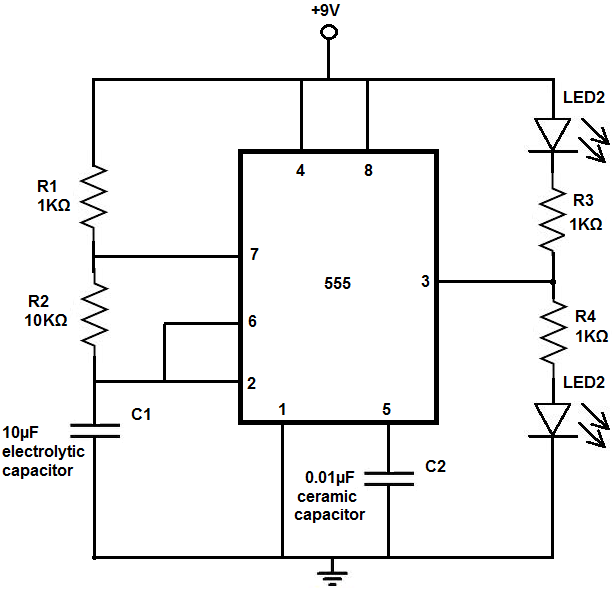
It seems that most of these flashing LED circuits are built with a 555 timer - here's a schematic for an alternating LED flasher that I found on Instructables:
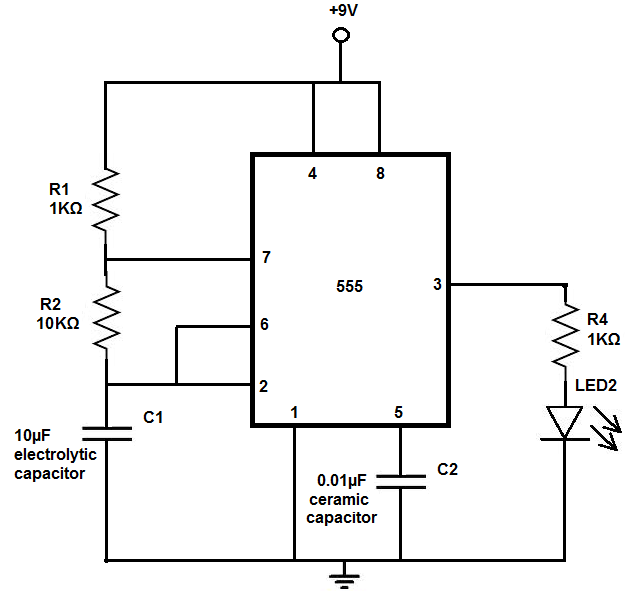
The same Instructables page also gives a circuit for a single flashing LED (which I could probably hook up another LED in parallel to in order to have two simultaneous flashing LEDs):
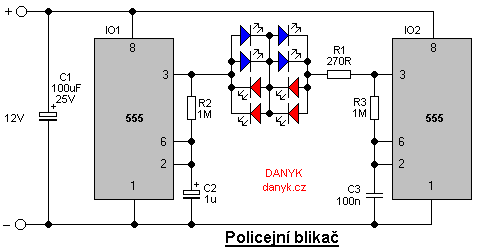
I also found a circuit that strobes the LEDs like police lights:
The problem is combining them all into a single board/circuit, and adding the adjustment for the rate of flashing, as well as making sure the outputs are happy driving LEDs of a fairly wide range of forward voltages. I'm thinking of a few transistors that connect power to the individual function circuits on demand; based on what I've seen, I don't even need to provide a 'go' signal for these, just power.
Is this something I can even do without a MCU?

 Home
Home Help
Help Search
 Login
Login Register


