Author Topic: Class A stereo amplifier  (Read 16932 times)

0 Members and 2 Guests are viewing this topic.

Offline John Heath

  • Frequent Contributor
  • **
  • Posts: 444
  • Country: ca
  • 2B or not 2B
Re: Class A stereo amplifier
« Reply #25 on: February 04, 2018, 03:17:47 am »
The CRT was the base. You start from a mounted CRT and work your way backwards. It made me laugh. Not an easy way to make a TV but then again the CRT is the hardest part to make. Transistors with a gain in the single digits !

The video posted was well thought out. Great graphics. I could see how this would be a valuable leaning tool. Found another one .


Even without understanding the language I am getting half of what he is saying. This is mostly do to the great graphics.

Also I found a respectable picture of your scope. That is a nice scope. 250 MHz not 150 MHz as I said.
 

Offline Pawelr98Topic starter

  • Regular Contributor
  • *
  • Posts: 105
  • Country: pl
Re: Class A stereo amplifier
« Reply #26 on: February 04, 2018, 04:42:08 am »
Those russians have entire series. The title of the series would be "Prostaya Elektronika" which means "simple electronics".
I decided to self-learn cyrillic because of my russian oscilloscope.
Comes useful when searching on russian websites.

An example of a "second-rate" diode.
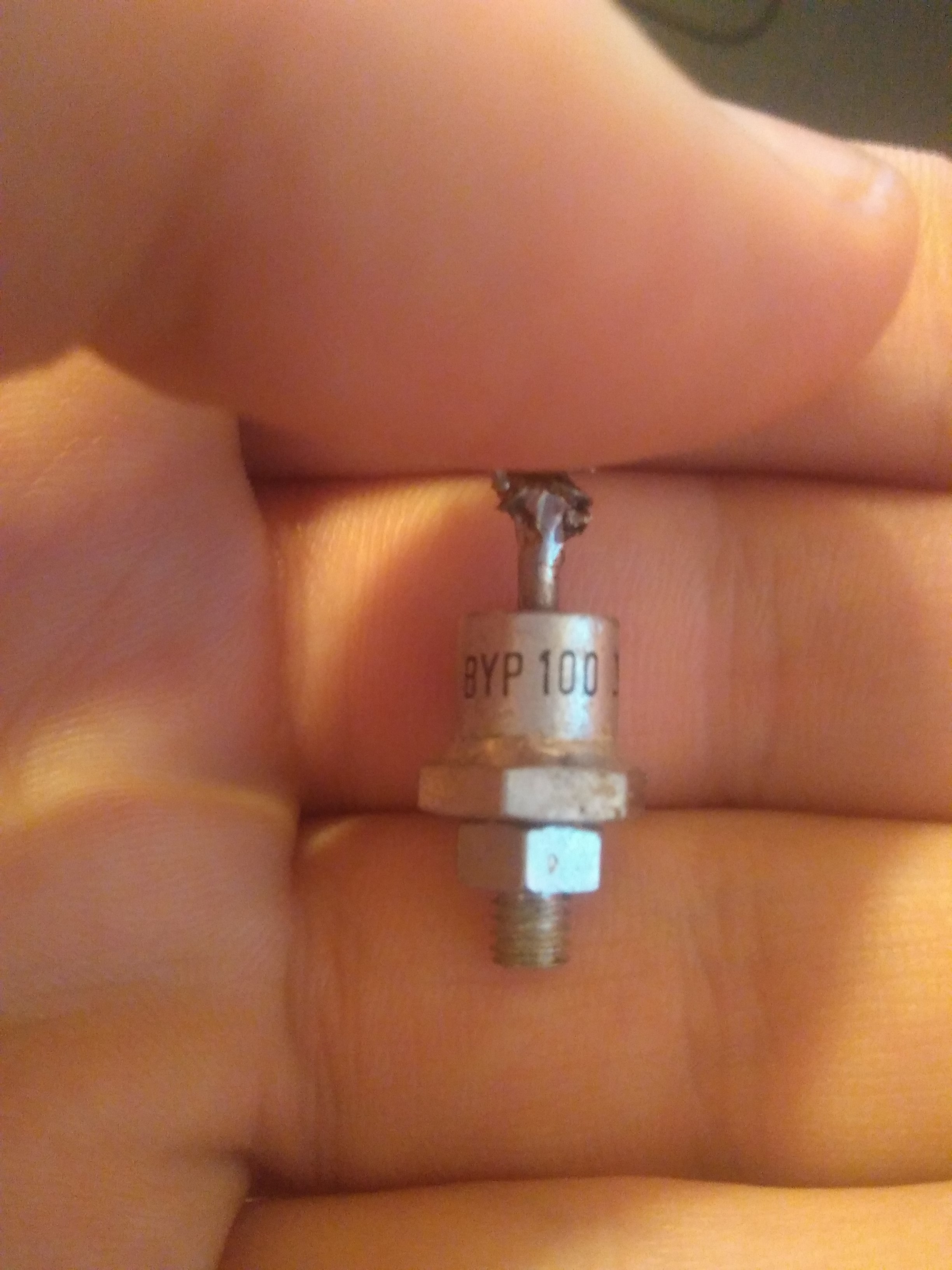
Normally marked as BYP680-100.
5A 100V general purpose diode.
This one is marked as BYP100, you won't find it in any datasheet from the time.

What kind of load can this "second-rate" diode handle ?
Dunno really. May have lower current rating, higher leakage current or decreased max voltage.

Sometimes "second-rate" devices were repurposed or used for "bottom of the line".
Broken transistors used as diodes (case was the same, collector leg was cut).
TG1 (small germanium PNP) is the second example.
Beta:9-20
Ft=300KHz
For comparsion TG5(from the same family, most popular):
Beta:25-80
Ft=800KHz

TG1 doesn't even have Vcemax rating. Only a Vcbmax of -10V is given.
There's only a graph which shows Vcemax in relation to Rbe.
Current and power rating is the same as for entire family.
In reality it was a bad device:


Sometimes you could get a transistor which had single digit beta but otherwise performed OK (eg. could take same power as proper device).
Such devices were often sold in hobbyist shops etc. A "not fully functional" mark was often given but sometimes not(which may cause problem today as the stock of such shops spreaded over private owners).

I was born after communism era (1989, I was born in 1998) but I often deal with equipment/parts from that time.
At my university there's plenty of vintage equipment from that era.

When browsing old books/magazines you can find very interesting projects.
I recall a self powered AM radio with amplifier from a polish magazine.
A voltage multiplier was used to turn radio waves into power for germanium transistors.

I have a friend who attends technical highschool which specializes in radio communications.

He managed to build a working FM radio on a single transistor.
Superregenerative receiver.
 

Offline John Heath

  • Frequent Contributor
  • **
  • Posts: 444
  • Country: ca
  • 2B or not 2B
Re: Class A stereo amplifier
« Reply #27 on: February 04, 2018, 07:28:26 pm »
For self powered a radio could tune it the strongest station out there and use it for power. With this power it can tune in weak stations and amplify them.  This means the strong transmitter station is providing power to listen to weak AM stations. You should send a letter of thanks to the strong transmitter AM station for providing power to listen to other AM radio stations , ha.

I have head of 1 transistor AM radios that will drive a speaker ! But I have never seen a 1 transistor FM radio. Do you have a diagram of it?
 

Offline Pawelr98Topic starter

  • Regular Contributor
  • *
  • Posts: 105
  • Country: pl
Re: Class A stereo amplifier
« Reply #28 on: February 05, 2018, 01:42:56 am »
Superregenerative receiver is one option.

LM386 is used for audio signal amplification.

But as always the russians built something interesting:

http://gef79.narod.ru/Shem/Radiopriem/64.htm
Quality is good enough to be connected with stereo decoder.
This is not Superregenerative but something else. I have a description of the device in Polish.
It seems to be a generator which tunes to 1/2 of station frequency.
Signal from antenna synchronises the generator.
I managed to get such information.

GT311E is a very high frequency germanium transistor.
Such transistors are commonly used in soviet TV's or oscilloscopes (as in my case).

This one is tuned for OIRT band (65.5-74MHz) so values would have to be adjusted for CCIR band (87.5-108MHz).

Eastern Bloc was using OIRT band which created problems after transition to new CCIR band.
I still work on one OIRT radio which refuses to work with CCIR correctly.
100+MHz works OK but lower band is unstable.

Will have to inverstigate using the popular SDR receiver.
It can be used as spectrum analyser which can check superheterodyne frequency.
 

Offline John Heath

  • Frequent Contributor
  • **
  • Posts: 444
  • Country: ca
  • 2B or not 2B
Re: Class A stereo amplifier
« Reply #29 on: February 05, 2018, 03:40:16 am »
So it would be a 100 MHz AM receiver tuned just off the station frequency so that it would act like a frequency slope detector , FM decoder. Yes?


Offline Conrad Hoffman

  • Super Contributor
  • ***
  • Posts: 2260
  • Country: us
    • The Messy Basement
Re: Class A stereo amplifier
« Reply #30 on: February 07, 2018, 12:20:23 am »
Here's a circuit I did "way back". It worked great, but I know at least one person had some stability issues with it, so watch grounds and such.
 

Offline John Heath

  • Frequent Contributor
  • **
  • Posts: 444
  • Country: ca
  • 2B or not 2B
Re: Class A stereo amplifier
« Reply #31 on: February 07, 2018, 03:00:52 am »
I could not help playing with it. Apologies in advance. Assume regulated rails so we do not need a zener for bias pot. One zener and one resistor gone. Set gain to 1 therefore feed back resistors not required. Two more resistors gone. Assume ground isolation condensers are on the power supply not the op-amp. I realize this is cheating but I am not above cheating when it comes to simplicity. Two more condensers gone. This leaves only two resistors plus 1 pot and 1 condenser. It is perfect.
 

Offline Pawelr98Topic starter

  • Regular Contributor
  • *
  • Posts: 105
  • Country: pl
Re: Class A stereo amplifier
« Reply #32 on: February 07, 2018, 03:37:57 am »
So it would be a 100 MHz AM receiver tuned just off the station frequency so that it would act like a frequency slope detector , FM decoder. Yes?

Superregenerative receivers do use slope detection.It can be used for receiving high-frequency AM radio broadcasts.

The russian design however is different.
It seems to be Analog Phase Locked Loop(APLL) on a single transistor.
It synchronises with the second-harmonic of the input signal.

The design works with Silicon transitors as well.
Here's a circuit I did "way back". It worked great, but I know at least one person had some stability issues with it, so watch grounds and such.

Does this really have <0.02% THD ?

IRF530 is a cheap transistor.
Drain on case=no isolation needed for the main device.
The load transistor would need isolation though.

For a headphone amp this won't produce much heat so it shouldn't be a problem.

I will try to go and purchase CEMI UL1111.
I found one electronics store in Gdansk which sells vintage parts.
This chip contains differential pair(along with three standalone transistors) which is useful for various designs.

It cannot withstand high voltages (15V Vce) but it's a cheap matched pair.
Pretty much a clone of western CA3046.
High Ft is an additional bonus. May use those for RF applications.

For AB class I usually go with one-chip amplifiers.
TDA2003,LM386 and recently TDA2822M.

My first discrete AB class is most likely going to be the Ge USSR amp.

Germanium amplifiers can be pretty much rail-to-rail amplifiers if done correctly.
Very useful if supply voltage is limited.

TDA2822M is good as it has 1.8V minimum (popular LM386 is 4V) but I heard that Ge can go even lower.
 

Offline Conrad Hoffman

  • Super Contributor
  • ***
  • Posts: 2260
  • Country: us
    • The Messy Basement
Re: Class A stereo amplifier
« Reply #33 on: February 07, 2018, 04:42:41 am »
The measurement was probably for 1 kHz but I don't remember as it was so long ago. The number is 0.002%, not 0.02%. The design does produce significant heat if biased for anything useful. I built it on a fairly substantial heat sink, probably 70 mm x 70 mm x 130 mm. Though it looks simple, a fair amount of work went into the design and substituting or changing anything will probably cause some type of problem. Do that after getting it working as drawn.
 

Offline Leo Bodnar

  • Frequent Contributor
  • **
  • Posts: 843
  • Country: gb
Re: Class A stereo amplifier
« Reply #34 on: February 07, 2018, 08:48:42 am »
Easy solution for the bottom MOSFET in [negative] current source mode is to use two-three diodes in series with a gate trim pot.  This is how I did it in 1980s.  Glue or thermally couple the diodes to the MOSFET.  This will stop the thermal runaway.
Good news is you might not need thermal control.  Bad news is MOSFET would have melted by then. 
There are two thermal effects working against each other (Vgs and Ids) but equilibrium is usually in few dozen amp range.
Ferrite beads on gates will stop oscillations.
Leo

P.S. I did not use load resistance in current source because this would have made it active current source.  It was just MOSFET in constant current mode.
« Last Edit: February 07, 2018, 01:16:38 pm by Leo Bodnar »
 

Offline John Heath

  • Frequent Contributor
  • **
  • Posts: 444
  • Country: ca
  • 2B or not 2B
Re: Class A stereo amplifier
« Reply #35 on: February 07, 2018, 01:00:57 pm »
The measurement was probably for 1 kHz but I don't remember as it was so long ago. The number is 0.002%, not 0.02%. The design does produce significant heat if biased for anything useful. I built it on a fairly substantial heat sink, probably 70 mm x 70 mm x 130 mm. Though it looks simple, a fair amount of work went into the design and substituting or changing anything will probably cause some type of problem. Do that after getting it working as drawn.

If I needed an amplifier and it was important I would go with the original Hoffman design. I can well imagine my boiled down version would have problems. But it is fun to try and eliminate components , somewhat like a cross word puzzle.   
 

Offline Pawelr98Topic starter

  • Regular Contributor
  • *
  • Posts: 105
  • Country: pl
Re: Class A stereo amplifier
« Reply #36 on: March 04, 2018, 09:51:09 pm »
Time for Germanium.

My first discrete AB class amplifier.


MP37 NPN
MP42 PNP
TG5S PNP

Schematic which I received from university professor I know(he's vice-dean of other department on my university).

He also provided me with a better schematic but for now I experiment with this one.

TG50 is a different transistor. I decided to use MP42 because TG50 was made in Poland while MP37 is USSR-made.

MP37 is much weaker than MP42.
The best MP37 paired with the worst MP42(gain wise that is).
MP42 is higher current,higher power and higher gain.
 

Offline mikerj

  • Super Contributor
  • ***
  • Posts: 3660
  • Country: gb
Re: Class A stereo amplifier
« Reply #37 on: March 05, 2018, 10:41:38 am »
On the subject of simple amplifiers, can anyone remember a crude class D design using (I think) BC108s on the output?  It was published in one of the UK electronics magazines, probably back in the 70's, and had pretty terrible distortion but I built it and it did work.  I've not been able to find the design since however.
 

Offline Pawelr98Topic starter

  • Regular Contributor
  • *
  • Posts: 105
  • Country: pl
Re: Class A stereo amplifier
« Reply #38 on: May 03, 2018, 12:11:22 am »
Started working with tubes.


Soviet 6S19P triode. Main use was series voltage regulation in military aircrafts.


Isn't the glow nice ?


Regulated grid and anode voltage.

Anode voltage is 180V zener + KSC5027 NPN transistor (800Vce).
Grid regulation is 4x15V zener.

I have a audio transformer which was originally used in Stern 7e86, an Eastern German Vacuum tube radio from 50's.
The radio used 6V6 (in Eastern Germany) or EL84 (version for Polish market) as output tube, 40mA@240V so it should be fine with 6S19P.

170V anode(~320R primary, 185V before transformer),-60V grid which results in 44mA anode current.
Close to original value used in the radio.


Share me

Digg  Facebook  SlashDot  Delicious  Technorati  Twitter  Google  Yahoo
Smf