Author Topic: Different die pictures  (Read 183031 times)

0 Members and 5 Guests are viewing this topic.

Online NoopyTopic starter

  • Super Contributor
  • ***
  • Posts: 2339
  • Country: de
    • Richis-Lab
Re: Different die pictures
« Reply #350 on: September 04, 2024, 06:22:30 pm »


The SAB8068 is the Siemens variant of the 8086 processor. The index 1 indicates the fastest binning with a maximum clock of 10 MHz.


The dimensions of the die are approximately 4,5mm x 4,4mm. The various functional blocks of the processor are clearly visible.

This image is also available in a higher resolution: https://www.richis-lab.de/images/cpu/11x02XL.jpg (40MB)


M202 could be an internal project name.


There is a charge pump on the top edge that generates a negative voltage. The negative potential is fed to the base of the package and thus to the substrate via a bondpad. The same circuit was integrated a second time at the bottom edge, where a bondwire also leads to the base of the package. The negative substrate potential optimises the characteristic curves of the integrated transistors.


https://www.richis-lab.de/cpu10.htm

 :-/O
 
The following users thanked this post: RoGeorge, ch_scr, D Straney

Offline quadtech

  • Regular Contributor
  • *
  • Posts: 79
  • Country: in
Re: Different die pictures
« Reply #351 on: September 08, 2024, 01:52:10 pm »
 

Online NoopyTopic starter

  • Super Contributor
  • ***
  • Posts: 2339
  • Country: de
    • Richis-Lab
Re: Different die pictures
« Reply #352 on: September 13, 2024, 09:09:29 am »


The SAB80186 was a very old part on my website. I have update this part now.  8)

The SAB80186 was produced by Siemens and is based on the Intel 80186. The processor shown here operates at a clock frequency of 8MHz. There is also the bin SAB80186-1 which allows operation at 10MHz.


The datasheet contains a block diagram of the SAB80186, which is still quite good to understand.


The dimensions of the die are 8,1mm x 7,3mm. The individual functional blocks are clearly visible. Siemens used a so-called MYMOS process, that´s a n-channel silicon gate process.

This image is also available in a higher resolution: https://www.richis-lab.de/images/186/07XL.jpg (100MB)


The copyright clearly shows that the architecture was licensed from Intel. The meaning of the characters EZM remains unclear.


M239 seems to be a typical Siemens internal project designation. A21 could stand for a revision.


https://www.richis-lab.de/IC_01.htm

 :-/O
 
The following users thanked this post: RoGeorge, ch_scr, D Straney

Offline Abdull

  • Newbie
  • Posts: 3
  • Country: 00
Re: Different die pictures
« Reply #353 on: September 13, 2024, 10:08:44 am »


The SAB80186 was produced by Siemens and is based on the Intel 80186.


The meaning of the characters EZM remains unclear.

"EZM" could mean "Entwicklungszentrum für Mikroelektronik Ges.m.b.H". As pointed out in a 1979 press release, the EZM integrated circuits research and development unit was founded by Siemens and Austria in Villach, Austria (Austrian commercial register entry).
 
The following users thanked this post: Noopy

Online NoopyTopic starter

  • Super Contributor
  • ***
  • Posts: 2339
  • Country: de
    • Richis-Lab
Re: Different die pictures
« Reply #354 on: September 13, 2024, 10:28:14 am »
Thanks for the hint!
That sounds pretty reasonable.
 
The following users thanked this post: Abdull

Online NoopyTopic starter

  • Super Contributor
  • ***
  • Posts: 2339
  • Country: de
    • Richis-Lab
Re: Different die pictures
« Reply #355 on: September 16, 2024, 02:14:15 pm »


An here is an update for the Intel i486SX!

In contrast to the DX variants of the 80486, the Intel i486SX does not have a floating point unit. It can be operated at a maximum clock frequency of 33MHz.


In order to be able to lead the many potentials of the processor to the outside, they were placed on two levels of the ceramic package.


The dimensions of the die are 10,6mm x 7,0mm. This image is also available in a higher resolution: https://www.richis-lab.de/images/486SX/17XL.jpg (116MB)


The i486SX is a separate variant, it is not just binned. A corresponding designation can therefore also be found on the die.


According to Wikipedia, the minimum structure width of the process used here is 1µm.


https://www.richis-lab.de/IC_02.htm

 :-/O
 
The following users thanked this post: macboy, RoGeorge, ch_scr, D Straney

Online RoGeorge

  • Super Contributor
  • ***
  • Posts: 8222
  • Country: ro
Re: Different die pictures
« Reply #356 on: September 16, 2024, 10:57:55 pm »
Wow!  Didn't know bonding wires can be on more than one level.  Have you seen other chips like this?

Offline D Straney

  • Frequent Contributor
  • **
  • Posts: 382
  • Country: us
Re: Different die pictures
« Reply #357 on: September 16, 2024, 11:22:24 pm »
Anything high-pin-count, really - here's an ASIC from a probable rocket engine controller:
 
The following users thanked this post: RoGeorge

Online NoopyTopic starter

  • Super Contributor
  • ***
  • Posts: 2339
  • Country: de
    • Richis-Lab
Re: Different die pictures
« Reply #358 on: September 17, 2024, 02:45:38 am »
Yes, that´s not that special.

I can´t say where but I´m pretty sure I have seen packages with three steps to give enough room for connecting the bondwires.  :-+
 
The following users thanked this post: RoGeorge

Online NoopyTopic starter

  • Super Contributor
  • ***
  • Posts: 2339
  • Country: de
    • Richis-Lab
Re: Different die pictures
« Reply #359 on: September 23, 2024, 01:37:16 pm »


Do you remember the ATtiny841?

High res: https://www.richis-lab.de/images/uC/04x04XL.jpg


If you remove the metal and polysilicon layers, it becomes clearer where the various functional blocks have been integrated. As was to be expected, the large memory area is located under the solid metal surface. The relatively large square area in the bottom right-hand corner contains the SRAM. To the left of the SRAM, a square structure can be seen, which was also found in the ATtiny10 (https://www.richis-lab.de/uC03.htm). It contains the registers for configuring inputs and outputs, timers, ADCs and similar functions. The relationship between the ATtiny10 and the ATtiny841 can be clearly seen in many places.

High res: https://www.richis-lab.de/images/uC/05x05XL.jpg


The flash memory has the same structure as in the ATtiny10, it is just larger. In contrast to the ATtiny10, however, the ATtiny841 also contains an EEPROM. The EEPROM is located above the flash memory and stands out visually. The proportions show why usually just a small amount of EEPROM is integrated in microcontrollers. At 8kB, the flash memory is sixteen times as large as the EEPROM at 512B. However, the space required by the memory cells is only eight times as large.

The selection and evaluation circuits can be seen around the memory areas. The capacitors of the charge pumps, whose higher voltage is required to write to the memory cells, appear to be integrated at the left edge of the image.


In detail, the flash and EEPROM memory cells differ only slightly. At this level, both memory types work very similarly. In flash memory, however, memory cells can only be written in groups.

The EEPROM consists of 132*32 cells. It therefore contains 128 Bits in addition to the program memory, which can be used for lock bits or similar functionalities. The flash memory has 130*512 memory cells. There are 1024 bits in the background.


https://www.richis-lab.de/uC04.htm

 :-/O
 
The following users thanked this post: RoGeorge, D Straney

Online NoopyTopic starter

  • Super Contributor
  • ***
  • Posts: 2339
  • Country: de
    • Richis-Lab
Re: Different die pictures
« Reply #360 on: September 26, 2024, 03:03:09 am »


Not a die, not a semiconductor.  ;D Here you can see an SMD quartz resonator built by NDK. The history of the Japanese company NDK goes back to 1948. In addition to quartz resonators, NDK's product range also includes oscillators and SAW filters. The NX5032SD can resonant at frequencies between 9.75MHz and 40MHz. The model shown here oscillates at 26MHz, which can be seen in the first line. In the second line, there are two numbers next to the NDK logo, which usually represent a type of datecode. The NX5032SD is certified according to AEC-Q200 for use in the automotive sector and allows accelerations of up to 2,000g.


The dimensions of the package are 4,9mm x 3,1mm. Inside is a square quartz crystal to which square electrodes have been applied. The crystal is attached on the left-hand side and is also electrically contacted via this attachment.


https://www.richis-lab.de/xtal_01.htm  :-/O
 
The following users thanked this post: RoGeorge, ch_scr

Offline D Straney

  • Frequent Contributor
  • **
  • Posts: 382
  • Country: us
Re: Different die pictures
« Reply #361 on: September 26, 2024, 04:51:42 am »
Interesting looking at the different attachment methods: a quick survey of the oscillator modules I've opened (from a variety of applications, high-rel. avionics stuff to telecom to standard commercial) shows only circular discs, fixed at both ends.

So it stood out to me, that your crystal is a long, thin cantilever beam, instead of a wide circle supported at both ends.  However, all of mine are much larger than ~3x4 mm, even in the same frequency ballpark (12 Mhz - 40 Mhz).  I'm guessing the geometry has to change to shrink the size while keeping the frequency similar: because a beam supported at both ends is drastically stiffer than a cantilevered beam (with one end unsupported), its (1st-mode) resonant frequency will be much higher.  So by moving from a doubly-supported wide shape to a narrower cantilever, that probably lowers the shape-dependent resonant frequency, which counteracts the drastic increase in resonant frequency from the smaller dimensions.
...if that makes sense.
 
The following users thanked this post: RoGeorge, ch_scr

Online NoopyTopic starter

  • Super Contributor
  • ***
  • Posts: 2339
  • Country: de
    • Richis-Lab
Re: Different die pictures
« Reply #362 on: September 26, 2024, 08:41:35 am »
I agree with you. Usually you see this circular discs. It seems they had to build different geometries for the small packages that are used today. And your explanation that the single support decreases the shape-dependent frequency sounds reasonable too.  :-+

I´m surprised this single support quartz is stable enough for an acceleration of 2.000g.  :box:

Offline T3sl4co1l

  • Super Contributor
  • ***
  • Posts: 22435
  • Country: us
  • Expert, Analog Electronics, PCB Layout, EMC
    • Seven Transistor Labs
Re: Different die pictures
« Reply #363 on: September 26, 2024, 02:53:23 pm »
Outline doesn't matter much: these are flextural mode crystals, with the waves confined between electrodes, making some kind of... bulk shear mode wave, I think it is?  And then obviously that wave is confined between boundaries so 1/2 wave is the lowest resonance, and n+(1/2) wave overtones beyond that.

The outline (of electrode and wafer) control how waves from the local area spread out and reflect around; reflections will give spurious tones, probably of poor coupling for the most part (narrow spectral lines, low amplitude), and mode conversion to longitudinal, surface-acoustic and beam modes will give all other manner of tones, mostly at frequencies well outside of the oscillator bandwidth, but occasionally splitting poles, i.e. making resonances near the main mode, or when nonlinearity is included so that once the main oscillation starts up, other modes can potentially mix in (good luck probing those, lol, and the oscillator doesn't care once started up on the main peak, but to say in principle at least?).

You can imagine something like... if you find some spur modes that couple into surface waves, and then you start the cantilever oscillating (1/4, 3/4, etc. wave as the case may be), you've got modes on top of modes and could get some FM (manifests as spurs splitting into peaks), analogous to the warpy-woobly sound of a sheet of metal being flexed around, but in specific controlled modes and rates.

The bulk shear mode of course is largely immune to such effects, so is a good choice as dominant oscillation mode.

In any case, all those spurious modes will vary with how much space they have to fill, and the ratio between OD (outer diameter, or outer dimensions) and overlapping electrodes (dia/dimensions) will have something to do with the relative amplitude, spacing and abundance of those modes.

Tim
Seven Transistor Labs, LLC
Electronic design, from concept to prototype.
Bringing a project to life?  Send me a message!
 

Offline D Straney

  • Frequent Contributor
  • **
  • Posts: 382
  • Country: us
Re: Different die pictures
« Reply #364 on: September 27, 2024, 01:50:55 am »
Huh interesting, good to know - I obviously haven't worked out the macro-scale resonant parameters based on typical quartz Young's modulus & dimensions (would probably be orders of magnitude off, then), but given the frequency I guess it shouldn't be surprising it's much smaller-scale propagation, and not damped by air resistance etc. the way it would be if it was actually bending the crystal lengthwise.  Sounds like it's the thickness that's really the key parameter then.

In that case, wonder why it's arranged as a cantilever in the Noopy's small crystal: only reason I can think of as a non-expert here is that it's about giving it a non-rigid mounting for some level of vibration isolation (and/or CTE mismatch between it and the package, over the longest dimension?) - the discs are mounted on flexible bent pins, and some even sit on wound springs (see the top-right one in my photos above).  Can imagine it was harder to isolate the smaller crystal that way within the form-fitting package and low height - maybe the manufacturing process wouldn't have worked with some flexible crystal posts bonded on the inside, and it was easier to just mount it rigidly at one end, and use the bulk material properties of the quartz to give it flexibility.

Online NoopyTopic starter

  • Super Contributor
  • ***
  • Posts: 2339
  • Country: de
    • Richis-Lab
Re: Different die pictures
« Reply #365 on: September 27, 2024, 02:59:33 am »
The story behind the quartz resonators is complex. Every time I hear details it seems like a micracle that they usually resonate in the way they are specified.  :phew:

Offline bsdphk

  • Regular Contributor
  • *
  • Posts: 237
  • Country: dk
Re: Different die pictures
« Reply #366 on: September 27, 2024, 03:51:56 pm »
The ultimate reading about quartz crystals is John R. Vig's tutorial

He developed the tutorial over many decades and there are many different versions on the net, find one and read it.

 
The following users thanked this post: Noopy

Offline T3sl4co1l

  • Super Contributor
  • ***
  • Posts: 22435
  • Country: us
  • Expert, Analog Electronics, PCB Layout, EMC
    • Seven Transistor Labs
Re: Different die pictures
« Reply #367 on: September 27, 2024, 07:01:14 pm »
It's really not a lot of cantilever: the unsupported span is less than the two-supported disc in the much larger oscillator. Keep in mind scale, these are small (down to a couple mm) chips. :)

Tuning fork crystals (32kHz etc.) have bulk motion, and typically poorer Q; they would benefit from vacuum, but I think the enclosed space acts like acoustic inductance, in much the way a helical resonator's housing acts not as a wave resonator but just a confinement of the fields within.  More accurately: a resonator below cutoff.  That leaves whatever absorption due to the gas within, which can be low, but is nonzero.

I think Q goes up a few decades in vacuum?  So if you want a really clean oscillator... Of course, the mass of the air has some effect, too, so mind the tuning.

Tim
« Last Edit: September 27, 2024, 07:24:59 pm by T3sl4co1l »
Seven Transistor Labs, LLC
Electronic design, from concept to prototype.
Bringing a project to life?  Send me a message!
 

Online NoopyTopic starter

  • Super Contributor
  • ***
  • Posts: 2339
  • Country: de
    • Richis-Lab
Re: Different die pictures
« Reply #368 on: September 27, 2024, 07:05:18 pm »
You are right, the quartz is small. Nevertheless 2.000g is a lot. ...but it seems to be not too critical...  :-//

Online NoopyTopic starter

  • Super Contributor
  • ***
  • Posts: 2339
  • Country: de
    • Richis-Lab
Re: Different die pictures
« Reply #369 on: October 04, 2024, 06:44:54 pm »


The 2025 calendar is online:

German version: https://shop.meinbildkalender.de/richis-lab//?katid=6260

English version: https://shop.meinbildkalender.de/richis-lab//?katid=6261

 :-/O

...unfortunately no worldwide shipping, just europe...  :(
« Last Edit: October 04, 2024, 07:01:19 pm by Noopy »
 
The following users thanked this post: RoGeorge

Online NoopyTopic starter

  • Super Contributor
  • ***
  • Posts: 2339
  • Country: de
    • Richis-Lab
Re: Different die pictures
« Reply #370 on: October 07, 2024, 05:01:05 pm »


Here you can see a watch quartz crystal. Watch crystals oscillate at 32,768 kHz. This low frequency is advantageous for use in watches, where it can be used to generate the necessary second pulse without great effort. An even lower resonance frequency would lead to larger quartz crystals. The 32,768 kHz is a compromise, from which a clock of exactly 1 Hz can be generated with 15 frequency dividers in a relatively power-saving manner.

The manufacturer and the designation of this quartz cannot be determined. The characters AF513 cannot be assigned. The embossed letters JAP could indicate that it was manufactured in Japan. On the right, the package material is so thin that the metal housing of the quartz crystal shines through. The SMD package type is referred to as SM7. The length is 6,9mm. The width is 1,4mm. The two contacts of the quartz resonator are located on the left, where the package has a bevel. On the right, two further contacts are used for mechanical stabilization.


The package contains a metal tube with a diameter of 1 mm and a length of approximately 5 mm.


The quartz crystal with the dimensions 3,4mm x 0,6mm is located in the metal tube. To represent the low resonance frequency, the quartz must be cut in the shape of a tuning fork.


Various coatings can be seen on the ends. Either these coatings are also in the left-hand area and they are only running out here or additional coatings have been used up at the ends. In any case, both areas were adjusted with a laser. The length of the metallization was also adjusted.


The metallization on the quartz is remarkably complex. The NKG training document “Introduction of Tuning Fork Quartz Crystals” shows that with such crystals, all four sides of the two rods are usually coated with electrodes. In this example, the metallization is designed so that the two connection pins are on opposite sides.


The image above is from the publication “Quartz-Enhanced Photoacoustic Spectroscopy: A Review”, which appeared in the journal Sensors. Here, too, the contacting can be seen on all sides of the two rods. In this case, the contact can be made on one of the two sides.


The quartz above is 0,1 mm thick. Surprisingly, there is no metallization on the side. On one side it seems there is a wire. In fact, however, the edge is simply not flat. On this side, the crystal protrudes a little in the middle. This could be a remnant of the cutting process. There are also no conductive coatings on the inside of the rods or on the short sides.


The connections obviously only contact the quartz crystal on one side. No metallization can be seen on the edges. This means that the metallization is only actively driven on one side. The metallization on the other side remains passive. Only the capacitive transfer of a certain potential is conceivable.


https://www.richis-lab.de/xtal_02.htm

 :-/O
 
The following users thanked this post: edavid, RoGeorge, BrianHG, D Straney

Online NoopyTopic starter

  • Super Contributor
  • ***
  • Posts: 2339
  • Country: de
    • Richis-Lab
Re: Different die pictures
« Reply #371 on: October 11, 2024, 10:55:47 am »


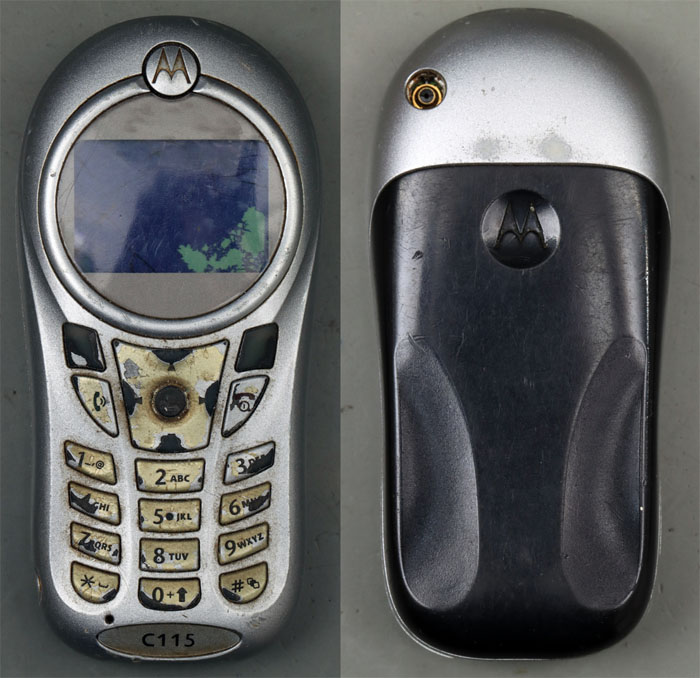
The Motorola C115 is a cell phone that uses the Calypso chipset from Texas Instruments. This model has already seen its best days, which is why it can be dismantled without feeling guilty. Cell phones with the Calypso chipset are often used to install custom software. The Osmocom project (https://osmocom.org/) is one more widespread.
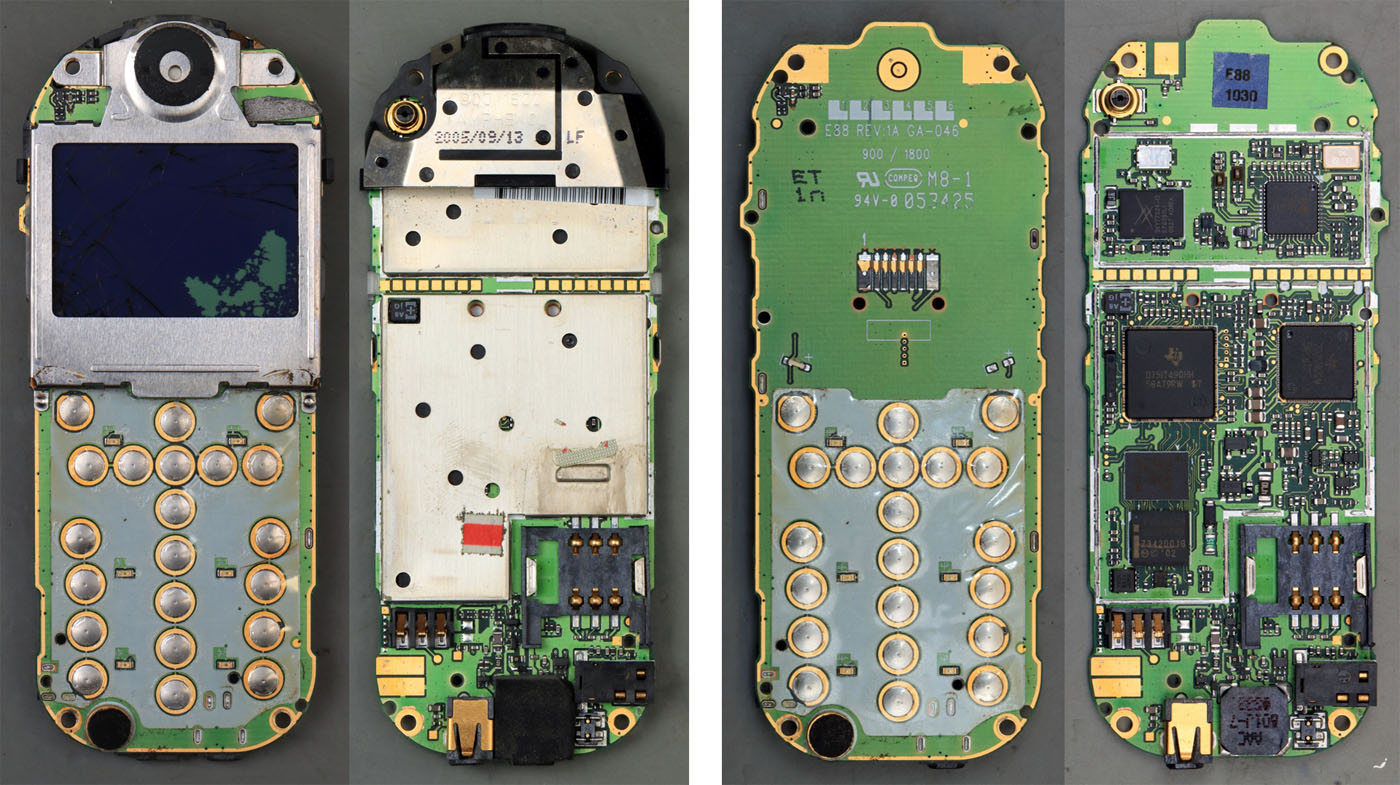


The core of the C115 is a PCB that covers the entire surface of the housing. The speaker, LCD display and keypad buttons are located on the front. On the back, in the upper area, a plastic element carries the antenna. Below this, most of the electronics are located under two shields.
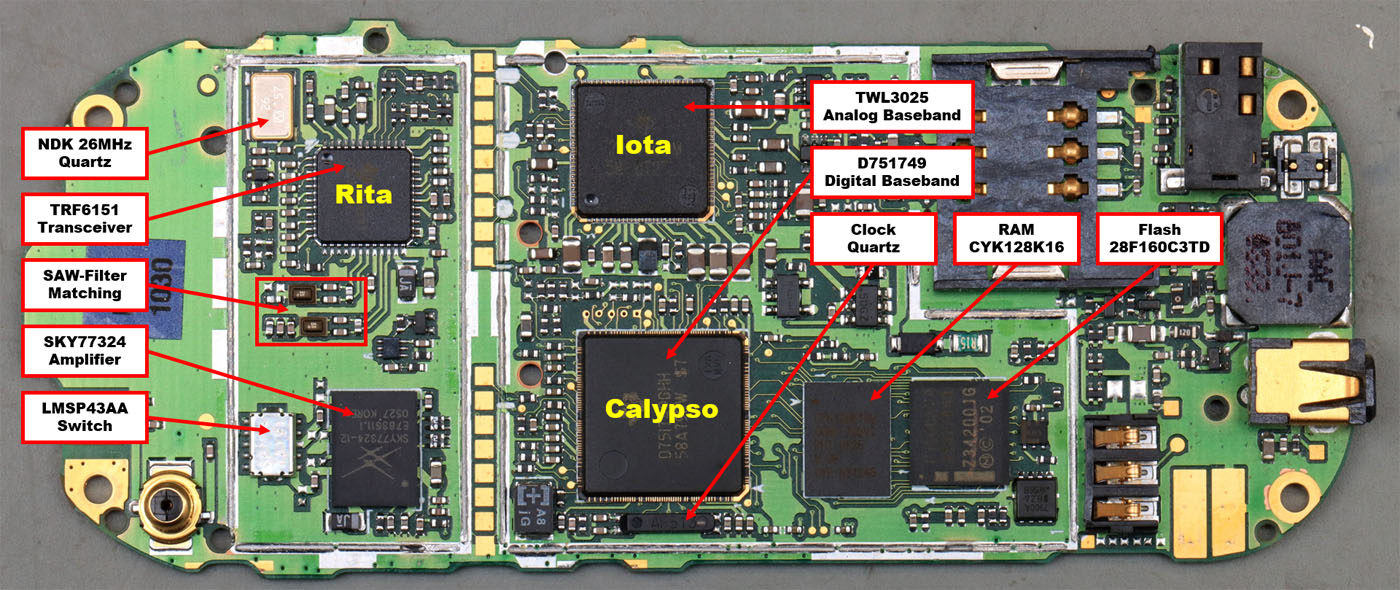


Here the core components of the circuit are marked. The antenna first leads to the Murata LMSP43AA. This switch connects the antenna to one of the two transmitters or to one of the two receivers. The SKY77324 from Skyworks is used as the transmitter amplifier. It amplifies the two possible transmission frequencies via two separate channels. Signals that are received pass through SAW filters that filter out the desired frequency range. The Texas Instruments TRF6151 is the transceiver that generates the RF signals for the transmitter from the data to be transmitted and processes the received signals so that they can be digitally evaluated. It is connected to the 26 MHz NDK NX5032SD crystal. The TRF6151 also bears the name Rita and is one of the components of the Calypso GSM chipset.

The Texas Instruments TWL3025, also known as Iota, is the analog baseband processor. It handles analog signal processing and many other functions required in a cell phone. For example, Iota controls the charging of the battery and controls the SIM card. Calypso, the Texas Instruments D751749, is the third component of the GSM chipset. It is the digital baseband processor that handles all digital functions. It contains an ARM processor and a DSP. The internal real-time clock works with a clock crystal. The pseudostatic 2MBit RAM Cypress Semiconductor CYK128K16MCCB was fitted as the main memory. The 2MB Intel 28F160C3TD flash EEPROM serves as read-only memory for the processor.
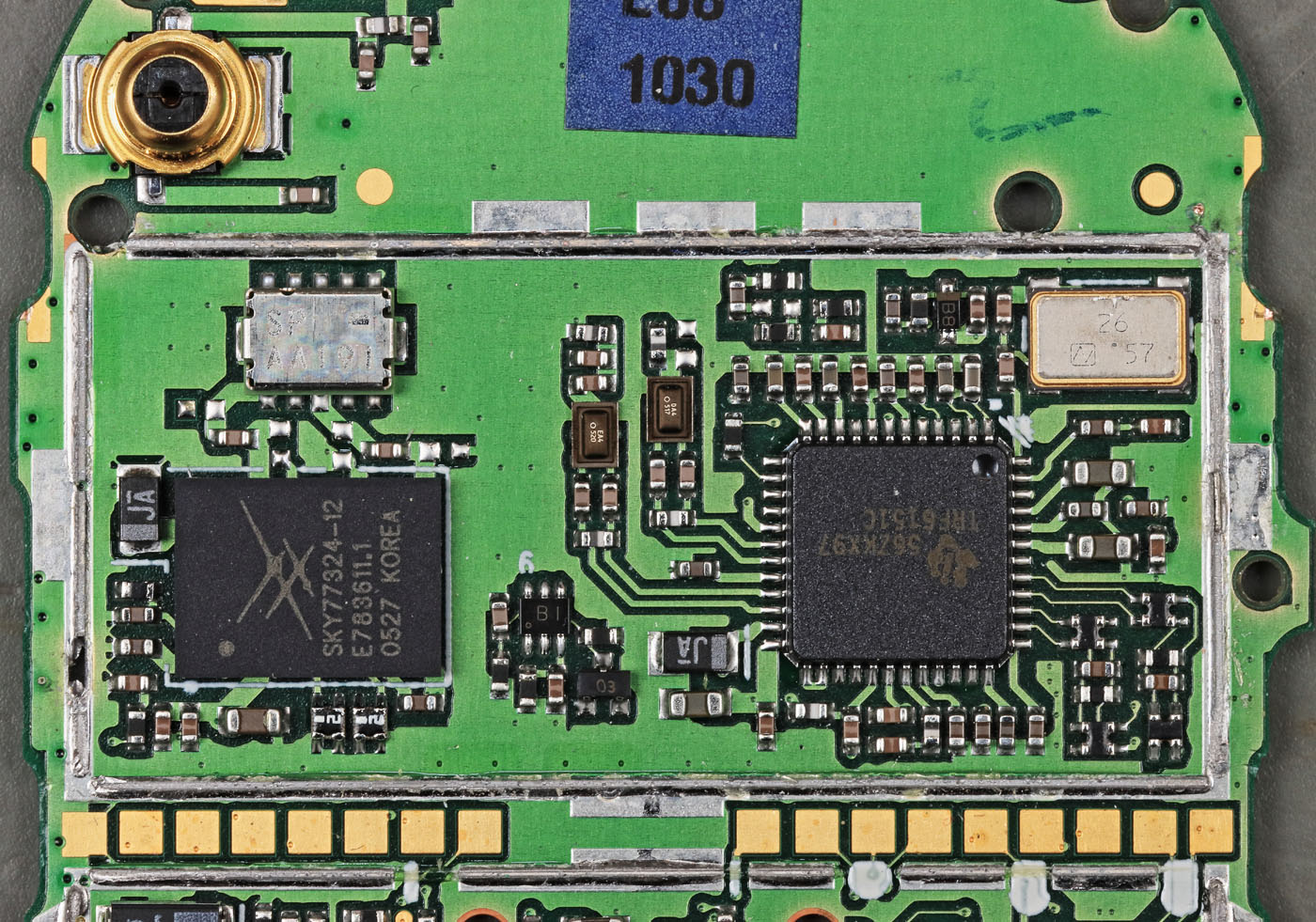


The upper shield rests on the PCB all around. The lower shield, on the other hand, has several openings. There are testpads between the two areas.
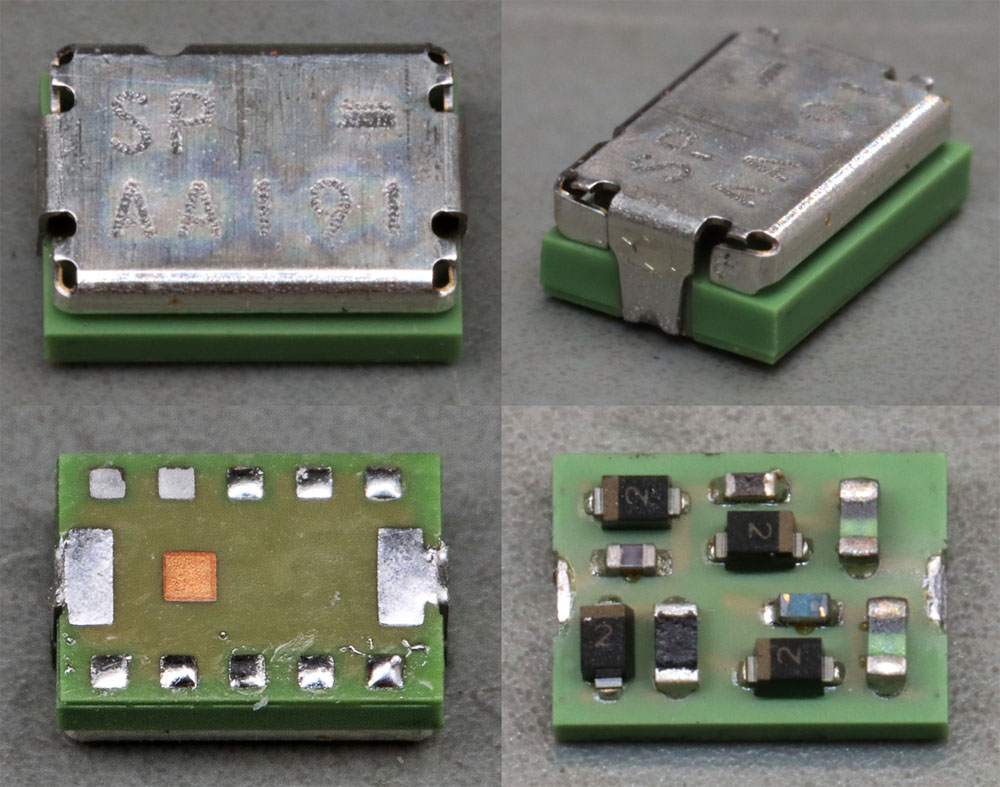


Murata refers to the LMSP43AA module as a switchplexer. It switches the antenna to one of four interfaces. These are one transmitter and one receiver path each for the frequency bands around 900 MHz and 1800 MHz. Removing the metal cover reveals four Infineon BAR64 PiN diodes operating as switches. The remaining components are probably used for impedance matching. Obviously, a special PCB material was used as circuit carrier.
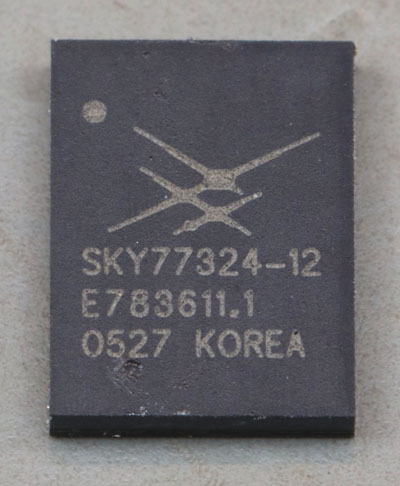
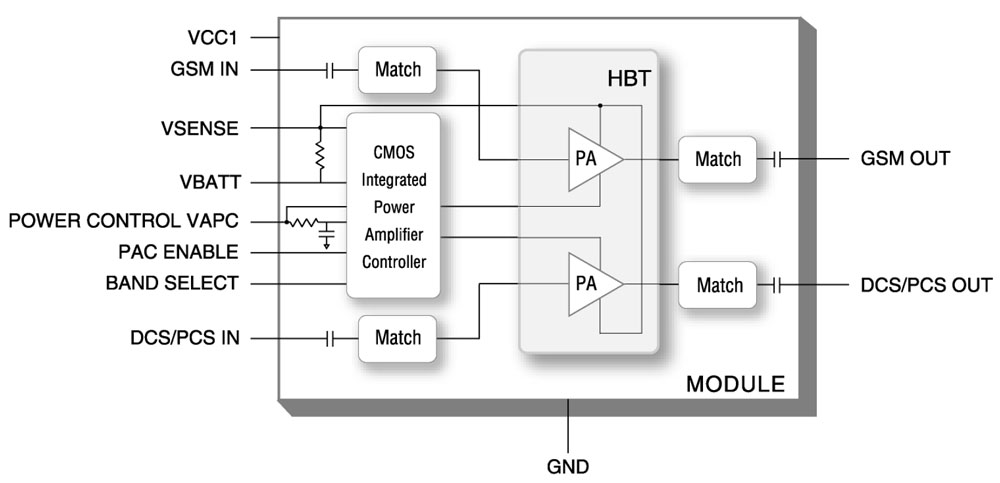


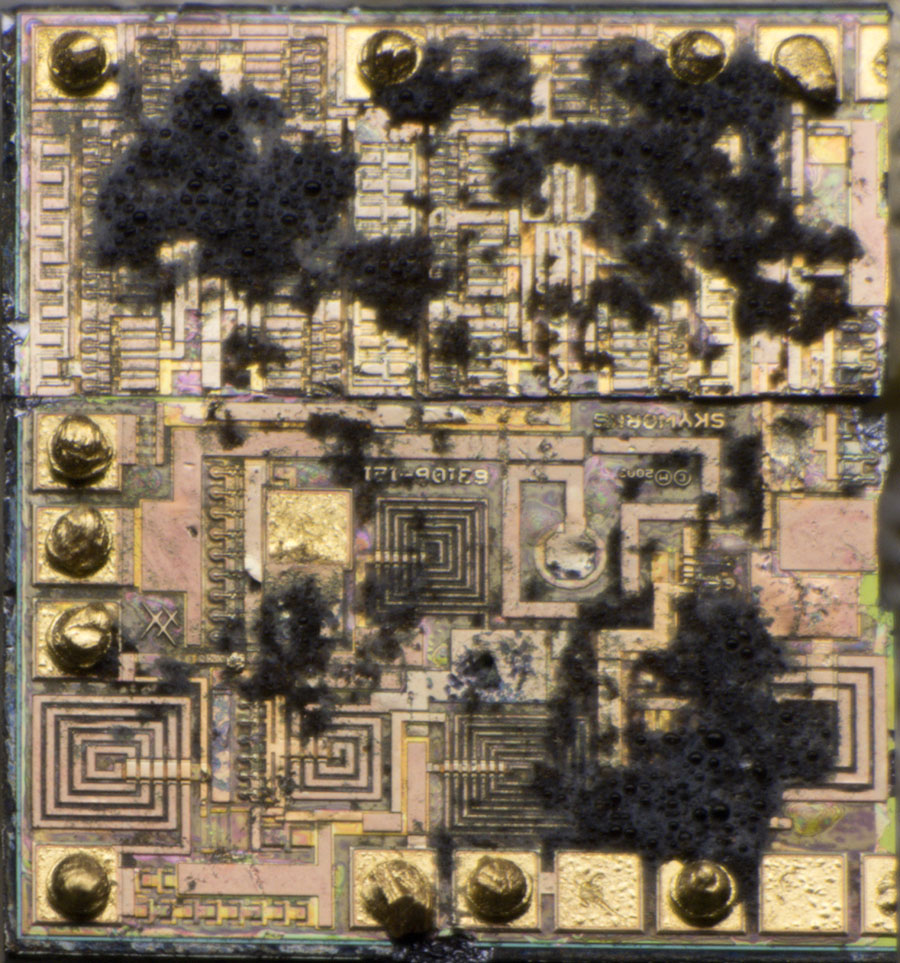
The RF amplifier used in the C115 is a Skyworks SKY77324. The block diagram already gives an indication of the structure. The two amplifiers are located in an HBT area. HBT stands for Heterojunction Bipolar Transistor. Different semiconductor materials are used within one transistor, which enables very high switching frequencies. The amplifier control, on the other hand, is implemented in a classic CMOS process. In addition, further components for impedance matching of the inputs and outputs are integrated in the package.
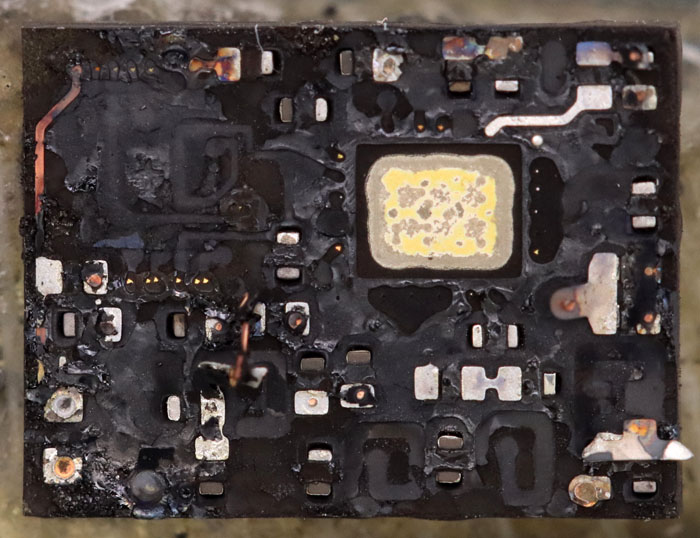


If you remove the interposer from the package, you can clearly see the many different elements. One of them is thermally connected to the large pad on the underside of the package. It can be assumed that this is the amplifier, which must be optimally cooled. The regularly arranged bondwires of a second die can be seen in the top left corner. Several SMD components are also visible.
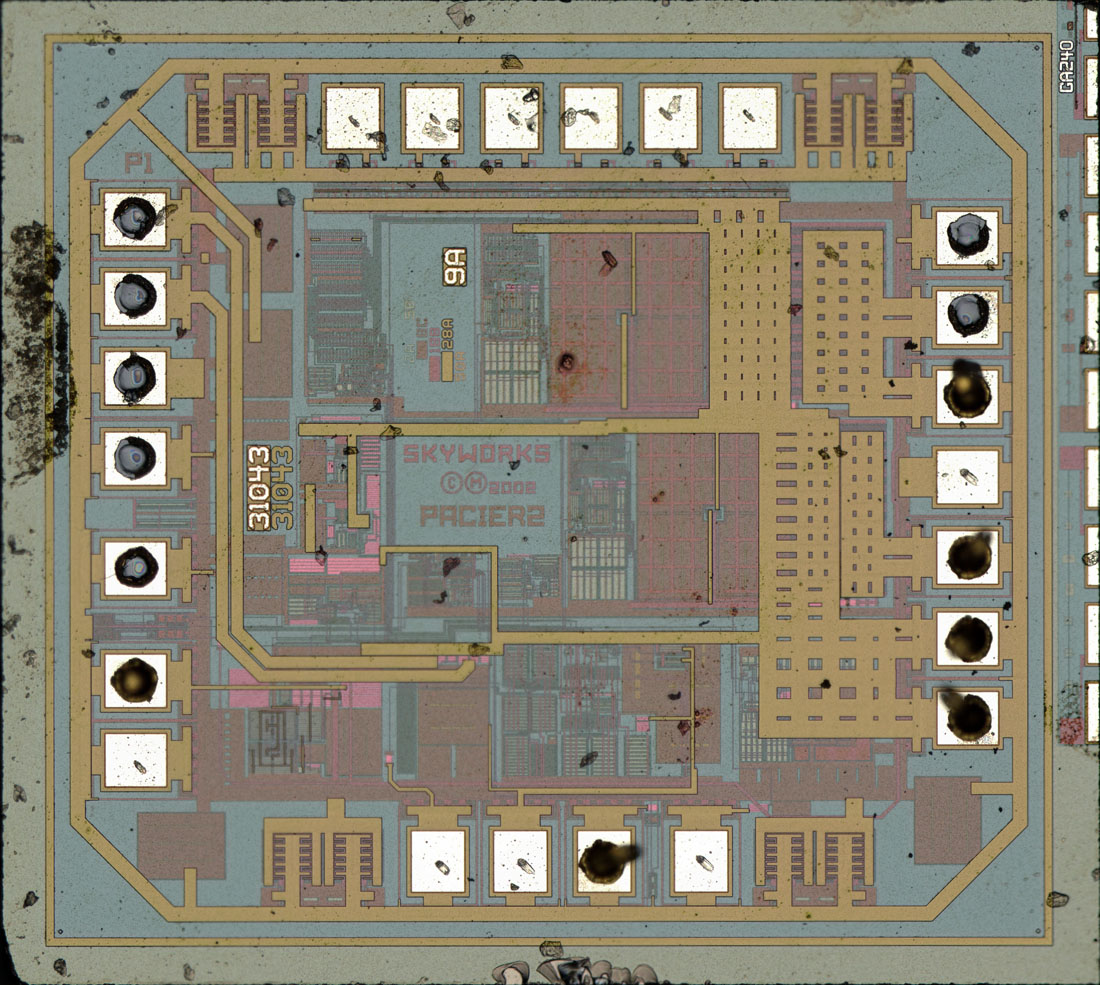


The control module is called Pacier2 and was apparently developed by Skyworks in 2002. This image is also available in higher resolution: https://www.richis-lab.de/images/modem/02x09XL.jpg (9MB)
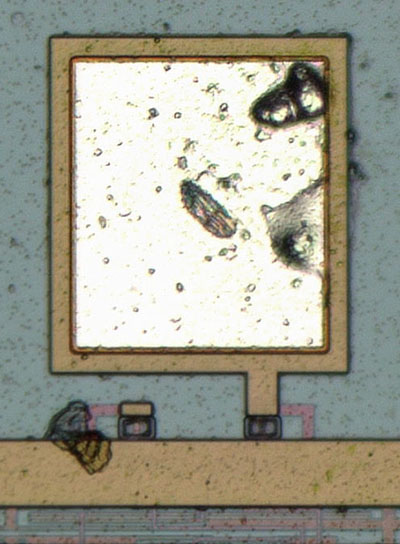


Classic fuses were used on the upper edge of the die.
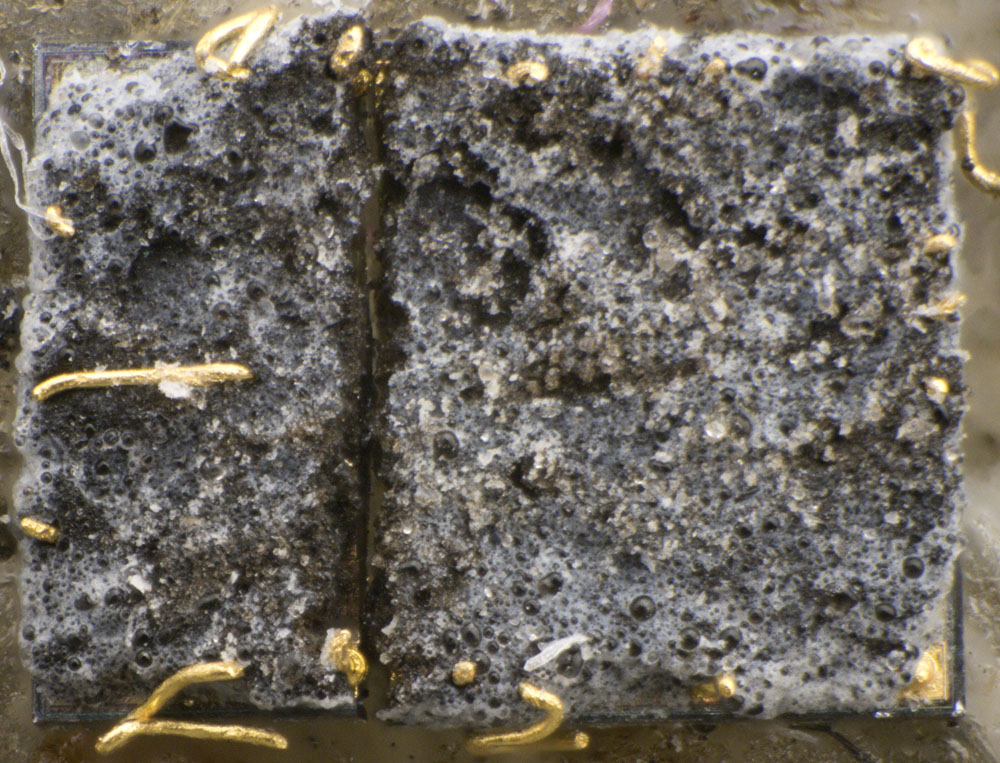


The package material sticks to the die of the HBT amplifier just as strongly as on the Skyworks SKY68001-31 (https://www.richis-lab.de/modem01.htm#SKY68001-31). In the end, the die is broken twice and still very dirty.
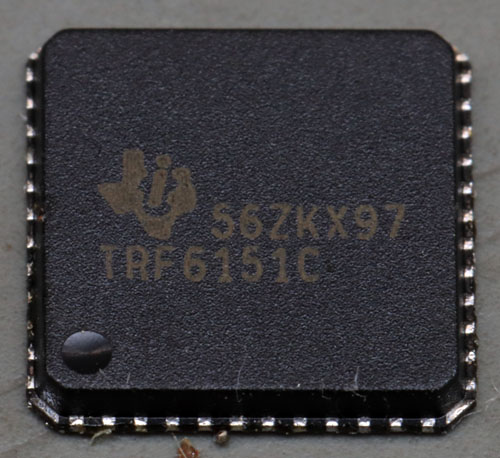
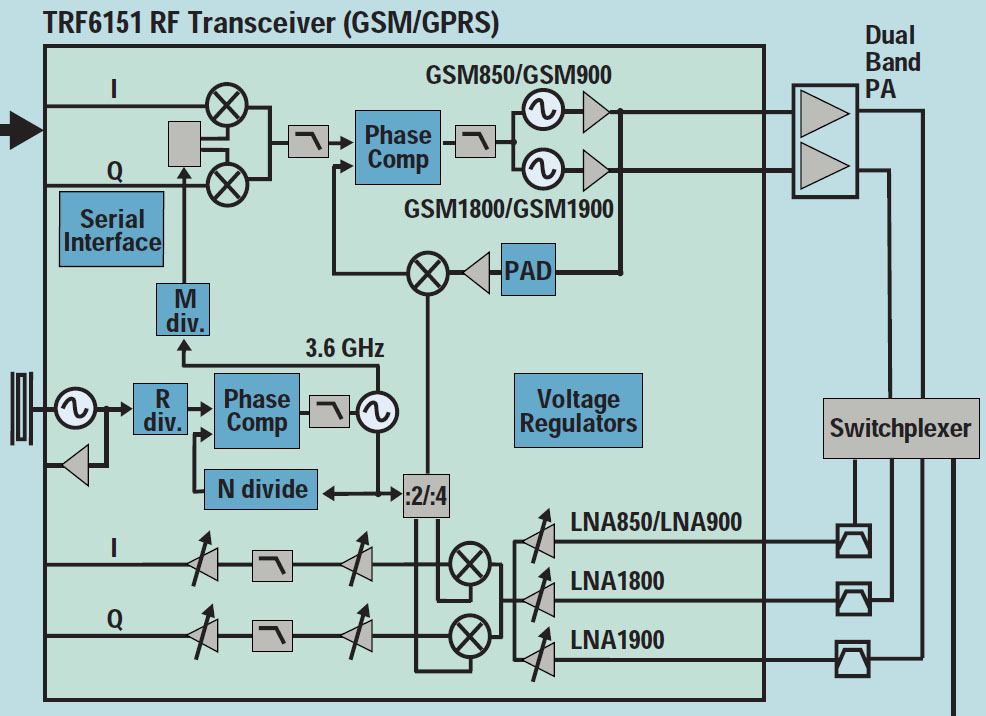


The datasheet for the Texas Instruments TRF6151 (“Rita”) transceiver is not particularly detailed. In the presentation “TCS4105 UMTS chipset solutions”, however, Texas Instruments shows a detailed block diagram. The transceiver generates and modulates the necessary frequencies. At the same time, the received signals are processed, downmixed and filtered.
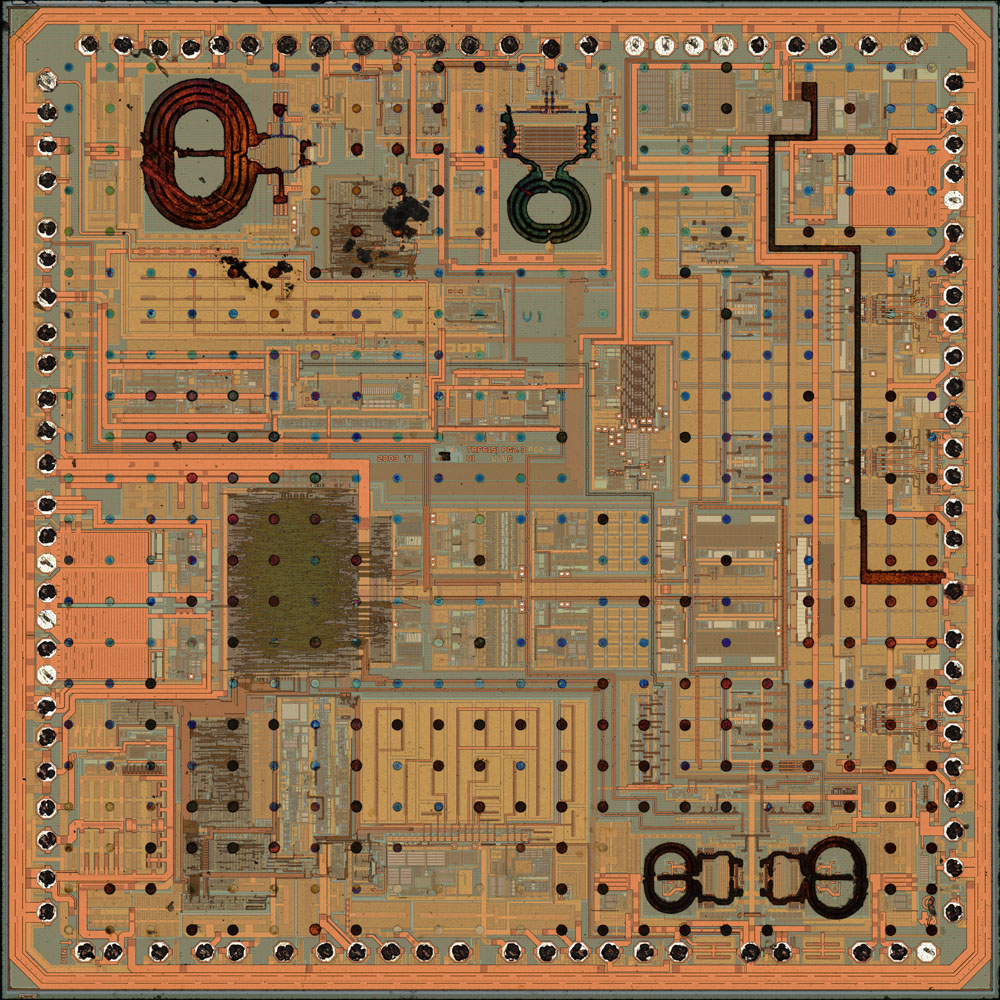


The transceiver was manufactured using the RFSIGE1 process. This is a 0,25µm BiCMOS process based on silicon-germanium and thus achieves a transit frequency of 50GHz. The top, relatively thick metal layer is immediately noticeable due to its large structures. If inductances are to be represented, as here, then the lower resistance of the thick copper layer has a positive effect on the attenuation. Dots were applied as dummy structures in the many areas where the top metal layer does not carry any conductors. This ensures more homogeneous properties of the surface.

This image is also available in higher resolution: https://www.richis-lab.de/images/modem/02x14XL.jpg (51MB)
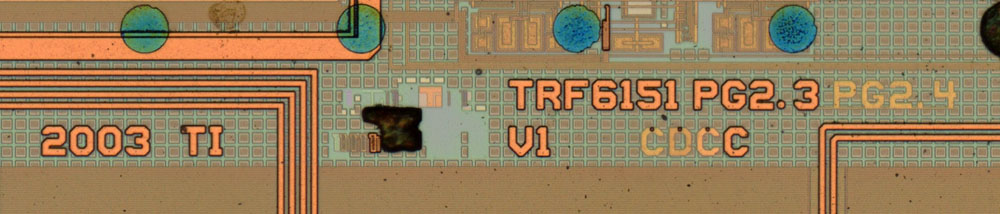


The die bears the designation TRF6151. The letters CDCC could be revisions of masks. In addition to the thick, top metal layer, the transceiver appears to have been constructed with four additional metal layers.
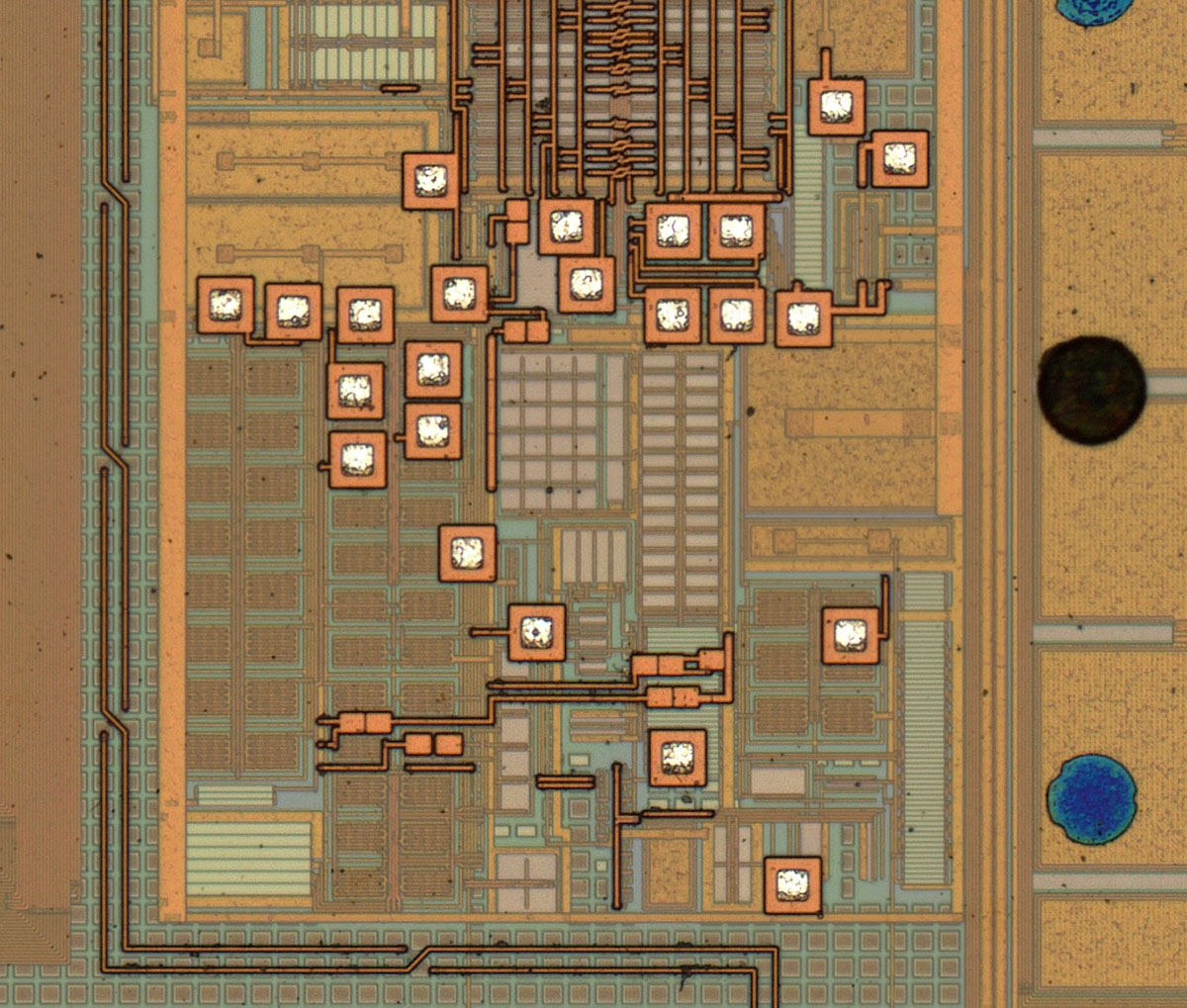


There are many small, square testpoints on the die.
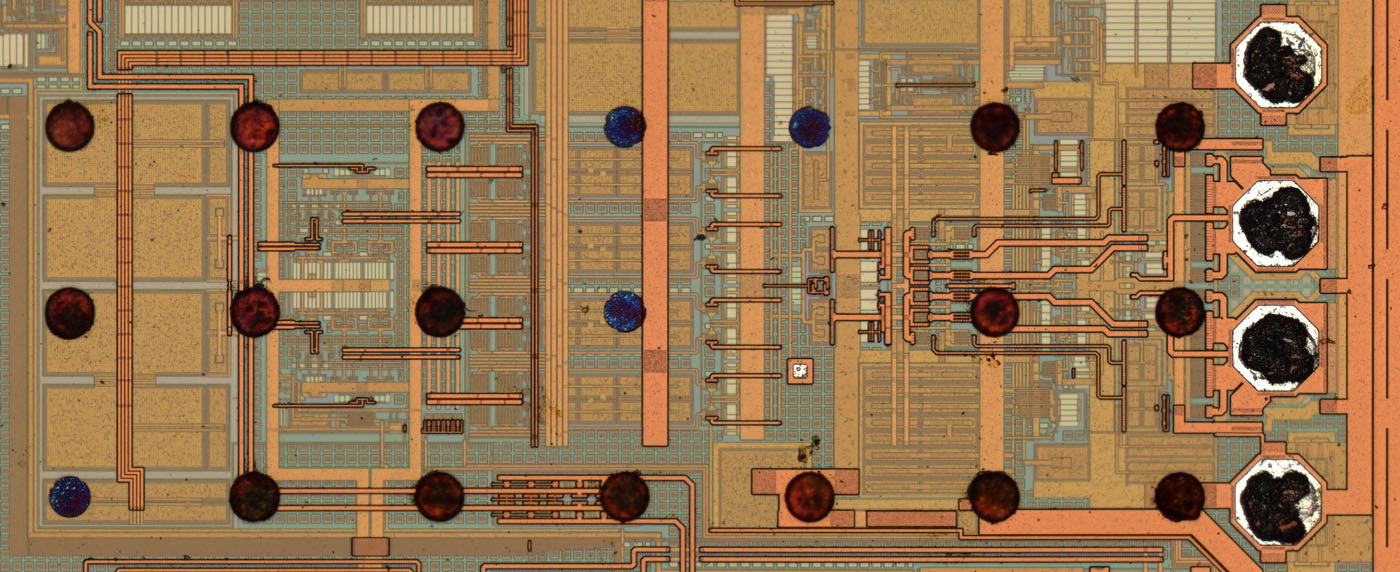


The details of the circuits cannot be resolved and they are too complex for in-depth analysis. Nevertheless, the function of some structures can be guessed. Here you can see one of the three receiver paths.
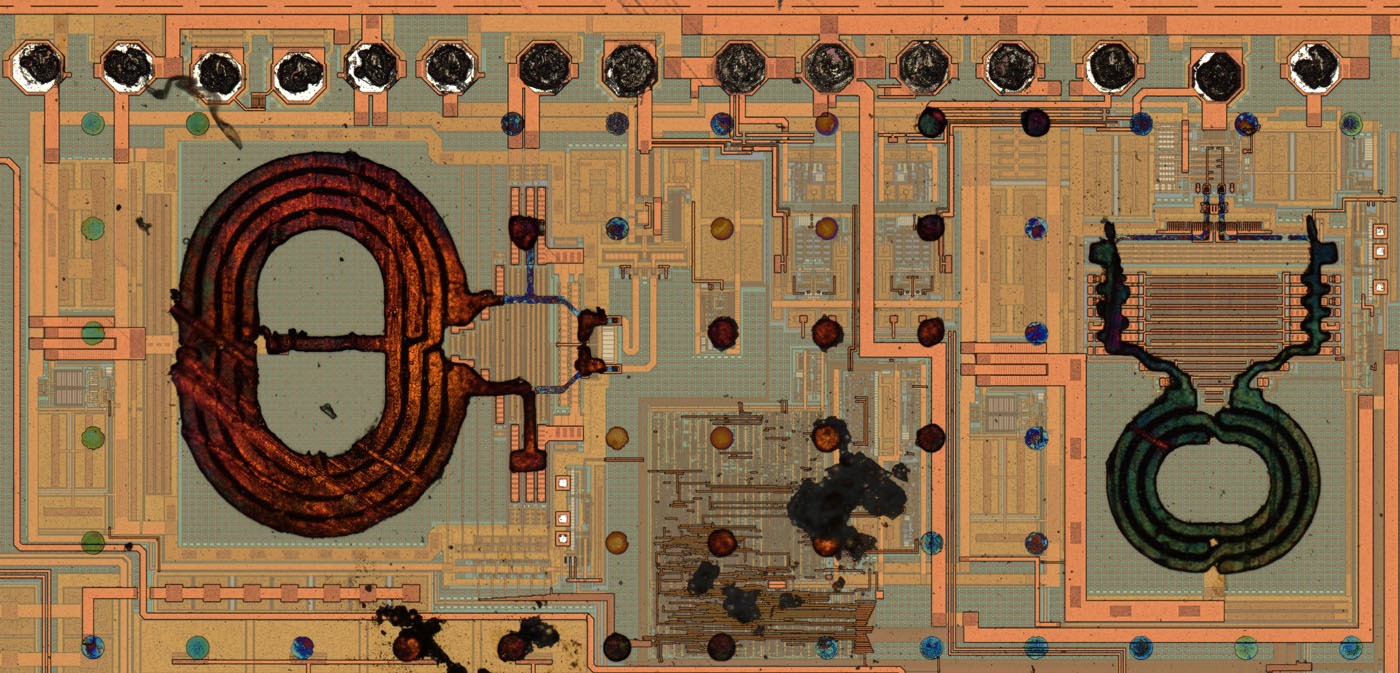


The large structures on the upper edge appear to be part of the output stages. The different sizes would match the different frequencies.
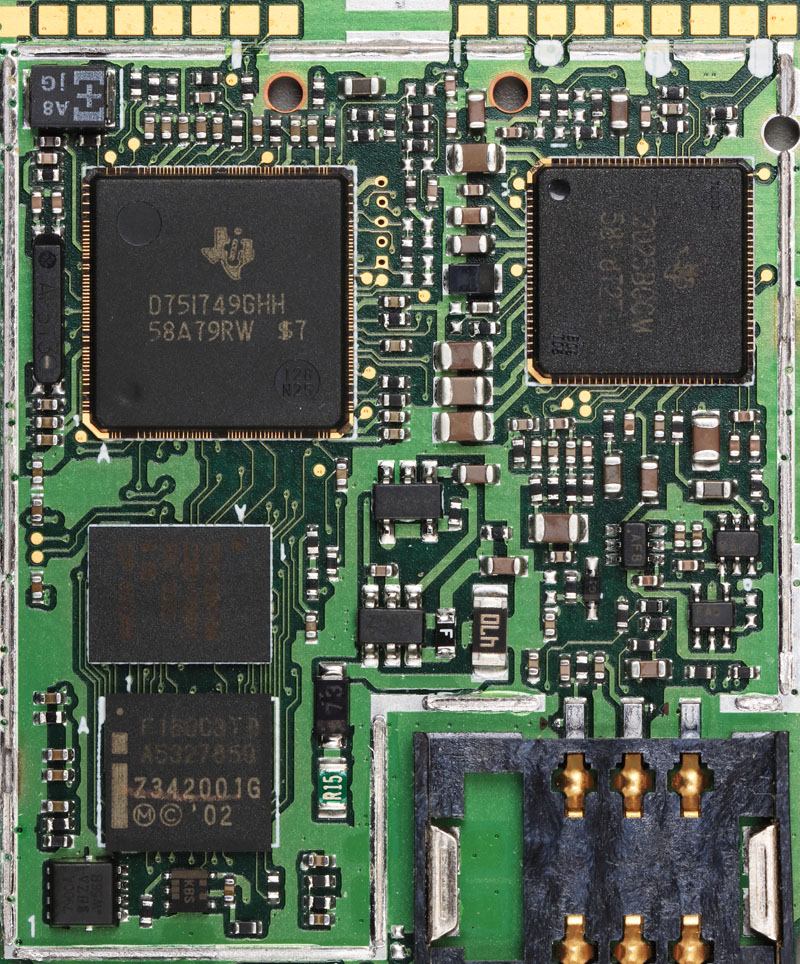


Most of the remaining circuitry is located under the second shield.
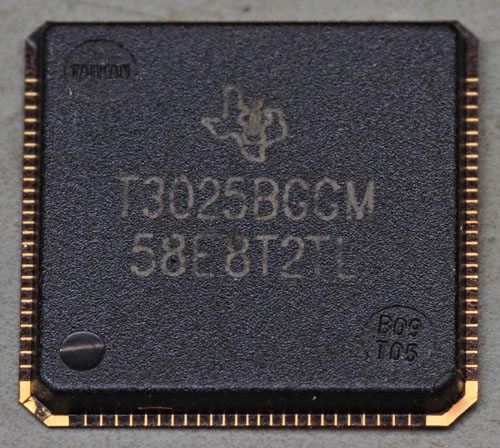


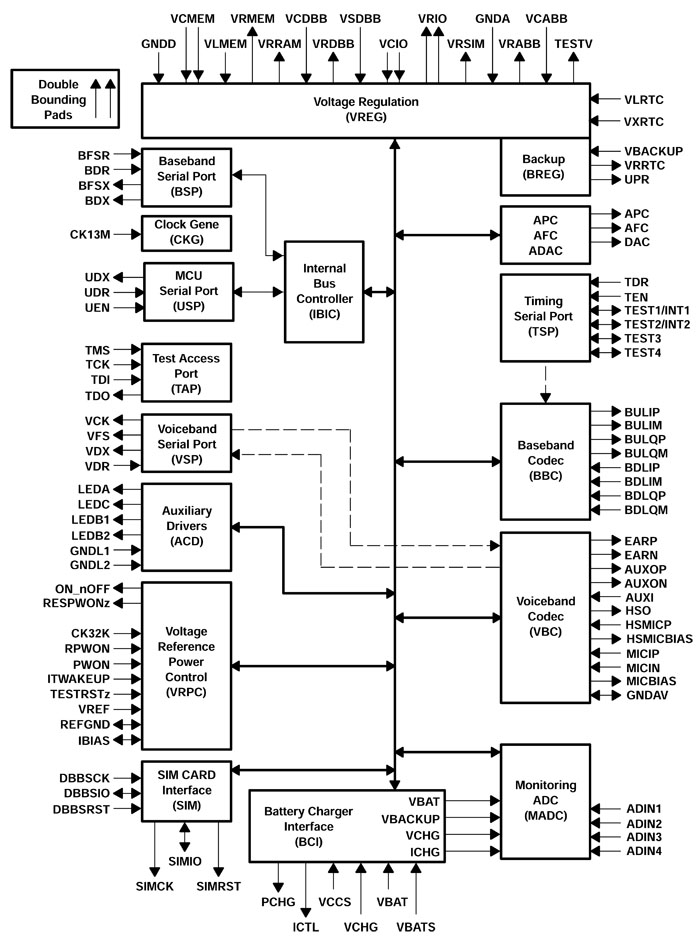
The package of the Texas Instruments TWL3025 is simply labeled T3025. It is part of the GSM chipset and bears the name Iota in this context. The TWL3025 is referred to as an analog baseband processor. However, it not only realizes the interface between the transmitter/receiver area and the classic processor of the system. Functions such as the power supply and the interface to the SIM cards are also integrated. The block diagram from the datasheet shows the various function blocks.
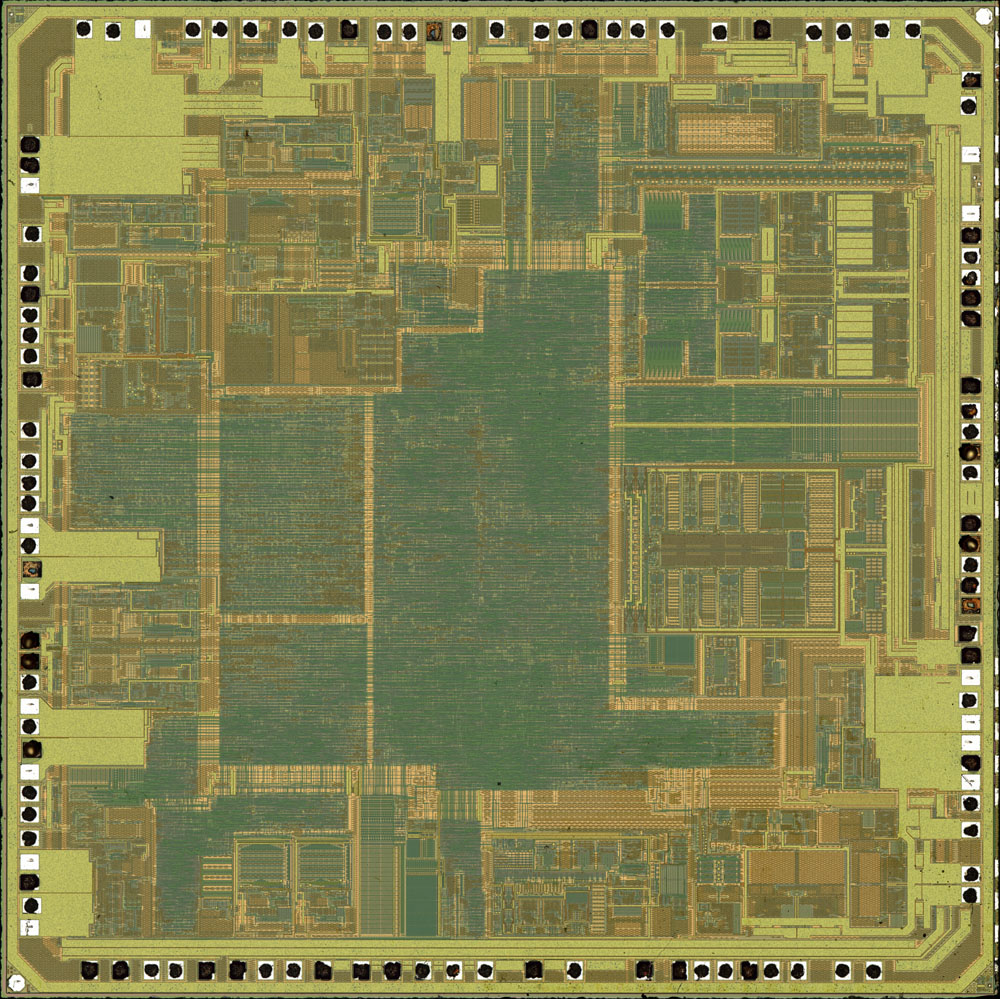


The die contains large areas of logic. However, there are also many structures that are much more heterogeneous. This image is also available in higher resolution: https://www.richis-lab.de/images/modem/02x21XL.jpg (50MB)
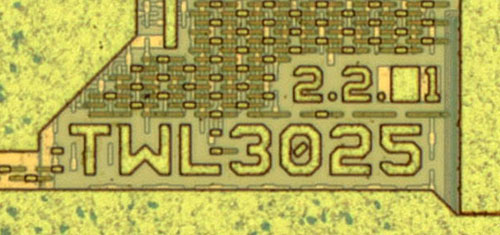


The inscription on the die shows even more clearly that it is a TWL3025. The numbers above it could indicate the revision. The free areas are filled with the dummy structures typical of Texas Instruments.
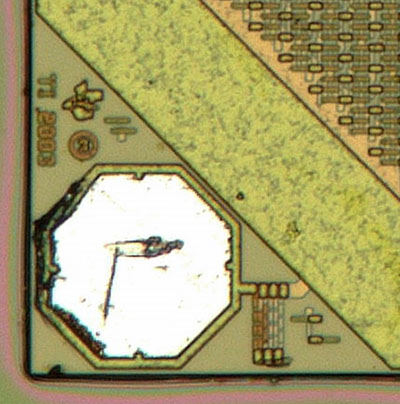


There is a copyright from 2003 in the bottom left and top right corners.
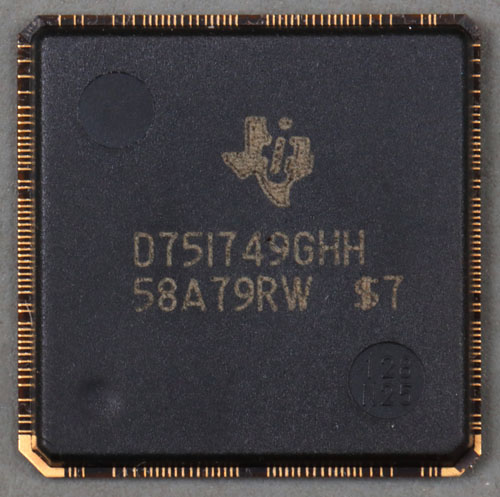


The Texas Instruments D751749GHH is the digital baseband processor and is referred to as Calypso within the Calypso chipset itself. It contains an ARM processor that controls the cell phone and a DSP for fast signal processing.
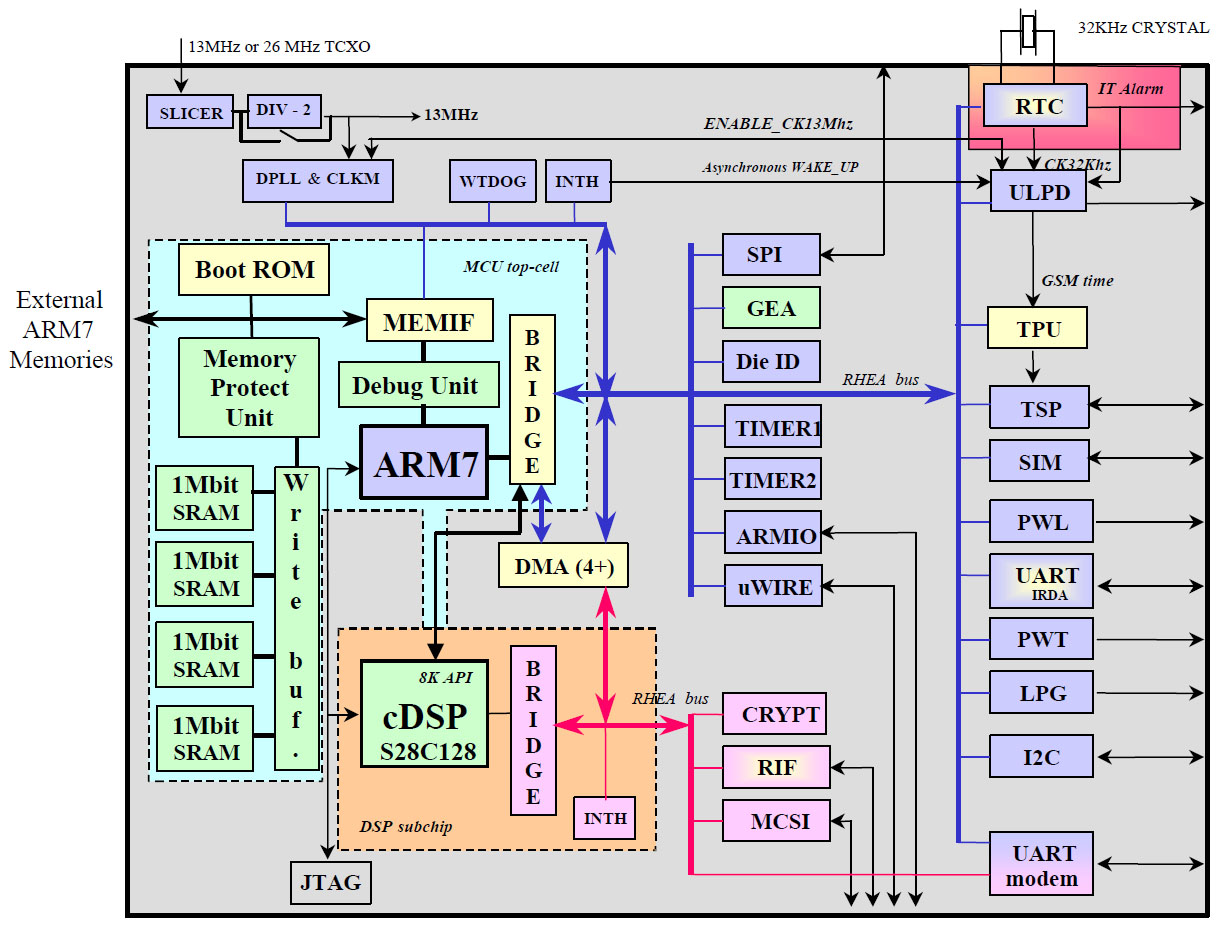


There is a detailed specification from Texas Instruments for the Calypso chip. It applies to the HERCROM400G2. This is an internal designation of the Calypso processor, of which there are different variants and development stages. The D751749GHH, for example, is always referred to as Calypso Lite G2. Even if this contains a slightly different configuration, the block diagram above still gives an impression of how the Calypso processor is structured.
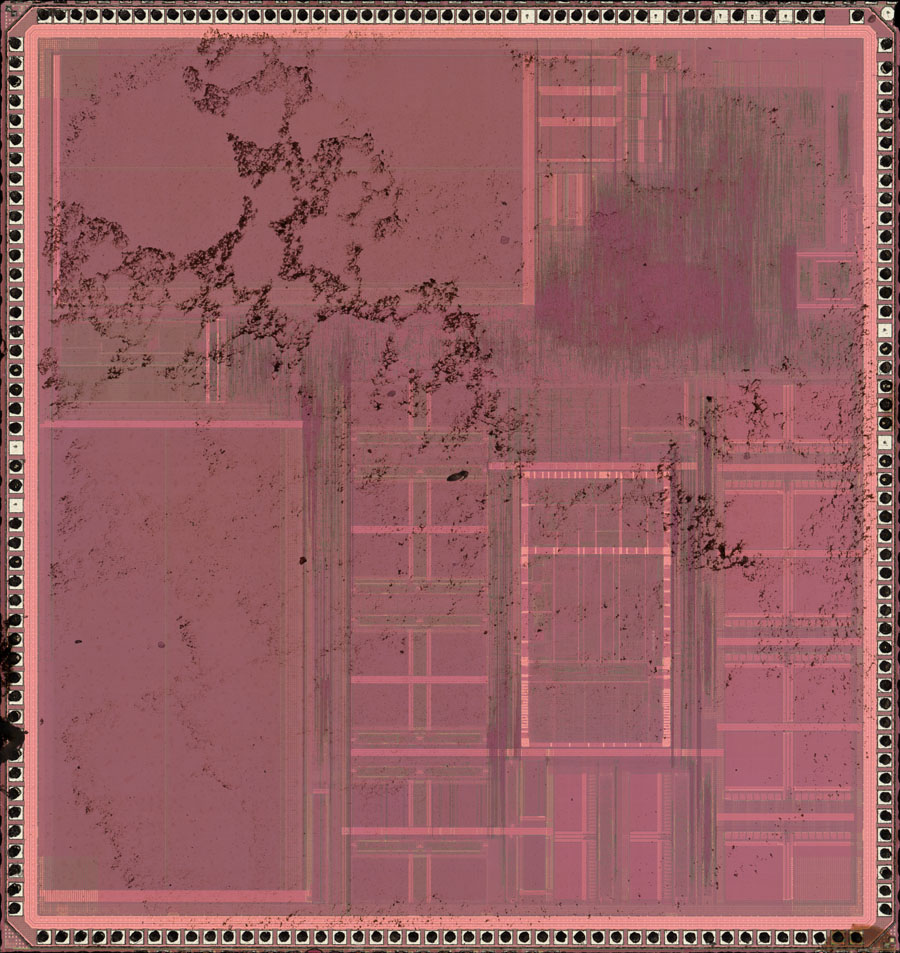


On the die of the D751749GHH one can speculate about the function of some areas, but at first glance hardly anything is clearly recognizable.

This image is also available in higher resolution: https://www.richis-lab.de/images/modem/02x26XL.jpg (75MB)
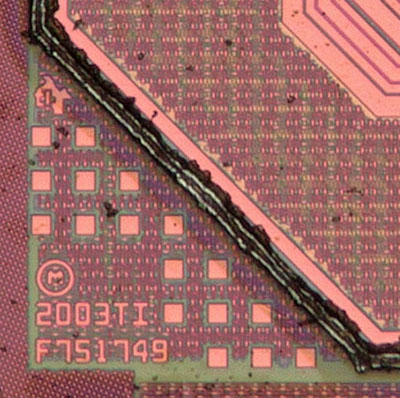


The designation F751749 is shown in the bottom left-hand corner.


https://www.richis-lab.de/modem02.htm

 :-/O
 
The following users thanked this post: Vgkid, RoGeorge, ch_scr, D Straney

Online RoGeorge

  • Super Contributor
  • ***
  • Posts: 8222
  • Country: ro
Re: Different die pictures
« Reply #372 on: October 11, 2024, 12:17:36 pm »
Wow, discreet PIN diodes inside the Rx/Tx switch, thanks for the disclosure, and for the SMD parts number!  :-+
https://www.alldatasheet.com/datasheet-pdf/view/149579/MURATA/LMSP43AA-191.html
https://www.alldatasheet.com/datasheet-pdf/view/78976/INFINEON/BAR64.html


Always wanted to experiment with PIN diodes, but didn't have any, or so I thought.  Well, it happens that I have instead some Motorola 115C phone scrap somewhere :D, so now I can try this:

#118: Basics of PIN diodes and their use in RF switch applications
w2aew


(other w2aew PIN diode related videos)
#82: How to use a Diode as a Switch / Diodes as Switches / Basics of Diode Switches
#200: T/R Switch w/ PIN Diodes and Lumped Element Quarter-wavelength transmission line
#130: PIN Diode 3rd order Intermodulation Distortion (IMD) vs. bias current - how to measure

Thank you!
« Last Edit: October 11, 2024, 12:24:54 pm by RoGeorge »
 
The following users thanked this post: Miyuki

Online NoopyTopic starter

  • Super Contributor
  • ***
  • Posts: 2339
  • Country: de
    • Richis-Lab
Re: Different die pictures
« Reply #373 on: October 11, 2024, 05:26:34 pm »
Never throw anything away!  ;D

I will try to open the PIN diodes but I assume the dies are infinitesimal tiny.  :-/O

Happy to help!  :-+

Online NoopyTopic starter

  • Super Contributor
  • ***
  • Posts: 2339
  • Country: de
    • Richis-Lab
Re: Different die pictures
« Reply #374 on: October 31, 2024, 03:11:47 pm »


I have an update for the KA610 which was built on a Master Slice IC called IA60.
We have talked about the KA610 here:
https://www.eevblog.com/forum/projects/different-die-pictures/msg3446828/#msg3446828


Thanks to John McMaster we now have a picture of the Interdesign Monochip F which was the archetype for the IA60.
https://siliconpr0n.org/map/interdesign/monochip-f/single/interdesign_monochip-f_mcmaster_plot.jpg

Interdesign was founded by Hans Rudolph Camenzind, the developer of the famous NE555. Interdesign was later sold to Ferranti. In the picture above Resistors are colored green. Pinch resistors can be recognized by the slightly stronger green. NPN transistors are colored blue, PNP transistors red.


A comparison of the monochip F with the IA60 shows that the arrangement of the elements is not quite the same. A closer look also reveals that the IA60 contains 51 PNP transistors and 89 NPN transistors (plus the four large NPN transistors), which is different to the specification.


Exar has also reproduced the monochip. The XR-F100 shown here corresponds to the Monochip F. This design is also not an exact copy.


https://www.richis-lab.de/KA601.htm#Monochip

 :-/O
 
The following users thanked this post: RoGeorge


Share me

Digg  Facebook  SlashDot  Delicious  Technorati  Twitter  Google  Yahoo
Smf