Author Topic: Square holes  (Read 17029 times)

0 Members and 3 Guests are viewing this topic.

Offline Stonent

  • Super Contributor
  • ***
  • Posts: 3824
  • Country: us
Re: Square holes
« Reply #25 on: June 18, 2014, 04:44:26 pm »
Square hole bit?


The larger the government, the smaller the citizen.
 

Offline grumpydocTopic starter

  • Super Contributor
  • ***
  • Posts: 3034
  • Country: gb
Re: Square holes
« Reply #26 on: June 18, 2014, 05:03:51 pm »
Quote
Square hole bit?
I don't think you can just pop those into a Black & Decker  :)
 

Offline N2IXK

  • Frequent Contributor
  • **
  • Posts: 724
  • Country: us
Re: Square holes
« Reply #27 on: June 18, 2014, 05:04:58 pm »
Those square hole end mills are cool, but they need a really rigid spindle. Like a vertical milling machine or a really good quality drill press.  Not going to work in a hand drill at all.
"My favorite programming language is...SOLDER!"--Robert A. Pease
 

Offline Fred27

  • Supporter
  • ****
  • Posts: 737
  • Country: gb
    • Fred's blog
Re: Square holes
« Reply #28 on: June 18, 2014, 05:33:43 pm »
I'd love an excuse to get something like the Proxxon MF70 (with the ultimate aim of a CNC conversion) but this isn't it.
Deep down you *know* that you should go for a MF70. I CNC converted one and it's been really useful. I see from the mention of £ that you're in the UK. If you happen to be near Redhill in Surrey you'd be welcome to pop over and do your cut outs. Be warned though, you will then want to get your own!

Some info on conversion here if you're interested:
http://0xfred.wordpress.com/2012/02/12/proxxon-mf70-cnc-mill-conversion/
 

Online jamesglanville

  • Contributor
  • Posts: 49
Re: Square holes
« Reply #29 on: June 18, 2014, 05:41:07 pm »
That looks like a nice connector. What is it?

It's an XT60 connector, often used in RC stuff because of the high current capacity (60A continuous).
 

Offline grumpydocTopic starter

  • Super Contributor
  • ***
  • Posts: 3034
  • Country: gb
Re: Square holes
« Reply #30 on: June 18, 2014, 06:34:55 pm »
Quote
Deep down you *know* that you should go for a MF70.
Indeed :)

Quote
I CNC converted one and it's been really useful. I see from the mention of £ that you're in the UK. If you happen to be near Redhill in Surrey you'd be welcome to pop over and do your cut outs. Be warned though, you will then want to get your own!

A bit too far for me but thanks for the offer.
 

Offline jimjam

  • Regular Contributor
  • *
  • Posts: 196
  • Country: au
Re: Square holes
« Reply #31 on: June 19, 2014, 10:21:14 am »
Some info on conversion here if you're interested:
[url=http://0xfred.wordpress.com/2012/02/12/proxxon-mf70-cnc-mill-conversion/]http://0xfred.wordpress.com/2012/02/12/proxxon-mf70-cnc-mill-conversion/[/URL]
Hi Fred, That looks really neat. I am interested in the PCB making ability of this set up. Do you have a video that shows how it works and perhaps some more details on how to set it up etc, or perhaps some links to other sites?
 

Offline rob77

  • Super Contributor
  • ***
  • Posts: 2100
  • Country: sk
Re: Square holes
« Reply #32 on: June 19, 2014, 10:35:06 am »
Some info on conversion here if you're interested:
[url=http://0xfred.wordpress.com/2012/02/12/proxxon-mf70-cnc-mill-conversion/]http://0xfred.wordpress.com/2012/02/12/proxxon-mf70-cnc-mill-conversion/[/URL]
Hi Fred, That looks really neat. I am interested in the PCB making ability of this set up. Do you have a video that shows how it works and perhaps some more details on how to set it up etc, or perhaps some links to other sites?

be aware of the very small range for MF70 - the cross table (sold as KT70 separatelly as well) has a travel range approx 130mm x 45mm - so only small boards can be milled on MF70.
 

Offline grumpydocTopic starter

  • Super Contributor
  • ***
  • Posts: 3034
  • Country: gb
Re: Square holes
« Reply #33 on: June 19, 2014, 10:12:17 pm »
Well......

For me I'm tolerably pleased with how an attempt panned out. Following suggestions I drew up a template in inkscape as follows



and printed it onto a sticky label which I then stuck onto the surface of the plastic. I do have a drill stand - a cheap and wobbly one but better than nowt and managed to drill the holes reasonably accurately, I then filed out the hole to the printed edges with a needle file. Well - two, in fact, as a small square one was best for the ends  and a flat one was best for the sides.

The result is not that bad, not perfect by a long way but I'm happy with it as a one off (bear in mind the slot is 5mmx9mm when looking at the image). Whether it is "good enough" for something I want to make a few 10's of and flog on ebay is another question.
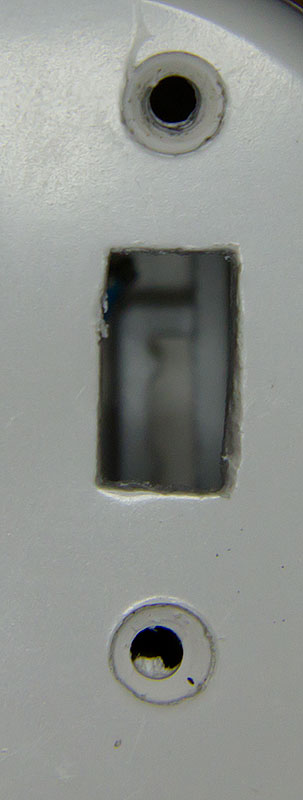


The centres did end up off (too far apart) by about 0.3mm - about 0.1mm of that was the printer not quite being totally accurate - using the switch itself as a template would definitely help that. Also the plastic is very soft so clogged the files rather a lot.

A punch & die would without doubt be the best solution but I'd need to be sure of selling well north of 100 before I could even consider it from an economic point of view.

This is about 100x better than my last similar effort (which I simply threw away in disgust) - using the printer eliminates the errors in marking up that I used to make which were then just compounded by my inability to follow them. Having even a crude drill stand helps a fair bit as well.
 

Offline N2IXK

  • Frequent Contributor
  • **
  • Posts: 724
  • Country: us
Re: Square holes
« Reply #34 on: June 19, 2014, 11:03:56 pm »
Not too bad at all.  :-+

Since we are talking soft plastic, you might consider using a tiny router blade, engraving burr, or endmill in a Dremel or similar rotary tool. If you stripped a switch of its guts, and used the metal frame as a guide for the routing, it might work. reasonably well for a small run of panels.
"My favorite programming language is...SOLDER!"--Robert A. Pease
 

Online mikeselectricstuff

  • Super Contributor
  • ***
  • Posts: 14835
  • Country: gb
    • Mike's Electric Stuff
Re: Square holes
« Reply #35 on: June 19, 2014, 11:18:48 pm »
ABS is really quick to file- drill it as close as you can then file out to size.
For best appearance, I usually use a square/rectangular file with one edge ground off, so you only do one side at a time - makes it easier to flatten one edge without digging into the adjacent one
Youtube channel:Taking wierd stuff apart. Very apart.
Mike's Electric Stuff: High voltage, vintage electronics etc.
Day Job: Mostly LEDs


Share me

Digg  Facebook  SlashDot  Delicious  Technorati  Twitter  Google  Yahoo
Smf


- - -
-->