Author Topic: A "good enough" magnifier (headband magnifier) for electronics work  (Read 342 times)

radzeck, analogix and 1 Guest are viewing this topic.

Online analogixTopic starter

  • Frequent Contributor
  • **
  • Posts: 265
  • Country: no
I'm in need of a magnifier of some sort while working on my projects because of ageing eyesight (and components that are getting smaller by each year that passes by).
I've gone through a number of discussions on the matter and concluded that for me, a magnifier attached to the head of some sort appears to be the most practical (as it'll allow for free head movement while (and switching between) soldering, finding or attaching components, reading schematics etc.)

In forum-discussions the Donegan Optivisor appears to be the clear winner and a no brainer, and the Chinese lookalikes aren't even worth considering.
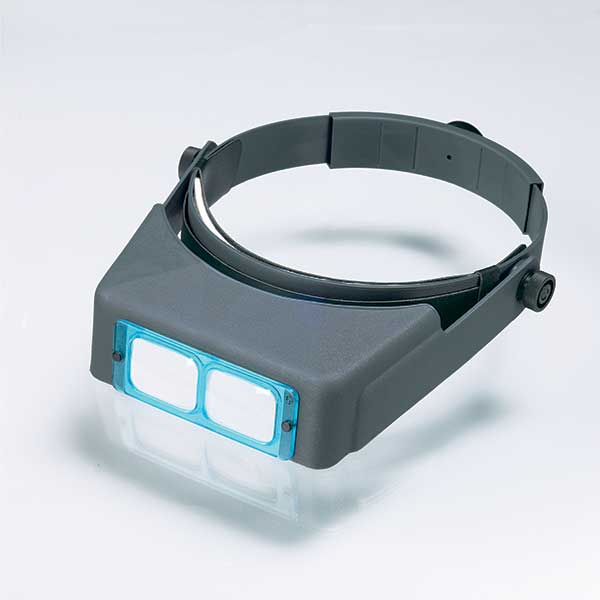
(image source: Donegan optical company)

On the other hand there are cheap head-worn magnifiers slightly different from the above design, with multiple lenses included and the ability to use two lenses together, at a greatly reduced price. At first I had my mind made up, aiming for the Donegan Optivisor, but then I came across a video by Adama Savage (from the TV-show "Mythbusters):
Adam Savage's Favorite Tools: Wearable Magnifiers!

... where he highly recommends the 101Color Head Mount Magnifier Glasses with Detachable Ultra Bright LED Head Lamp - 5 Interchangeable Lenses: 1.0X, 1.5X, 2.0X, 2.5X, 3.5X Magnification (Amazon.com). I've found similar magnifiers (and I believe also the exact same model) at Ali Express as well.
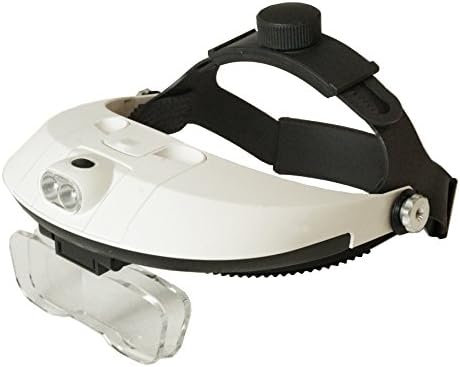
(image source: Amazon.com)

Another video praises a similar type of cheap headband magnifier:
Clayton Darwin: Best Magnifiers for Electronics (and Old Eyes, Crafts, Etc.).

Obviously they aren't for professional use, and there's no way the optics can be on par with something like the Donegan Optivisor, but will it be good enough for the occasional use for an electronics hobbyist?
Apart from saving a few bucks on not getting the Donegan Optivisor, what I like about them is that they come with multiple lenses (Donegan's only comes with one, and although you can buy extra ones separately it makes us hard to decide up front which strength I'd need when there's nowhere locally I can actually try them out).
I also like its ability to combine two lenses, which the Donegan can't.
Finally the built-in lamp looks useful (but I wouldn't get one of those Ali Express ones with a built-in rechargeable battery -I've heard of cheap, exploding batteries before, and I'd avoid having that risk close to my face and instead have one relying on regular batteries).
« Last Edit: December 20, 2025, 09:53:22 pm by analogix »
 

Offline voltsandjolts

  • Supporter
  • ****
  • Posts: 3234
  • Country: gb
Re: A "good enough" magnifier (headband magnifier) for electronics work
« Reply #1 on: December 20, 2025, 10:04:47 pm »
I have the Donegan DA-5, it's very good. The LED light add-on is overly expensive, but don't feel like I need it.

It's probably worth getting a cheap one to start with, just to see how you get on with a headband magnifier.
I also have this £15 one from RS and it's "OK", fine for quick and occasional use;
https://uk.rs-online.com/web/p/magnifiers/1830966

Note when soldering with a headband, you're very close to the workpiece, you must get a fan to blow/extract solder fume.
 

Online coppercone2

  • Super Contributor
  • ***
  • Posts: 13316
  • Country: us
  • √Y√... 📎
Re: A "good enough" magnifier (headband magnifier) for electronics work
« Reply #2 on: December 20, 2025, 10:14:40 pm »
I think for handheld ones eschenbacks optik are awesome, even for stuff that is hard to read but not that small or is just dirty.

Expensive, and its plastic, but the form factor is good. Its damn handy, compared to one of those loupes, that folds, which is just too small, and the light is good, unlike alot of hand held magnifier glasses. Its like tactical
« Last Edit: December 20, 2025, 10:16:24 pm by coppercone2 »
 

Online tggzzz

  • Super Contributor
  • ***
  • Posts: 24131
  • Country: gb
  • Numbers, not adjectives
    • Having fun doing more, with less
Re: A "good enough" magnifier (headband magnifier) for electronics work
« Reply #3 on: December 20, 2025, 10:33:42 pm »
The "best" choice will be highly personal.

I suggest trying a cheap solution without prejudice. If it work well enough, fine. If it doesn't then you have a better understanding of what is important for you, and you haven't lost much money.

One point to consider is whether you can wear your prescription spectacles with the magnifier.

My preference is for the type with several different magnification unenclosed lenses that flap down, e.g.
https://uk.rs-online.com/web/p/magnifiers/1750436
There are lies, damned lies, statistics - and ADC/DAC specs.
Glider pilot's aphorism: "there is no substitute for span". Retort: "There is a substitute: skill+imagination. But you can buy span".
Having fun doing more, with less
 

Offline jpanhalt

  • Super Contributor
  • ***
  • Posts: 4750
  • Country: us
Re: A "good enough" magnifier (headband magnifier) for electronics work
« Reply #4 on: December 20, 2025, 10:36:35 pm »
1) I've gone through a number of discussions on the matter and concluded that for me, a magnifier attached to the head of some sort appears to be the most practical (as it'll allow for free head movement while (and switching between) soldering, finding or attaching components, reading schematics etc.)

2)Apart from saving a few bucks on not getting the Donegan Optivisor, what I like about them is that they come with multiple lenses (Donegan's only comes with one, and although you can buy extra ones separately it makes us hard to decide up front which strength I'd need when there's nowhere locally I can actually try them out).

@1: I agree fully and got back into the hobby in about 1996 (age 53).  I am now 82 and my 2x Optivisor serves me 100% of the time for assembly.  Rarely, I use a dissecting scope to read a part number or for photography.

@2  I don't know about any of the less expensive versions. One important thing to me is a glass lense.  I would never consider one with a plastic. lense.  Mine has the added loupe on the left side.  That is nice to have but not essential.  The smallest passive parts I work with are 603's.

The OptiVisor is comfortable, and there are times I have gone to the front door not realizing it was on my head.  So far, I have not been visited my men with white coats that have sleeves tied together.  The idea of using an  optical scope for assembly just doesn't appeal to me as the required bench height for comfortable use is quite a bit lower than what I am comfortable using routinely for assembly.  (Assuming a typical table chair height.)
« Last Edit: December 20, 2025, 10:41:11 pm by jpanhalt »
 

Online analogixTopic starter

  • Frequent Contributor
  • **
  • Posts: 265
  • Country: no
One point to consider is whether you can wear your prescription spectacles with the magnifier.

My preference is for the type with several different magnification unenclosed lenses that flap down, e.g.
https://uk.rs-online.com/web/p/magnifiers/1750436

Yes, I use glasses (for reading and anything close up), and both the cheap headband magnifiers that were suggested in those videos allow for keeping your glasses on.
The RS Pro one you linked to looks very similar to the one in the first video (I bet they're all made in one Chinese factory and sold under a number of different brands).
I also like the option of being able to switch between different lenses and even combining two at once, along with prescription glasses.

PS: the magnification factor/choice of lens has me confused.
Is it a matter of first choosing a comfortable working distance between the eyes and the circuit board you're soldering (around 30cm/12" perhaps?), then choosing glasses with a diopter strength that shows things clearly at that distance, and finally (this time the headband magnifier) choose whatever magnification you need in order to actually see the details of what you're trying to solder?
It would of course be easier to try all of this out in person before buying, but most of the places they sell this stuff is online.

Online coppercone2

  • Super Contributor
  • ***
  • Posts: 13316
  • Country: us
  • √Y√... 📎
oh and its probobly not relevant to headbands, but for handheld.. get aspheric lens. So much better.

another tip for these, is to do something about the batteries. I have multiple that got thrown out because of leaked batteries. I don't know why, they just like to leak, the headband ones. Maybe people were leaving them on because the switch is hard to access, or there is some other problem.  :palm:

also if you just want trends, every cheap one I had, the working distance was poor. When you pay more, usually you get more working distance, even if you don't know nothing about it.


Oh right, the switch was also very low quality, and I think the problem with the optivisors was that it was not turning off all the way when off. Might wanna check or better replace the switch. I hate their quality, even for $60. I stick to the handhelds (have 2 eschenback's of different kinds). There is also a ~15 dollar "pop up' magnifier on amazon (aspheric, black deck of cards shape) that has superb performance, but it will break the mechanism after 1 fall from 1 meter. GREAT optics and lighting though, for the price.
« Last Edit: Yesterday at 12:47:47 am by coppercone2 »
 

Online mawyatt

  • Super Contributor
  • ***
  • Posts: 5194
  • Country: us
Good advice to get a cheap pair first, then decide on what you want for the better headbands. We have a cheap headband pair with multiple lenses and LEDs, this works well but more often we reach for the old Optivisor headband.

Also consider a cheap Andonstar microscope with built-in platform, dual LEDS on arms and small display. These are very useful for old eyes and work well for electronics.

Best 
Curiosity killed the cat, also depleted my wallet!
~Wyatt Labs by Mike~
 

Online tggzzz

  • Super Contributor
  • ***
  • Posts: 24131
  • Country: gb
  • Numbers, not adjectives
    • Having fun doing more, with less
Choose the distance, then choose the magnification so that it is in focus. IIRC I use one of the 2.5D lenses in addition to my spectacles.

One quick and dirty trick is to buy several pairs of £1 reading glasses in a supermarket, and slip those in front of your prescription specs.

Look on fleabay for things like this https://www.ebay.co.uk/itm/187203356018
At £13 it isn't worth worrying too much; just buy and try!

I throw the LED away, and use a bench light on a swan neck.

Don't forget they are useful at any angle, e.g. peering into PC case on the floor, or whatever. Much more flexible than microscopes in that respect.
« Last Edit: Yesterday at 01:04:39 am by tggzzz »
There are lies, damned lies, statistics - and ADC/DAC specs.
Glider pilot's aphorism: "there is no substitute for span". Retort: "There is a substitute: skill+imagination. But you can buy span".
Having fun doing more, with less
 

Offline jpanhalt

  • Super Contributor
  • ***
  • Posts: 4750
  • Country: us
It's often not clear when discussing magnifiers whether one is referring to diopter or magnification.  Many of the ads  on Amazon say "magnification" but really mean diopter. 

The formula for conversion is:  magnification = (diopter/4) +1

I suspect the reason for giving diopters and saying magnification is puffery.
 

Offline jfiresto

  • Frequent Contributor
  • **
  • Posts: 994
  • Country: de
It is not puffery, just the definition of  a diopter. A simple, 1 diopter lens has a focal length of 1m. Define that as 1X magnification.

A 2 diopter lens has a focal length of 1m / 2 = 0.5m, so twice as close and thus 2X magnification.

A 4 diopter lens has a f.l. of 1m / 4 = 0.25m, four times as close and thus 4X magnification, and so on.

FWIW, I find prescription computer glasses with a +1.5 diopter correction (0.67m focal distance) let me do the largely pre-SMD work I could do when I was younger. But everyone's eyes are different and can change.
« Last Edit: Yesterday at 08:38:27 am by jfiresto »
-John
 

Online tggzzz

  • Super Contributor
  • ***
  • Posts: 24131
  • Country: gb
  • Numbers, not adjectives
    • Having fun doing more, with less
FWIW, I find prescription computer glasses with a +1.5 diopter correction (0.67m focal distance) let me do the largely pre-SMD work I could do when I was younger. But everyone's eyes are different and can change.

I used to find that OK, but now I have +2.5D/+3.5D and a little astigmatism correction. I also use different glasses for the TV and driving. Fortunately you can get prescription glasses very cheaply nowadays, sunglasses a little less so. Look for first order offers, two for one, cheap rims etc.

Personally I hate bifocals for ordinary use: differing magnification makes things nearer/further as I tilt my head, which makes me clumsy.
« Last Edit: Yesterday at 10:47:19 am by tggzzz »
There are lies, damned lies, statistics - and ADC/DAC specs.
Glider pilot's aphorism: "there is no substitute for span". Retort: "There is a substitute: skill+imagination. But you can buy span".
Having fun doing more, with less
 

Online magic

  • Super Contributor
  • ***
  • Posts: 7759
  • Country: pl
It is not puffery, just the definition of  a diopter. A simple, 1 diopter lens has a focal length of 1m. Define that as 1X magnification.

A 2 diopter lens has a focal length of 1m / 2 = 0.5m, so twice as close and thus 2X magnification.

A 4 diopter lens has a f.l. of 1m / 4 = 0.25m, four times as close and thus 4X magnification, and so on.

For simple magnifiers the usual convention is indeed linear, but "1X magnification" is defined as 4D because 25cm is considered a distance that healthy eye can see unaided. Then the rule is simply: assume that the eye is focused at infinity and see how much closer than 25cm you can see. A 40D lens allows observing the same object from 2.5cm distance so it's 10X and so on. The rule gets odd at low powers because with a "1X magnifier" you can actually see at 12.5cm by focusing the eye to 25cm, but that's what it is.

I don't know if all vendors follow it exactly, but it's common. AFAIK it also works for microscope eyepieces, for example.

This topic comes up every now and then and a useful tip I got from previous iterations is to look for "Galilean" or "dental" loupes. These use a combination of positive and negative lenses to achieve more apparent magnification at lower effective focal length, i.e. longer working distance.

I got a 3.5X one from AliExpress and it has ~35cm working distance with a few centimeter depth of field and more magnification than a simple +4D lens, whose WD is limited to 25cm.
 

Offline jfiresto

  • Frequent Contributor
  • **
  • Posts: 994
  • Country: de
I asked an optometrist to prescribe an (achromatic) Galilean loupe from Eschenbach but found it was worse than the simple lens 2.5X flip up loupe I have been using.  :( I am going to ask around and see if anyone has found a Keplerian loupe they like.

Technical Aspects and Clinical Usage of Keplerian and Galilean Binocular Surgical Loupe Telescopes used in Dentistry or Medicine (PDF)
-John
 

Online magic

  • Super Contributor
  • ***
  • Posts: 7759
  • Country: pl
What was bad about it?

The three things I'm not entirely happy about mine are:
1. could use more field of view, but it's good enough for soldering SMD or manipulating small things
2. a bit of chromatic aberration on high contrast edges, rare enough that I almost never notice it
3. it came with clips for mounting on eyeglasses but I don't have any, and my DIY substitute isn't quite perfect yet

I definitely appreciate the 35cm working distance, and that it's mounted on my head so I don't need to lean over a microscope and can quickly turn to look at anything I want.


Share me

Digg  Facebook  SlashDot  Delicious  Technorati  Twitter  Google  Yahoo
Smf