Author Topic: What happened to MAX Technologies?  (Read 2611 times)

0 Members and 1 Guest are viewing this topic.

Online peter-hTopic starter

  • Super Contributor
  • ***
  • Posts: 6020
  • Country: gb
  • Doing electronics since the 1960s...
What happened to MAX Technologies?
« on: May 06, 2026, 07:59:03 am »
This company has been selling ARINC429 test equipment - as well as a load of other avionics and milspec "bus" products.

No reply on any phone # (voice mail only) or to any emails, for some months now.

The cellphone # of one of their engineers is also dead.

https://www.maxt.com/maxt/home.html

I have one of their 4 figure priced PCI cards and their software, and one PCMCIA card, both running, and a new PCI card which I want to get running. But the software needs codes which are PC configuration dependent. Yeah, "that system" where if you change the motherboard you need new codes :)

They use keylib32.dll which generates some sort of hash from the current machine config, and you give this to MAXT, and they give you codes you enter and this enables the functionality. They offer a free (zero cost) mode where you get just 1xTX and 1xRX but they still need to issue codes for that.

Their software was written over the last 25+ years (there is stuff online where one of their devs was asking questions on forums c. 2002, when developing a PCMCIA version :)) in Delphi. And Delphi supports this module by generating a large number of calls to it so it cannot be patched practically.

Their main guy in Europe lists on LinkedIn as having left the company last month

Manel Pouget
MAX Technologies
12 yrs 3 mos
Director at MAX Technologies Europe
Jan 2020 - Apr 2026 · 6 yrs 4 mos
Toulouse, Occitanie, France

and from yesterday lists a new job

Key Account Manager
SPHEREA · Permanent
Apr 2026 - Present · 2 mos
Toulouse, Occitanie, France

Better leave those two PCs powered 24/7 because that produces the best reliability in electronics :)

It's a lesson - as if one was needed - to avoid software which is locked to the hardware of the PC or laptop. Basically everything MAXT made will end up in the bin within not many years, due to this ridiculous copy protection. Especially in companies which have a self imposed requirement to run only the latest OS. They won't know how the keylib32.dll copy protection system works so they will chuck out the old PC, move the card to a new one, and then discover it...

Someone suggested using just the card and doing own software. I would expect the API to be immensely complex. This is the sort of card
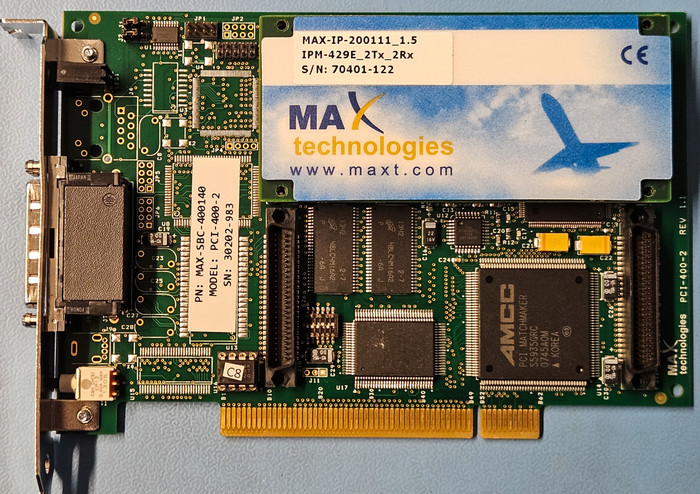
and there is a huge FPGA on it. Their older cards (I have one of them too) is 2x the length and with more huge FPGAs. These cards are a tour de force of hardware design. Their old PCMCIA card must be absolutely packed, since it does 16xTX and 16xRX, IIRC (I have one, enabled for just 1xTX and 1xRX which is all I need.

They also spent a lot of time on the software. They have packet definitions for every imaginable ARINC429 packet, and these vary according to grouping so e.g. (just an illustration) label 250 might be altitude if from the INS or ground speed if from the GPS. Plus some of the packet definitions vary anyway according to which avionics document you read; the Honeywell GPWS 400 page tome is a common reference, with great detail, but not universally followed. This software does actually run without the codes so you can use it as a packet reference manual :)

The way to get this working is to attack keylib32.dll. This googles to a lot of people playing around with it. It decrypts its executable data and loads it into RAM for execution, to resist disassembly.
« Last Edit: May 06, 2026, 02:51:55 pm by peter-h »
Z80 Z180 Z280 Z8 S8 8031 8051 H8/300 H8/500 80x86 90S1200 32F417
 
The following users thanked this post: Someone

Offline amyk

  • Super Contributor
  • ***
  • Posts: 9168
Re: What happened to MAX Technologies?
« Reply #1 on: May 07, 2026, 02:25:47 am »
There are companies specialising in cracking such things, although their usual customers have machines in the 5-6 figures range.
 

Offline 5U4GB

  • Super Contributor
  • ***
  • Posts: 1747
  • Country: au
Re: What happened to MAX Technologies?
« Reply #2 on: May 07, 2026, 03:29:29 am »
I have one of their 4 figure priced PCI cards and their software, and one PCMCIA card, both running, and a new PCI card which I want to get running. But the software needs codes which are PC configuration dependent. Yeah, "that system" where if you change the motherboard you need new codes :)

This level of stupid has always annoyed me, there's a $50,000 dongle attached to the software - the hardware it's driving - so why do you need to copy-protect the software?  Do they think someone's going to get a $10 board off Aliexpress and use the software with it?

Friend of mine got sick of having to get new license codes from the vendor, something that could sometimes take weeks, and cracked the software used to drive a six-figure piece of hardware. The vendor found out and threatened to sue, however in the process of cracking the software he'd discovered some unwanted supplementary functionality the vendor had added to it. This stuff was used in US national labs so he suggested to the vendor that this wouldn't be a good look for them if it got out.

Both sides agreed to pretend the whole thing had never happened.
 
The following users thanked this post: tom66, Yansi, tooki, TUMEMBER, I wanted a rude username

Online peter-hTopic starter

  • Super Contributor
  • ***
  • Posts: 6020
  • Country: gb
  • Doing electronics since the 1960s...
Re: What happened to MAX Technologies?
« Reply #3 on: May 07, 2026, 12:59:16 pm »
I've had stuff like this cracked in years past, to get rid of a dongle. But dongles were always easy.

Other things, more recent, are also often easy. For example Autodesk Fusion (thread in the CAD section) is cracked by patching a few bytes. But it gets you nothing unless you work totally alone and never have to open a native format file from somebody else. It's like jailbreaking an Ipad; useless in practice because so much stops working if you stop updating.

But keylib32.dll is much harder. Delphi integrates with it and generates a large number of calls to it, so patching the exe is probably not viable. Googling around, people have had a go at the DLL itself but each one is different so if you found one cracked one, it would not work with this application.

The scheme takes a snapshot of ~20 properties of the PC e.g. HD S/N, volume S/N, CPU S/N, amount of RAM, etc. It works a bit like the Windoze activation system whereby it permits a certain number of changes so e.g. you can add RAM or put in a bigger HD but if finds a new CPU then you have to re-activate. I am sure none of the MAXT users were aware of this scheme.
Z80 Z180 Z280 Z8 S8 8031 8051 H8/300 H8/500 80x86 90S1200 32F417
 

Online peter-hTopic starter

  • Super Contributor
  • ***
  • Posts: 6020
  • Country: gb
  • Doing electronics since the 1960s...
Re: What happened to MAX Technologies?
« Reply #4 on: May 27, 2026, 05:25:42 pm »
An update in case anyone comes across this.

After some weeks I got an email response from a Clément Finotto but he didn't seem to know anything or be able to do anything. He obviously received some email(s) from me but afterwards received no more :) He gave me some email addresses for their US end which bounced back. He also gave me more email addresses for himself which turned out to be dud also.

I managed to call him once. He answered with "hello", not the company name. Very odd.

The software uses the following fingerprint sources:
  - GetVolumeInformationA (disk serial)
  - Netbios NCBASTAT (MAC)
  - GetAdaptersInfo (adapter info)
  - Registry: ProcessorIdentifier, SystemBiosDate, SystemBiosVersion, SystemIdentifier, Machine, Machnm1/32/64
  - WMI: Win32_BaseBoard
  - GetSidSubAuthority (computer SID)

I can report that their keylib32.dll copy protection software does tolerate a clone of the HD to an SSD (Samsung EVO) using Clonezilla's command line option
sudo dd if=/dev/sdb of=/dev/sda bs=64k status=progress conv=fsync
so you can now prolong the life of the PC. Once that stupid software decides that "too much" has changed, it will ask for new keys and then you are screwed and your 4 or 5 digit hardware will be useless.

So if you are using MAXT hardware for testing something, build a box which emits those packets, because one day you will need it :)

« Last Edit: May 28, 2026, 08:57:54 am by peter-h »
Z80 Z180 Z280 Z8 S8 8031 8051 H8/300 H8/500 80x86 90S1200 32F417
 

Offline booscrawl

  • Regular Contributor
  • *
  • Posts: 191
  • Country: us
Re: What happened to MAX Technologies?
« Reply #5 on: May 28, 2026, 03:05:06 am »
Have you tried throwing the problem at Claude Code? It can likely patch a few thousand library calls without too much difficulty.
 

Online peter-hTopic starter

  • Super Contributor
  • ***
  • Posts: 6020
  • Country: gb
  • Doing electronics since the 1960s...
Re: What happened to MAX Technologies?
« Reply #6 on: June 01, 2026, 11:30:24 am »
Would Claude not refuse to do this sort of thing?
Z80 Z180 Z280 Z8 S8 8031 8051 H8/300 H8/500 80x86 90S1200 32F417
 

Offline Psi

  • Super Contributor
  • ***
  • Posts: 12640
  • Country: nz
Re: What happened to MAX Technologies?
« Reply #7 on: June 01, 2026, 11:40:56 am »
What happened to MAX Technologies?

They've reached their limit  :-DD
Greek letter 'Psi' (not Pounds per Square Inch)
 
The following users thanked this post: 5U4GB

Offline coromonadalix

  • Super Contributor
  • ***
  • Posts: 8785
  • Country: ca
Re: What happened to MAX Technologies?
« Reply #8 on: June 01, 2026, 12:51:14 pm »
you have softwares who can grab "all there is" when put in ram, expanded / unpacked exe's and others, memory dump 

alas if i recall ... not free, but i think one was, to some extent   ?
 

Offline hwasti

  • Regular Contributor
  • *
  • Posts: 62
  • Country: us
Re: What happened to MAX Technologies?
« Reply #9 on: June 01, 2026, 03:48:05 pm »
From what I can see, the original business model for Max Technologies was to service a specialized industry using specialized hardware and software, designed using knowledge and expertise not available readily. They could demand and received a ton of money for that. Finding a niche market and servicing it well is the oldest trick in the book for building a successful business.

The following discussion is generic and not about any particular company.

Then something happened that changed their world: Internet allowed free dissipation of knowledge.

Just about anyone could acquire the knowledge to understand these busses. Companies like HOLT made ICs that could do everything their $10,000 board did in a single chip and sell it for under $100. FPGAs became more accessible. FPGA designers and open-source FPGA designs become more accessible.

Companies like this had two options. They could adapt or try and milk existing customer base as long as possible and then go under.

Adaption to the new environment requires capital investment, possibly a lot of it. The only thing that would distinguish them from a dozen small no-name startups and freelance consultants offering the same service is their brand name and reputation (I am assuming it is good). That could build a viable business moving into the future, but it would not be the money printing machine that they were used to. It would require a structural change and an attitude reset.

The second option was to minimize capital investment and see how long they can sell what they currently make, mostly to current customers and referrals from them. At that point they are just trying to squeeze every last bit of value out of their reputation and customer goodwill.

As annoying as it is to current customers, the second option may be the better financial path for a small privately owned company owned by a person close to retirement, or worse, a second-generation owner that inherited a business they do not understand. There is a small window where they can monetize the name by selling the company to a new buyer who wants to follow that first option. Once that window closes, the second option is the only viable path.

Back to the OP's problem.

Today, nothing that Max Technologies does is all that hard to do; neither the hardware, nor the software. If you start from scratch, you can most probably get to the end result faster and cheaper than if you try and preserve your investment in the outdated hardware.

In my decades of working with a variety of companies, the single biggest mistake I have seen companies make over and over again is to spend money trying to preserve their "investment" in technologies or infrastructure that no longer makes sense. I hope you do not fall into the trap.

Good luck.
 

Online peter-hTopic starter

  • Super Contributor
  • ***
  • Posts: 6020
  • Country: gb
  • Doing electronics since the 1960s...
Re: What happened to MAX Technologies?
« Reply #10 on: June 01, 2026, 07:18:23 pm »
ARINC429 (and 1553; their other main line) were no secrets. MAXT, along with Excalibur in the US, make/made test gear which generates packets and receives packets.

Somebody spent ages typing up a huge database of packets, different ARINC429 labels and their 32-bit layout, etc, so the packets get displayed in actual units e.g.


This kind of tool is always useful. Well, always while ARINC429 is in use. It is widely used in aviation but AFAIK much reducing on modern airliners, and I suspect MAXT's big market was Airbus, which like everybody French buys French as much as possible. But ARINC429 is being replaced by Ethernet, and maybe fibre. In general aviation (a small market) it remains but Garmin control more and more of that business and they use CAN, Ethernet, and it is all proprietary and undocumented so no market there. ARINC429 is great because it is wide open, well documented, and if you want to interface to some bit of kit, your choice may be secret RS232, secret RS422, secret CAN, secret Ethernet, or ARINC429 which is almost always obvious. But as I say, small market outside the US.

MAXT implemented multi channel ARINC429 with FPGAs which is a good way to do it especially if you want to log high speed into RAM. I use the Holt HI-3593 chip which is great (but expensive at £100) and does 2 in 1 out, SPI, and if you want say 16 in 16 out then you best use an FPGA. Also when MAXT got going, say 30 years ago, FPGAs were all the rage.

My interest in MAXT is only in that I have a regular need to generate and receive ARINC429 packets. ALL tools for this are 4 or 5 digits, due to the market. For me it is a hobby; not currently selling anything with it. With MAXT's free software (all gone  now; download links dead, but I have v2 saved) you got 1xTX and 1xRX, with almost any of their PCI cards, which come up on Ebay from time to time, cheap since nobody knows what they are (probably removed from some airline avionics shop). They also did a PCMCIA card, which needs an old laptop, but works great (I found one on Ebay Germany for €100).

A crack is sure to appear for their software, however. A clever guy with the right tools can probably do it in a day. When that Delphi+DLL scheme was done 20 years ago, it would have taken much longer.

Google turns up some fun old links e.g.
https://groups.google.com/g/microsoft.public.win32.programmer.kernel/c/lJelWMhFV60 (never post under your company name)
https://ecos.sourceware.org/ml/ecos-discuss/2006-03/msg00214.html
I think he left c. 2006.

https://www.aviationtoday.com/2001/05/01/the-pulse-of-the-databus-market/ for some history :)
« Last Edit: June 01, 2026, 07:30:48 pm by peter-h »
Z80 Z180 Z280 Z8 S8 8031 8051 H8/300 H8/500 80x86 90S1200 32F417
 

Offline 5U4GB

  • Super Contributor
  • ***
  • Posts: 1747
  • Country: au
Re: What happened to MAX Technologies?
« Reply #11 on: June 01, 2026, 07:39:23 pm »
Somebody spent ages typing up a huge database of packets, different ARINC429 labels and their 32-bit layout, etc, so the packets get displayed in actual units e.g.

This sounds like something you'd do with WireShark, they already have minimal ARINC429 support via Lua dissectors so fleshing that capability out might be more practical than trying to keep hostile software running.
 
The following users thanked this post: Someone

Online peter-hTopic starter

  • Super Contributor
  • ***
  • Posts: 6020
  • Country: gb
  • Doing electronics since the 1960s...
Re: What happened to MAX Technologies?
« Reply #12 on: June 01, 2026, 08:27:29 pm »
It is indeed easy to just receive the 32 bit packet. Or generate one (it is a waveform with a specific slew rate).

Even my Lecroy 3034 has an arinc429 decode option, but it is crap.

Getting the named parameters, and there are thousands, is something else. If I can set up one of these tools for $500 for a PCI card off Ebay, it is great value. I have two running and no more.

Z80 Z180 Z280 Z8 S8 8031 8051 H8/300 H8/500 80x86 90S1200 32F417
 

Offline 5U4GB

  • Super Contributor
  • ***
  • Posts: 1747
  • Country: au
Re: What happened to MAX Technologies?
« Reply #13 on: June 01, 2026, 08:40:45 pm »
Getting the named parameters, and there are thousands, is something else.

"Claude, take all of the parameters from the ARINC629 specification and insert them into the following LUA dissector to allow them to be displayed".

This is just the sort of thing that stochastic parrots are meant for.
 

Online peter-hTopic starter

  • Super Contributor
  • ***
  • Posts: 6020
  • Country: gb
  • Doing electronics since the 1960s...
Re: What happened to MAX Technologies?
« Reply #14 on: June 01, 2026, 09:37:35 pm »
I never worked out who was buying those multi-k$ PCI cards with megabytes of RAM on them for packet logging. Must have been airlines, and firms developing airline avionics.

It is a kind of ATE business where you program a complicated set of stimuli and see what comes back. The MAXT software has a fantastic feature set of which 99% I never used.

That business is in terminal decline. The volumes were never high so money was made by high pricing.

With a micro and an HI-3593 you could build your own single channel analyser and generator, customised for your application, but you will never know if you are generating some packet correctly, whereas if you buy this thing, and you wrote your code per the spec, you can be fairly sure it will be working right.

Additionally, the spec is not trivial e.g. (just a random wrong example) label 126 could be ground speed if it is from a GPS, or it could be some radar data if coming from another source. Mostly there is no confusion but you have to be careful. Then Garmin came along and redefined the units from feet to miles, etc :) Also some Garmin boxes require ARINC429 packets in a specific order (you can look up ARINC743A) which is very very wrong and obviously done to frustrate 3rd party add-ons.
Z80 Z180 Z280 Z8 S8 8031 8051 H8/300 H8/500 80x86 90S1200 32F417
 

Offline Perkele

  • Regular Contributor
  • *
  • Posts: 76
  • Country: ie
Re: What happened to MAX Technologies?
« Reply #15 on: June 01, 2026, 09:59:24 pm »
Defunct company.
Old copy protection.
Interesting data in a "database".
Both of these can be done with Ghidra, or any decent "code spy" tool.
 

Offline Zoli

  • Frequent Contributor
  • **
  • Posts: 799
  • Country: ca
  • Grumpy old men
Re: What happened to MAX Technologies?
« Reply #16 on: June 02, 2026, 05:00:28 am »
you have softwares who can grab "all there is" when put in ram, expanded / unpacked exe's and others, memory dump 

alas if i recall ... not free, but i think one was, to some extent   ?
It's called "process dumper", and vaguely recall seeing free ones.


Share me

Digg  Facebook  SlashDot  Delicious  Technorati  Twitter  Google  Yahoo
Smf


-->