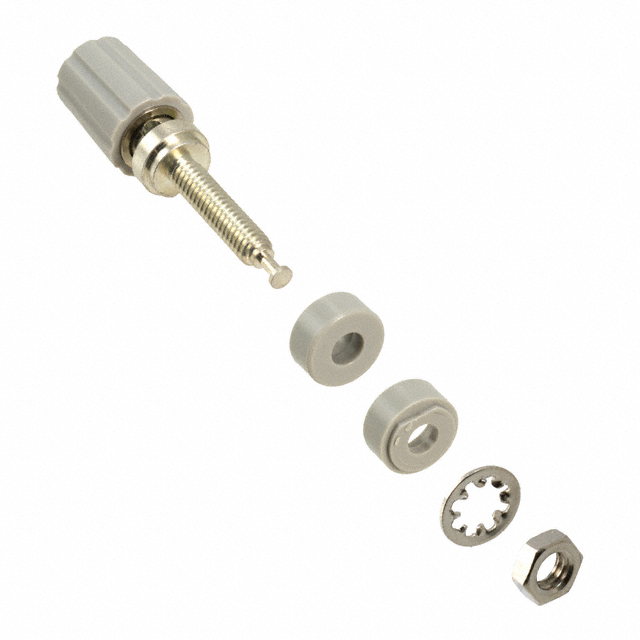
Is this a typical banana jack connector configuration (see attached)? I haven't been able to find it and may resort to fitting a jack from my inventory to fit but thought I'd ask first.
Most of the banana jacks I've found are a screw type that go through a PCB with a nut - similar to what I'll resort as a replacement.
This is interesting. I've looked for something like this before and haven't seen it.
https://www.digikey.com/en/products/result?s=N4IgTCBcDaIEYEMB2yUAIBWCDGBrEAugL5A
If you actually go to digikey and search "Jacks, Plugs" for "Termination = Threaded, Internal (Screw)", which is what you want here, you will see that there are only male banana jacks listed. Same for binding posts. Nothing there (that I found).
If you actually go to digikey and search "Jacks, Plugs" for "Termination = Threaded, Internal (Screw)", which is what you want here, you will see that there are only male banana jacks listed. Same for binding posts. Nothing there (that I found).
https://www.digikey.com/en/products/detail/cal-test-electronics/CT2908-5/5875062
No binding post though. That's actually what I was looking for previously. Not sure if that works for OP.
Binding post is the name I should have used as a name.
Unless the binding posts in the links can be fitted in, they are not the same as the original. Most likely these are custom and wanted to check if anyone recognized them before I fit alternate ones in.
The other day I realized something about the broken binding posts on my power supply. Unless I'm wrong and the three broken ones are a different type, it seems when the male thread broke off (see pictures in my initial post), it exposed the cylindrical portion. Once exposed, it looks like the cylindrical portion is nothing more than a coupling nut fully threaded on the inside.
One end is used for the mounting screw (which goes through the PCB first), and into the coupling nut. The other end normally has male threads protruding out (maybe 10mm), but is hollow so the banana jack can fit inside and where the plastic knobs screws onto (the plastic knobs have an internal nut).
The plastic knob itself doesn't hold the banana jack, it's all done in the hollow part of the male threaded part.
From what I can tell, the "coupling nut" takes a 4mm screw, however, I don't know the pitch. I'm wondering if a possibly exists hollow banana posts exists? I've looked on McMaster and they don't have 4mm.
I'm thinking about buying a screw and attempting to drill it. If successful, I'll have good posts, but still need a plastic knob with a nut so I can thread it onto the male threads.
Can you show a photo of where this was removed from? Its hard to envision a normal binding post not working, unless the hole needs to be drilled out or similar.
Not sure if the attached helps, but the power supply is in pieces, so I wouldn't get a good descriptive picture.
The screw goes through a conductive via on the PCB (whatever it would be called). The PCB is screwed to the back of the front panel, so the binding post is secured into the rear of the front panel by way of the PCB. The threads on the binding post poke through the front of the front panel, and the plastic screws onto it.
Not a bad idea and it would help guide the drill to hollow it.
I'll have to see what is worth it both financially and esthetically. This power supply has two channels plus a 5V DC output. Personally, I've never had a reason to use more than one channel for home projects; and never needed a locked 5V that I couldn't just produce with the same power supply.
Hmm..
Looks like you could start with a male-female standoff and drill down the male threaded part for the banana jack.
https://www.mcmaster.com/93655A441/


Banana plugs need a 4mm ID, so an M4 male thread isn't going to be big enough to drill through. Checking a random piece of equipment I have where the binding post nut isn't captive, the threads have a ~5.5mm major diameter. Possibly a #12 thread? Wouldn't be surprised if the forward threads are non-metric holdovers from some older design while the rear threads were swapped to ISO. But could also be something non-standard.
Sometimes it's easier in the end to modify the device to work with the hardware you can find than try to source (or bodge together) an exact replacement.
Could you make something like this work? You might have to work out a spacer/insulator or two nuts for the PCB.
I have those identical ones, however, they don't fit through the hole on the PCB.
Sometimes it's easier in the end to modify the device to work with the hardware you can find than try to source (or bodge together) an exact replacement.
I agree. This power supply was in one of the many trash bins at my company which is seldom home to equipment. My initial assumption was a few binding posts, a new knob, encoder, and this will be like new. Now I'm contemplating just capping the three holes and eliminating the 5V output; or maybe I can still find a way to retrofit something in that makes sense.
Seems silly to cap off a perfectly good working output, but also seems silly to use duct tape and gum to retrofit something.
It's not a high end power supply, and does have reviews similar to what I've seen regarding a flaky front panel, however, it is a linear supply whereas most others I own are switching.
Just an FYI/update, the piece I'm calling the coupling nut is a M4 x 0.7.
Not sure about when I'll move forward with reassembling, but wanted to give an update on the nut size.
Just an FYI/update, the piece I'm calling the coupling nut is a M4 x 0.7.
Not sure about when I'll move forward with reassembling, but wanted to give an update on the nut size.
You are aware that the #6-32 thread in my last post is equivalent to a M3.5 thread?
I was unaware.
The other day I was in Home Depot and used their nut/bolt board to see which one the "coupling nut" would fit for curiosity purposes.
I'm uncertain if their board had a 6-32, or if I have any in my stash at home, but good to know this is an equivalent.
Brass hollow threaded spacer that fits the thread on an ordinary jack. Cut down the stud on the back of the jack to have enough thread length for a screw through the PCB from the back.