-
[...] making the best use of whatever sampling rate the hardware can provide is still going to make for a better scope.
Not if 'making best use of' costs more than greater sampling rate.
I'm not sure that is what we see in the real world. For example, it would have been cheaper for Ford to just put a stonking big V8 in the Mustang to get 330 horses instead of a tricked out 4 cylinder, but they chose not to do that...
In the same way, low to mid range scopes probably have to use hardware that is available at a reasonable cost. Engineers can choose to put it together in creative ways, and maybe double up on some of the chips to interleave or otherwise boost performance. Using software creatively is going to be irresistible to most teams! -
I'm not sure that is what we see in the real world. For example, it would have been cheaper for Ford to just put a stonking big V8 in the Mustang to get 330 horses instead of a tricked out 4 cylinder, but they chose not to do that...
In the same way, low to mid range scopes probably have to use hardware that is available at a reasonable cost. Engineers can choose to put it together in creative ways, and maybe double up on some of the chips to interleave or otherwise boost performance. Using software creatively is going to be irresistible to most teams!
You can't analyze Ford's decision until you look at the regulatory picture--emissions and fuel economy--and know the actual costs involved. They've been stuffing 2.3 Turbos in Mustangs for 40 years, on and off. It is getting expensive to get larger engines through emissions as well. And believe me, if I know Ford (and I do) they have wrung out the costs in that EcoBoost pretty thoroughly.
As for scopes, my fairly old Tek TPS 2024 uses 2GSa/S. They have a 100MHz version that uses 1GSa/S. So to go to 200MHz, their best solution was to increase the sample rate to maintain fs/10. I'm sure they aren't idiots and I'm sure that increase cost some money--but that is what they did. Until I see actual acceptable performance from lower rates in an economy scope, I'm not going to assume it is easy or should be a given. -
it would have been cheaper for Ford to just put a stonking big V8 in the Mustang to get 330 horses instead of a tricked out 4 cylinder
I bet you the entire Internet that the tricked out 4 cylinder was chosen to maximize their profits. -
I'm not sure that is what we see in the real world. For example, it would have been cheaper for Ford to just put a stonking big V8 in the Mustang to get 330 horses instead of a tricked out 4 cylinder, but they chose not to do that...
In the same way, low to mid range scopes probably have to use hardware that is available at a reasonable cost. Engineers can choose to put it together in creative ways, and maybe double up on some of the chips to interleave or otherwise boost performance. Using software creatively is going to be irresistible to most teams!
You can't analyze Ford's decision until you look at the regulatory picture--emissions and fuel economy--and know the actual costs involved. They've been stuffing 2.3 Turbos in Mustangs for 40 years, on and off. It is getting expensive to get larger engines through emissions as well. And believe me, if I know Ford (and I do) they have wrung out the costs in that EcoBoost pretty thoroughly.
As for scopes, my fairly old Tek TPS 2024 uses 2GSa/S. They have a 100MHz version that uses 1GSa/S. So to go to 200MHz, their best solution was to increase the sample rate to maintain fs/10. I'm sure they aren't idiots and I'm sure that increase cost some money--but that is what they did. Until I see actual acceptable performance from lower rates in an economy scope, I'm not going to assume it is easy or should be a given.
Tek used to do that because interpolation is costly in processing power. "Take a sample-plot a dot" is simple as apple pie. And if you have to, if you linear interpolate with enough dots it's gonna look OK. So at that time economic way was to simply oversample. 5x sampling frequency is really OK if done right. But that interpolation via reconstruction filter and proper design of front end. -
it would have been cheaper for Ford to just put a stonking big V8 in the Mustang to get 330 horses instead of a tricked out 4 cylinder
I bet you the entire Internet that the tricked out 4 cylinder was chosen to maximize their profits.
4 cilinder is cheaper to make. Less moving parts to assemble. 8 cylinder V engine literally has two heads compared to 4 cylinders one. And then crankshaft, bearings...
And one thing is also important: blown 4 cylinder is smaller and lighter... Not only cheaper engine, but easier to design it into car...
-
They likely never would have designed that engine if it weren't for emissions standards. Adding turbos that have high reliability is not as cheap and easy a job as throwing it on your civic which can eat an engine a year. The intake and exhaust plumbing, extra oil and water lines, carbon build-up due to direct injection, and the direct injection components(high pressure fuel system)... If emissions weren't such an issue they would definitely just use a high output V8, just like they did before when emissions weren't as stringent(and they continue to tighten).
For good measure add in the required oil cooler so you don't ruin turbos, for high output engine you need intercoolers, and turbos are not cheap either. I'm betting an equivalent output V8 could be manufactured for less. Probably far less and there might not even be any weight savings because most of those turbo 4's use iron blocks(I may be behind the times here) but an NA V8 has no issues with aluminum. -
Wow, looks i missed the show grand finale, with the main character leaving the stage theatrically slamming the door. What a drama! The guy was already in cavitation mode when started the topic, it was clear the intent was to show everyone how stupid they are and how smart he is. Sure he will be doing fine on his .io board, some people are just born to run echo chambers.Just in case there are people reading this who are actually interested in in my original project of comparing low end scopes, I created [email protected] a while back when this thread got out of control. If you are interested in scope evaluations I invite you to join. It will be moderated to prevent the level of sheer idiocy that has dominated this thread. Join the group, but don't post and if enough people join I'll repost stuff from this thread and we can continue discussing what is right, wrong and a "feature" of DSOs.
Suggestion: Since this isn't the first time you've gone this route, maybe it would be more efficient to launch your next thread on groups.io, so you can maintain control of the content from the beginning. -
...., some people are just born to run echo chambers.
LOL, love that one!! -
[...]
For example, the dithering of samples that HP/Agilent introduced. It seems to me that by dithering the samples slightly, you end up with more fine grained results that would otherwise have to come from using a much higher sample rate - but the "punishment" is probably a longer acquisition time, as the dithered samples slowly build up the complete picture?
ETS (Equivalent Time Sampling) resolution is only limited by the ability to time the samples, given a repetitive signal. I think earlier Rigols even had it, but they've dropped it as a feature, which I'm guessing is because of how the trigger is implemented now. You still get a sort of random dot-walk effect that will give you a picture similar to an old ETS scope but this is not controlled and is due to the varied relationship between the trigger point and the sampling points.
I don't think the dithering that HP did (still does?) is the same at ETS?
If you have a constant e.g. 200MSa/s, and you can dither the samples e.g. by 5 discrete steps, you end up with a "slow" 1GSa/s.
Maybe that effectively is actually the same as equivalent time sampling, just done by random steps instead of one long linear sequence?
Just for fun..
When oscilloscope works with decimated samples many or some DPO scopes can do Sequential Acquisition Random Interleaving (SARI)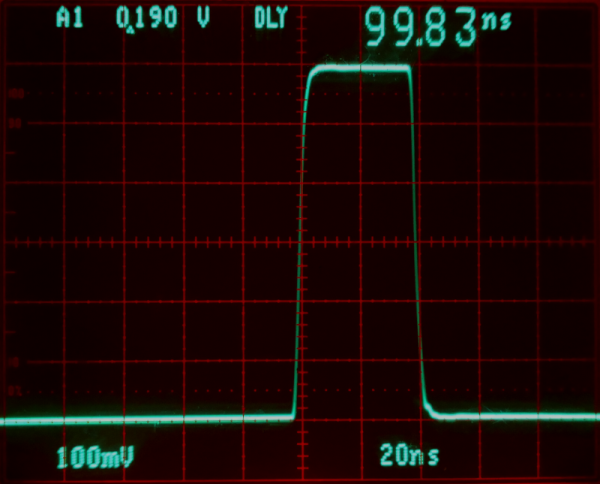
This is used signal.. 20ns pulse repeating 1.87MHz.
Next images scope have forced to low sampling speed using decimation and zoomed window for demonstrate aliasing and other things more easy.
Look carefully sampling speed and risetime etc things...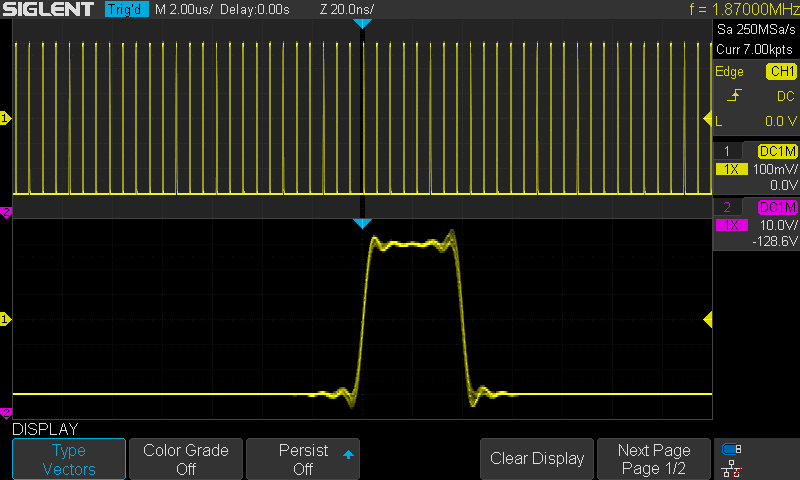
Sinc post interpolation on.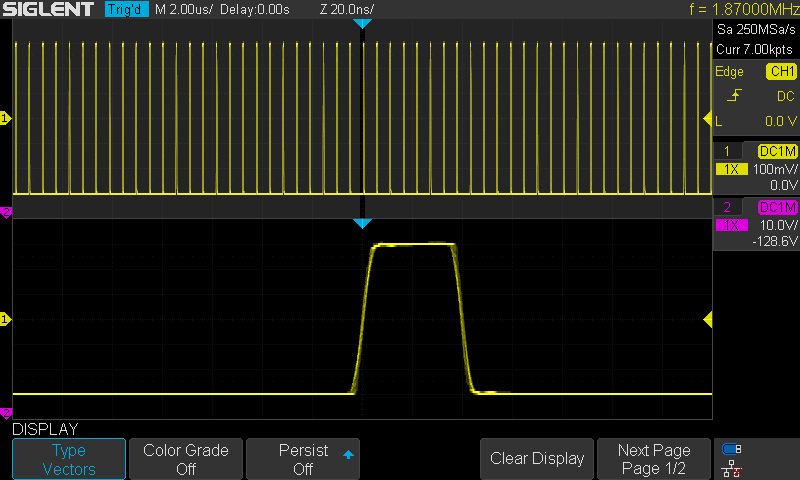
Linear post interpolation on.
It have many times specially by LeCroy and also others said that this is sometimes better for this kind of signals. No gibbs etc...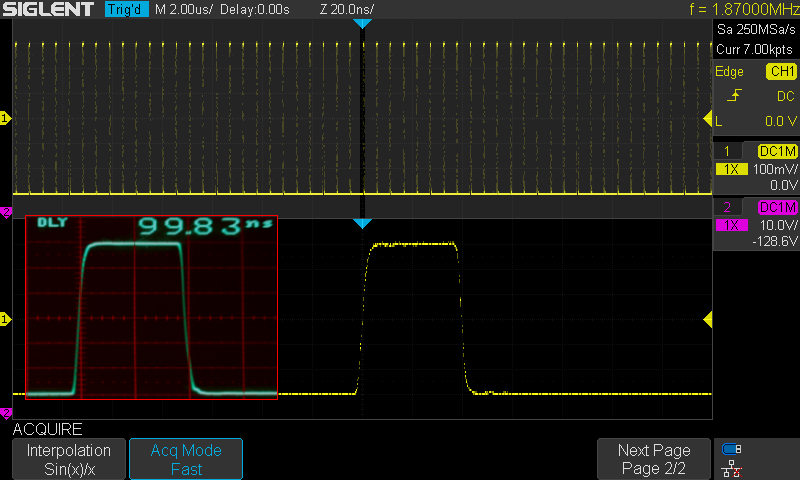
No interpolation, just pure samples and nothing else (SARI).
In live screen it looks better due to human eye-brain things etc.
If you turn Siglent scope to slow ack mode (what is also useful in some special cases, it works like conventional DSO) mode SARI is not possible.
Other signal, other case.
Specially in these gif animations live screen it looks better due to human eye-brain things etc. Also gif animation amount of frames and timing is not like in IRL where it looks better but this may give some idea for least some because here in forum are also beginners and scope many have many features, settings and adjusments. Not only these what we most use, example always Sinc on without even thinking if this is always best mode.
Signal 45MHz some kind of "squarewave" and things far over 25MHz Nyquist... (this is not very normal how we setup scope but it was more easy to demonstrate with tools what was just available at this time moment) But with this aliasing and not aliasing... just example about SARI with decimated samplerates. Aliasing, no aliasing. Just because random interleave. Of course this works only for enough continuous waveforms.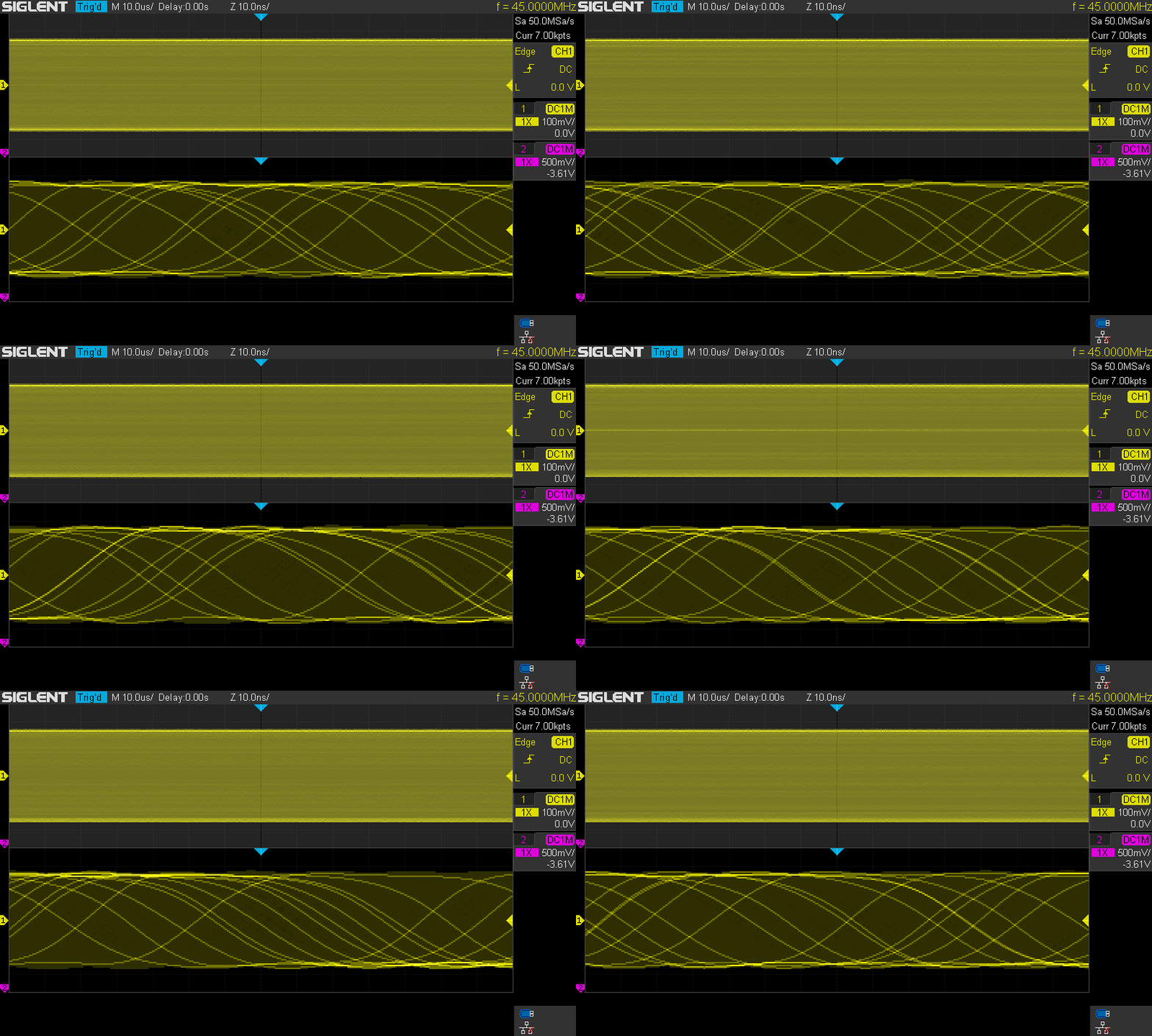
Nothing but aliasing
Sari and no aliasing
Even simple cheap tools have many features what user need be familiar. Too many times we use example scopes like "this is how I always have done" instead of thinking if it is always wise. Many hate dots mode but do not overlook it even when it is best in some situations, do not too much think polished nice picture, think what you need know about signal and nothing else. Modern DPO scopes can do lot of better than conventional DSO
-
Well that went well.

Perhapsnewall users should have to go on a course and get a DSP (Digital Scope Proficiency) licence before they're allowed to drive a scope. For increased revenue in the new "value chain" there could be large fines for learners caught speeding - going over 50us/div, or they could even be banned for driving while aliased.

I'm here all week.
Sari and no aliasing
Even simple cheap tools have many features what user need be familiar. Too many times we use example scopes like "this is how I always have done" instead of thinking if it is always wise. Many hate dots mode but do not overlook it even when it is best in some situations, do not too much think polished nice picture, think what you need know about signal and nothing else. Modern DPO scopes can do lot of better than conventional DSO
I like that bottom only 1 sample per waveform dots+persistance waveform, but won't the trigger position still have 22 1ns samples(*) per waveform cycle to work with, is it still as good when the trigger only has 5 or 6 samples per waveform cycle to work with.
*= maybe only 11 trigger samples per cycle to work with while Ch 1 & 2 are both on. -
At that timebase scope takes one sample per 20 ns. For a 45 MHz signal, that is a little above 1 sample per period. But since sampling clock of scope is not synchronous with signal, on every trigger that dot will fall on different part of curve. 1000 triggers later + persistence you have reconstructed waveform. At effective 10s off Gigasamples /s... That is how RIS scopes of old reconstructed waveforms.... Dot by dot ( of course using different electronics principles, before someone reacts..). That will work for any scope with dot mode and persistence.
I like that bottom 1 sample per waveform dots+persistence waveform, but won't the trigger position still have 22 1ns samples per waveform cycle to work with, is it still as good when the trigger only has 5 or 6 samples per waveform cycle to work with.
EDIT: I reread what you posted and realized it's not what you asked. Trigger engine works of full 1 GHz sampling clock. Trigger point is anyways interpolated, so it should work well with just a few samples (at 1 GHZ clock) . -
Yes Reg certainly went out on a limb stating that.
OTH, I can easily recognize that doing a 1 or 2 chips scope is a massive endeavour. My deep respect for those guys (US, chinese, germans, etc). And, some times, we take these equipments to debug our own 1-processor circuit!! And we like to expect/demand the equipment to be flawless and be as cheap as possible!
Agree!!
To be honest, I would like to apologize everybody for being persistent. I was really ticked off by " My goal in this is to embarrass the OEMs into improving their products.".
It just bothers me. The older I am, I seem to have harder time letting go.. I will be one grumpy old man one day...
Here's another thread investigating similar scope response characteristics:
https://www.eevblog.com/forum/testgear/oscilloscope-frequency-response-correction-program/Fungus
A previous life used to run a race team
You may laugh my personal occasional ride has 1400lbs torque with two turbos and nitrous but propane to go with the gas it weighs 1300kg, here's the rub it's a diesel. The last set of rollers we tested it it broke the retardation device
Always exceptions to rule i would agree
Lots of ways of skinning a cat
Sorry back on topic
Topic !
Reg has left the nest in disgust of all of us.
Been involved with a tiny bit of drag racing too helping the neighbor reach deadlines for meets.
All rotary powered, some 2r, some 3r, NA and turbed.
20B on meth and 40lb boost. First runs on hub dyno getting a basic tune. At a later date pushed to 1400 HP.
I finally get around to seeing what this thread is about and as I expected, the OP went off the deep end, again. They do seem to enjoy the drama:
https://www.eevblog.com/forum/rf-microwave/nanovna-custom-software/msg2688777/#msg2688777
"Ego pimping" became part of the work culture.
Looks like a nice setup. I've worked on a few home made dynos. One was a toy model to play with the controls, two were larger water brakes limited to around 100HP or so. Mostly I was putting together software and the electronics for them.
You can see my toy one here. While I have zero interest in the RC toys, I came across the group from my research and decided to post there.
https://www.msuk-forum.co.uk/forums/topic/81512-self-built-rc-dyno/?do=findComment&comment=1013094
For the bike, I just collect the data from driving it. It hardly makes enough power to run your friends cars starter motor.
Sorry for adding to the noise. I have a soft spot for things that are fast. -
Yeah it's pretty cool Joe and just for you here's the rest of it including the 2nd display with the live engine data.Been involved with a tiny bit of drag racing too helping the neighbor reach deadlines for meets.
Looks like a nice setup. I've worked on a few home made dynos. One was a toy model to play with the controls, two were larger water brakes limited to around 100HP or so. Mostly I was putting together software and the electronics for them.
All rotary powered, some 2r, some 3r, NA and turbed.
20B on meth and 40lb boost. First runs on hub dyno getting a basic tune. At a later date pushed to 1400 HP.QuoteYou can see my toy one here. While I have zero interest in the RC toys, I came across the group from my research and decided to post there.
You and your SW at it again, nice.
https://www.msuk-forum.co.uk/forums/topic/81512-self-built-rc-dyno/?do=findComment&comment=1013094 Quote
For the bike, I just collect the data from driving it. It hardly makes enough power to run your friends cars starter motor.
That's how the neighbor is improving his drag cars now too, it's all about the logging.
Sorry for adding to the noise. I have a soft spot for things that are fast.
Amazing what can be deduced from inspecting the 20 or so parameters in the pit and dialing in some engine tweaks that remove a problem and result in faster runs. Bloody interesting stuff.
-
Never did drag cars, just built the engines for the owners they gave the 1/4 mile what for
-
Never did drag cars, just built the engines for the owners they gave the 1/4 mile what for
Sad story about the setup above.....no not a prang but just as expensive in that we couldn't hold 20B's on the engine plate when they were making that sort of HP, even machine recessing them into it !
Factory steel castings couldn't handle the grunt at launch and got ripped apart.
So many $1000's later and billet end plates, them too recessed 2mm precisely into the engine plate we might soon be ready to go again. -
$$$ vs lower ET is some sort of exponential curve. The same is true with scopes!!
I don't think the groups.io is going to be of much help. I remember seeing him post about covid in the HP forums and when a few people posted jokes about the matter, he had a similar response. He reminds me of Kiriakos-GR, who also left to start his own forum. Too bad really as he had put together some fairly nice reviews.
https://groups.io/g/HP-Agilent-Keysight-equipment/search?ev=false&q=covid
-
Well that went well.
Perhapsnewall users should have to go on a course and get a licence before they're allowed to drive a scope. For increased revenue in the new "value chain" there could be large fines for learners caught speeding - going over 50us/div, or they could even be banned for driving while aliased.
I'm here all week.(rf-loop edit: /removed image from quote/ look it in orig quoted msg.)
Sari and no aliasing
Even simple cheap tools have many features what user need be familiar. Too many times we use example scopes like "this is how I always have done" instead of thinking if it is always wise. Many hate dots mode but do not overlook it even when it is best in some situations, do not too much think polished nice picture, think what you need know about signal and nothing else. Modern DPO scopes can do lot of better than conventional DSO
I like that bottom 1 sample per waveform dots+persistance waveform, but won't the trigger position still have 22 1ns samples per waveform cycle to work with, is it still as good when the trigger only has 5 or 6 samples per waveform cycle to work with.
In real life it do not even need persistence on. This peristence is here for demonstrate better how it looks in real and also for better imagine trigger jitter. This is DPO. Do you mean 1 sample per waveform or near 1 sample per one cycle in signal.
Here in this image every waveform displayed in bottom window have 7 samples (displayed samples interval is 20ns). It depends situation how many acquisitions (wfm) it can do inside one TFT update period what is in this model 40ms. So one TFT frame, depending wfm speed, may have lot of acquisitions overlaid in one frame and then every acquistion samples are interleaved randomly between sequential acquisitions. In cases where example wfm update rate is 20kwfm/s (not in this image) every TFT frame may have 800 acquisitions and so randomly interleved it looks quite dense, nearly like just continuous line.
Now, if you look carefully this image. As can see, visible is only one trace. But, because I want reduce also real true ADC samplerate as low as possible I have turned also Ch2 on but out from screen because this time there was not trace display off/on feature. So, sampling interval is 2ns! Now bottom window time scale is 10ns/div. 2ns is 1/5 div. There is not at all this amount of signal "jumping" in time axis, of course, as can see.
This also partially answer your question about if there is even less real samples in one period in signal.
Of course it do fine interpolation between true ADC samples for position samples, related to trigger position, to display. I do not remember fine interpolation (fine positioning in time axis) max resolution (xx picoseconds).
In image there is bit over 11 samples for one period in signal, not 22. So, every ancquistion is fine positioned and overlaid to display and without sync to signal dots in every overlaid acquisition is randomly interleaved producing quite good image about signal.
Teledyne LeCroy have much more sophisticated real Random Interleaved Samplimg mode - RIS. This Siglent mode is nothing if compare this and this Siglent is nearly just normal, of course not even advertised. User need only remember to use it in these cases where it is useful. Turn interpolations off... and turn Sinc or Linear on only when really needed and you avoid many problems, if not like look this kind of images, then even when you suspect something, check with Linear interpolation and without any interpolation, just dots (in scopes where dots are real only sampled and in scopes where Sinc can turn off and what do not produce extra fake dots in dots mode.) Scope where Sinc can not turn off when ever and scopes what do not even have real dots mode, example producing fake dots between true dots without even possible to turn off this bullshit... ==>> Recycle.
-
Gentlemen, start you engines elsewhere!!!! Or I'll be going groups.io...
-
Gentlemen, start you engines elsewhere!!!! Or I'll be going groups.io...
LOL
-
Gentlemen, start you engines elsewhere!!!! Or I'll be going groups.io...
Haven't found anything old yet you asked about......still looking through old drives.
-
it would have been cheaper for Ford to just put a stonking big V8 in the Mustang to get 330 horses instead of a tricked out 4 cylinder
I bet you the entire Internet that the tricked out 4 cylinder was chosen to maximize their profits.
4 cilinder is cheaper to make. Less moving parts to assemble. 8 cylinder V engine literally has two heads compared to 4 cylinders one. And then crankshaft, bearings...
And one thing is also important: blown 4 cylinder is smaller and lighter... Not only cheaper engine, but easier to design it into car...
It's all about the power to weight ratio... the founding principle of Lotus!
-
They likely never would have designed that engine if it weren't for emissions standards. Adding turbos that have high reliability is not as cheap and easy a job as throwing it on your civic which can eat an engine a year. The intake and exhaust plumbing, extra oil and water lines, carbon build-up due to direct injection, and the direct injection components(high pressure fuel system)... If emissions weren't such an issue they would definitely just use a high output V8, just like they did before when emissions weren't as stringent(and they continue to tighten).
For good measure add in the required oil cooler so you don't ruin turbos, for high output engine you need intercoolers, and turbos are not cheap either. I'm betting an equivalent output V8 could be manufactured for less. Probably far less and there might not even be any weight savings because most of those turbo 4's use iron blocks(I may be behind the times here) but an NA V8 has no issues with aluminum.
Agree, the V8 is a much cheaper way of making power, in a way that increasing the sample rate on a scope just isn't! Stretching the analogy even further, a V8 is increasing parallelism (8 one cylinder engines in parallel), whereas increasing the sample rate is like increasing the RPM of the engine so each cylinder does more explosions per second.
Increaing the RPM, like increasing the sample rate, will soon get you to the point where things start to become unreliable due to the forces involved...
Of course, you can still get V8 Mustangs... they are significantly more powerful than the tricked out 4 cylinder, but they are not stupidly much faster. They sound better!
-
Thanks for trying. I get the impression that the misinformed and no-things have to reduce our productive time with frivolous banter.
-
I wanted to add few more observation, looking at discussion here.
It's all wrong. Look at your samplerates and then think about how that aliases with your 50MHz carrier. If you do these kind of tests you need to use an 'odd' frequency like 33MHz. You'll see you can only get a good picture with lower samplerates when you turn peak-detect on.
But if we go with option 3. (downsampling by filtering), as suggested, we will filter out anything above 10 MHz..
On spectrum analyser, we would be looking at scale of 0-10 MHz and see nice clean spectra of that without any folding from upper bandwidth. Perfect.
What we will see on the screen of oscilloscope ?
As mentioned before: if you low-pass filter a signal you'll lose the high frequency content. Think about how a basic AM demodulator works; that is not a low-pass filter but an envelope detector. Do the same test with 20MHz bandwidth on and off and you'll see.
(Attachment Link)
This is an AM modulated signal using an 8.33MHz carrier and 100Hz modulation. Peak detect is on. Trace 1 (top) is unfiltered, trace 3 (bottom) is filtered using a 600kHz low-pass filter. I hope that this makes it very clear that anti-aliasing filtering based on the samplerate is a really bad idea on an oscilloscope.
This argument is all based on a 1950's use case for an analog scope testing for over modulation of an AM transmitter. It is *so* last century. A DSO should provide a spectrum analysis mode for this use case.
When you see spurious side bands the modulation is too high. Besides, very few people have a need to test the modulation of an AM transmitter in 2020 other than broadcast engineers who will be well equipped for the task
Have Fun!
Reg
