I've started to put together a collection of test-gear for hobby projects and electronics repair work (mostly audio). I currently have a Philips analog scope (PM3217) that is need of a calibration (visible difference in scale between the two channels) but I would prefer to avoid the cost and potential difficulty of finding a calibration house that can re-align it.
Is there a cheaper and easier way to go about this? I was planning to buy a new multimeter soon, could I just get something like an Extech EX330, measure any DC voltage or oscillator and match the scope vertical gain and time-base to the Extech?
Any recommendations for cheap used references available in Europe would also be much appreciated. Cheers.
A scope is not a precision tool - a DMM and a crystal oscillator is more than adequate for basic calibration
That's what I wanted to hear, thanks

Mike is right. An analog scope might be useable to 2% accuracy and I have yet to run into a multimeter worse than 1%.
Having said that I can recommend these two sources for references should you need to check/calibrate something more accurately:
http://www.voltagestandard.com/Home_Page.html I have the DMMCheck
http://www.gellerlabs.com/Voltage%20References.htm I have the SVR
They both have communicative owners and the quality of the product is good. I cannot vouch for the absolute accuracy of them but they seem to agree with each other which implies they are at least close to spec.
They shipped to me on Chile so I imagine Europe would be no problem.
I have the DMMCheck and I have obtained voltage readings between 4.9995 V and 5.0005 V on different meters I have compared it against. So it seems to conform to its specs.
You can order texas intruments voltage reference ICs as free samples. 0.05% accuracy and if you look at the bell curve, something like 80% of them are 0.01% or better. Search for REF5050. Just build it up on breadboard or whatever. You can put it in a fancy case for fun if you want. The voltage standards sold on that site are based off the same TI chips.
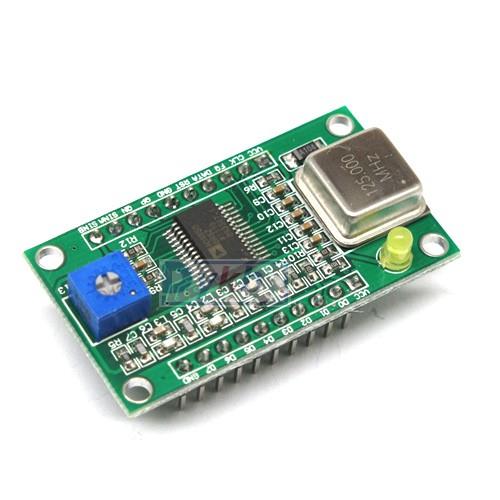
Might as well use a micro devboard like an Arduino with a crystal to provide the the reference frequencies, the crystal will be much better than 2%, and division by powers of two is also quite accurate. A variable DC source is usable, although a square wave is easier (don't have to keep switching between GND and DC coupling). You won't be able to verify the highest sweep speeds and vertical settings, the lowest attenuator settings may also be an issue. Bandwidth testing requires more expensive equipment (usually a leveled sine wave oscillator), but it's usually just a performance check without any adjustments anyway.
Check the calibration procedure in the service manual. It often requires you to go through all adjustments after the one you changed, so if vertical gain is the first adjustments, you'd ideally have to at least check all other items, since they may be influenced by the change in gain.