Author Topic: NEW PDVS2mini DC Voltage Reference from Ian Johnston - Reviewed - NOW WRYTECH  (Read 93905 times)

nnnnnnnn and 3 Guests are viewing this topic.

Offline Furna

  • Frequent Contributor
  • **
  • Posts: 386
  • Country: de
  • I still don't know
Re: NEW PDVS2mini DC Voltage Reference from Ian Johnston - Reviewed.
« Reply #125 on: July 30, 2025, 08:03:13 pm »
I collected earlier today the package from DHL.

Software v2.0 IMHO has at least one bug; see photo. At first boot, I entered the Settings menu and exited without saving.
When I entered the Settings menu again (with no rebbot) I foud what you see in the photo.

Software v2.0 is a little different than previous version.
I am not able to access the serial settings menu via press and hold the LEFT and RIGHT buttons simultaneously.
Anyway serial is working; it just start at the first command sent via a terminal application (I am using Putty).
You can also restore defualt values for the device (so I have back the correct values for the Settings menu).

Playing a bit with the device ...
The sky above the port was the color of television, tuned to a dead channel.
 
The following users thanked this post: wrytech

Offline wolfy007

  • Frequent Contributor
  • **
  • Posts: 261
  • Country: au
  • Back into electronics again, as a hobby this time.
Re: NEW PDVS2mini DC Voltage Reference from Ian Johnston - Reviewed.
« Reply #126 on: August 05, 2025, 03:29:49 pm »
wow, already sold out.
 

Offline Furna

  • Frequent Contributor
  • **
  • Posts: 386
  • Country: de
  • I still don't know
Re: NEW PDVS2mini DC Voltage Reference from Ian Johnston - Reviewed.
« Reply #127 on: August 05, 2025, 05:08:58 pm »
Software v2.0 IMHO has at least one bug; see photo. At first boot, I entered the Settings menu and exited without saving.
When I entered the Settings menu again (with no rebbot) I foud what you see in the photo.

Meanwhile this bug has been already corrected and was obviously due to the empty EEPROM.
<RestoreFactorySettings> serial command now also saves the values in EEPROM and new devices already have firmware v2.01
Unfortunately the firmware is not yet available on the web site and I am not sure to upgrade just for this samll change.
Indeed the web site has the new manual for firmware v2.01

I proposed Johannes to implement a new value "Half" for Charge Enable setting to charge the batteries to "storage" Voltage value ( 3.7*4=14.8 )
I am keeping the unit on all the time with a noisy switching PSU (as far as I know non damage should happen to circuit or compononents) but measurement will be done on batteries only.
Let's see ... currently I reached the result switching to "No" at half of the charge.

Yes the unit is already sold out ... remember "one man (not full time I guess) company".
The sky above the port was the color of television, tuned to a dead channel.
 
The following users thanked this post: ploxiln, wrytech

Offline Gertjan

  • Frequent Contributor
  • **
  • Posts: 328
  • Country: nl
Re: NEW PDVS2mini DC Voltage Reference from Ian Johnston - Reviewed.
« Reply #128 on: August 05, 2025, 05:59:26 pm »
Sorry, I bought apparently the last one. Next day it was marked "sold out".
Will receive it tomorrow.

Regards, Gertjan.
 
The following users thanked this post: wrytech

Offline wrytech

  • Contributor
  • Posts: 13
  • Country: de
    • wrytech
Re: NEW PDVS2mini DC Voltage Reference from Ian Johnston - Reviewed.
« Reply #129 on: August 05, 2025, 09:04:31 pm »
Hi all,

Thanks for the interest, the purchases, and the feedback so far. I’m quite happy with how the v2 introduction has gone.

Initial units were limited due to housings in stock running low. New one are currently in production and I have fully assembled and burned in PCBs ready, so restock won't take too long once the housings arrive.

Thanks also to Furna for spotting and pointing out the EEPROM bug and the discussion around it. It’s already fixed in units shipped over the weekend. The issue only appeared on new units if settings were exited without saving. Using "Save & Exit" once writes the needed values to EEPROM (as intended), and the problem won’t occur again. Root cause was the unit trying to restore values from an empty EEPROM; on power-up, defaults are loaded, so it slipped through initial testing. Really don't think I would have been able to find this one by myself haha

As always, looking forward to more discussions, feedback, etc.

Johannes
PDVS 2 Mini v2 now available at wrytech.eu
 
The following users thanked this post: SHF, wolfy007, Svgeesus, tonyalbus, ploxiln, Furna

Offline TheDefpomTopic starter

  • Frequent Contributor
  • **
  • Posts: 932
  • Country: nz
  • YouTuber Nerd - I Fix Stuff
    • The Defpom's Channel
Re: NEW PDVS2mini DC Voltage Reference from Ian Johnston - Reviewed.
« Reply #130 on: August 10, 2025, 12:09:51 am »
Johannes, I emailed you the other day to see if you were interested in sending me a unit to review, to replace my existing Ian Johnston V1 prototype (which this entire thread is based on), haven't had a response so wasn't sure if you got it or not, or if you are not interested in sending a V2 to me to review.
Cheers Scott

Check out my Electronics Repair, Mailbag, or Review Videos at https://www.youtube.com/TheDefpom
 

Offline Gertjan

  • Frequent Contributor
  • **
  • Posts: 328
  • Country: nl
A heads-up on the EBL 6F22 Li-ion 600 mAh batteries

TL;DR: These batteries are now having a new appearance. But likely are still the same batteries.


I bought 4 EBL 6F22 Li-ion 600 mAh batteries on Amazon. As recommended by Wrytech, and indeed in Europe Amazon seems to be the easiest supplier.

The photo on Amazon showed the well known batteries:


EBL_old_Amazon-1000pix.png

But what I received looked completely different:


IMG_4447__EBL_Li-Ion_battery_new-2000pix.jpg

The batteries as received measured 7,5V.  After charging, I measured 8,4V.  So it seems they still contain the same 2 Li-Ion batteries in series as before.

Two of these new EBL batteries are now in my PDVS 2 mini V2 for a week, and function without any problems.

regards, Gertjan.


The following users thanked this post: tonyalbus

Online IanJ

  • Supporter
  • ****
  • Posts: 2142
  • Country: scotland
  • Full time EE & Youtuber/Creator
    • IanJohnston.com
I believe EBL rebranded their entire product line. They sent out a press release Dec. 2024.

Still my 6F22 batteries of choice.

Ian
Ian Johnston - Original designer of the PDVS2mini || Author of WinGPIB
Website: www.ianjohnston.com
YouTube: www.youtube.com/user/IanScottJohnston, Odysee: https://odysee.com/@IanScottJohnston, Twitter(X): https://twitter.com/IanSJohnston, Github: https://github.com/Ian-Johnston?tab=repositories
 

Offline J-R

  • Super Contributor
  • ***
  • Posts: 1729
  • Country: us
 

Offline Gertjan

  • Frequent Contributor
  • **
  • Posts: 328
  • Country: nl
I wrote a driver for the PDVS 2 mini v2 for TestController, a Program that can log from many multimeters.


With this driver TestController can set the PDVS2mini Output voltage.  For example, with the "Param sweeper" popup one can do  sweeps of the output Voltage.  The PDVS2mini Set Voltage, Internal Temperature, and Battery Voltage can be read-out and logged.  Additional Status info is read out in the Setup Menu.

Please note: This configuration file is for the PDVS 2 mini v2. Unfortunately Wrytrech made changes to the communication protocol. So this driver won't work with older (pre v2) PVDS2 mini's. However, it won't be too difficult to adjust this device configuration file to the older commands.

Please find more info, and the definition file here: configuration file for the Wrytech PDVS 2 mini v2.
(It will be added to the TestController distribution with the next update)

Regards, Gertjan.
« Last Edit: August 15, 2025, 06:43:06 pm by Gertjan »
 
The following users thanked this post: faraday, tonyalbus, Furna

Offline wolfy007

  • Frequent Contributor
  • **
  • Posts: 261
  • Country: au
  • Back into electronics again, as a hobby this time.
Re: NEW PDVS2mini DC Voltage Reference from Ian Johnston - Reviewed - NOW WRYTECH
« Reply #135 on: September 13, 2025, 05:26:46 am »
still sold out?
 

Offline SHF

  • Regular Contributor
  • *
  • Posts: 83
  • Country: de
Precision is no coincidence
 

Offline Gertjan

  • Frequent Contributor
  • **
  • Posts: 328
  • Country: nl
Re: NEW PDVS2mini DC Voltage Reference from Ian Johnston - Reviewed - NOW WRYTECH
« Reply #137 on: September 19, 2025, 10:33:09 am »
Start-up behaviour of Wrytech PDVS2 mini v2

I measured the start-up / warm-up behaviour of my Wrytech PDVS2 mini v2 @ 10V output.

The measurement starts at switching on the cold PDVS2 mini v2
The red curve is the output of my PDVS2 mini v2, as measured by the 3458A DMM. The 3458A was pre warmed-up for 24 hours, and ACAL was done 15 minutes before starting the measurement.
The distance between Y axis grid lines represents  1ppm / 10uV.
The blue horizontal line represents where I think 10V really is*

The grey line is the measured PDVS2 mini v2 internal temperature.
Green & Pink are the room temperature and humidity. I managed to keep the room temperature constant.


Full size graph: PDVS2-mini-v2-start-up-3458A-3-hours-1200pix.png

- Within 15 minutes the PDVS2 mini v2 is in spec (Specced accuracy: ±50 μV)
- But it takes about 1:40 hours before the PDVS2 mini v2 is really stable.
- Note that the output voltage curve is more or less reciprocal with the internal temperature curve. This suggests that tempco is the biggest contributor the output variation.
- In this measurement the PDVS2 mini v2 output is about 1,5 ppm high. Possibly because of tempco, as the internal temperature is around 27,6degr.C, and the temperature stated in my Wrytech calibration sheet is 30.4degr. C. Something to look into :).


* This 3458A was calibrated a year ago by Keysight Boeblingen. I calculated the yearly drift using previous calibrations, and corrected for the last year. (Keysight states an uncertainty of 1,5ppm for the 10V range)

regards, Gertjan.
 
The following users thanked this post: IanJ, Kean, wolfy007, Furna, Shimonu

Offline Gertjan

  • Frequent Contributor
  • **
  • Posts: 328
  • Country: nl
Re: NEW PDVS2mini DC Voltage Reference from Ian Johnston - Reviewed - NOW WRYTECH
« Reply #138 on: September 21, 2025, 02:31:51 pm »
After the measurement in previous post, I was curious what part of the difference between the 10V of the PDVS2 mini v2 and the 3458A was due to tempco. Internal temperature of the PDVS2 mini during that measurement was 27.6°C, while this temperature was 30.4°C during the Wrytech calibration.

So I put the PDVS2 mini in a big cookie tin, together with a power resistor on a heatsink. This way I could add some warmth to the PDVS2 mini environment, and slowly rise its internal temperature.


Full size graph: PDVS2-mini-v2-temperature-variation-1200pix.png

Again the red curve is the output of my PDVS2 mini v2, as measured by the 3458A DMM. And the blue horizontal line represents where I think 10V really is.
Dark grey is the PDVS2 mini internal temperature, and pink is the room temperature.

The measurement starts where the measurement in previous post stopped. After applying some heat in the cookie tin (about 1.5W), temperatures are slowly rising, and as expected, the PDVS2 mini output drops.

Where the red line crosses the blue line, the PDVS2 mini output is exactly 10V (according to me :))

A bit after that point, at about 1:00, I stopped adding warmth, and opened the cookie tin to let the PDVS2 mini cool down again. This resulted on the second crossing of the blue line at about 1:45.

Then I tried to add just enough warmth to get the PDVS2mini v2 at just the optimum temperature, and keep it there. Alas, at 2:45 the batteries where empty, and the PDVS2 mini switched off (battery voltage is shown by the light blue line)

When looking at what internal temperatures the PDVS2 mini outputs precisely 10V, it is on average 29.5°C. And that is close to the Wrytech calibration sheet temperature of 30.4°C.

So "my idea of 10V" matches very well with the "Wrytech idea of 10V" :)
But, considering all uncertainties involved, this could just be a happy coincidence... (on my end I would expect an overall uncertainty of about 2ppm)
Also, it seems my PDVS2 mini v2 is a bit more sensitive to temperature then expected, so that needs more investigation....

regards, Gertjan.
« Last Edit: September 22, 2025, 08:22:22 am by Gertjan »
 
The following users thanked this post: Cyclotron

Offline Gertjan

  • Frequent Contributor
  • **
  • Posts: 328
  • Country: nl
Re: NEW PDVS2mini DC Voltage Reference from Ian Johnston - Reviewed - NOW WRYTECH
« Reply #139 on: September 24, 2025, 05:40:44 pm »
Wrytech PDVS2 mini v2 linearity

I measured the linearity of my Wrytech PDSV2mini v2.

The PDVS2 mini is controlled by TestContoller, and sweeps from 1V to 10.2V in 1230 steps Its output is measured with with the Agilent 3458A, on the 10V range in manual ranging.
A math function in TestController calculates the difference between input and output.


Full size graph: PDVS2-mini-v2-linearity-1-10.2V-100NPLC-1200pix.png

The red trace is the PDVS2mini v2 output, measured with the 3458A, blue trace is the set value of the PDVS2mini output. (hardly visible, because it is under the 3458A trace :))
The dark grey trace is difference between measured output and set value, in PPM.
Pink trace is the internal temperature of the PDVS2mini, to check if variations in the difference trace are correlated with temperature.

I tried to minimise the "noise" in the difference trace.
- Changing from 10NLPC to 100NLPC did not make much difference. So it is not a noisy PDVS2mini v2 output.
- Using a longer delay before taking the measurement, to let things stabilise, did not make any difference. The PDVS2mini v2 settles quickly, and I used a Teflon measurement cable with low absorption. (This measurement uses 0,5sec delay between a set-step and taking the corresponding measurement, I also tested with 2sec delay)

My conclusion is that most of this "noise" is due to the 20bit resolution of the MAX5719 DAC.
Mostly it is well in spec (Accuracy = Within 50 µV = 5ppm @ 10V)

Only on the low end the differences become somewhat larger.
Of course one has to realise that this not only a measurement of the PDVS2mini v2 linearity, but also of the 3458A. :)

Linearity is excellent. A flat line with only a hint of rise below 5V. It clearly pays off that the calibration has 11 set-points, not just "min" and "max". (MAX5719 INL = ±20LSB Max.)


I also took measurements with a sweep from 0V to 1V, to better explore the low voltage part. The 3458A was now in it's 1V range, so with optimal resolution and linearity for this measurement:


Full size graph: PDVS2-mini-v2-linearity-0-1V-100NPLC-1200pix.png

Indeed the differences become worse with lower voltages. Note that the difference scale is now coarser: ±100ppm instead of ±25ppm previously.
Extra shielding (cookie tin, guarding) made no difference. The PDVS2mini was galvanically isolated from the measurement PC using the IUSL Isolated USB Serial Link.
I think we see the bottom of the DAC barrel.

Linearity is still excellent until about 0.3V, below it becomes a bit worse.
Fortunately I can't think of a use case for these very low output voltages. (And a 100ppm deviation is still only 0,01%. :)

Edit: For more insight see this post below.

regards, Gertjan.
« Last Edit: September 25, 2025, 11:09:23 am by Gertjan »
 
The following users thanked this post: voltsandjolts, TUMEMBER

Offline HKJ

  • Super Contributor
  • ***
  • Posts: 4401
  • Country: dk
    • Tests
Re: NEW PDVS2mini DC Voltage Reference from Ian Johnston - Reviewed - NOW WRYTECH
« Reply #140 on: September 24, 2025, 06:12:19 pm »
Nice, but I am missing the actual error in uV. If you have saved the data it is easy to add it.
Use manual scale in TC and place it away from the center.
 

Offline Gertjan

  • Frequent Contributor
  • **
  • Posts: 328
  • Country: nl
Re: NEW PDVS2mini DC Voltage Reference from Ian Johnston - Reviewed - NOW WRYTECH
« Reply #141 on: September 24, 2025, 06:38:23 pm »
Nice, but I am missing the actual error in uV.

Hi HKJ,

Why do you prefer the error in uV instead of PPM?
I will add it tomorrow morning, and maybe I will I will find out when I see it :).

regards, Gertjan.
 

Offline HKJ

  • Super Contributor
  • ***
  • Posts: 4401
  • Country: dk
    • Tests
Re: NEW PDVS2mini DC Voltage Reference from Ian Johnston - Reviewed - NOW WRYTECH
« Reply #142 on: September 24, 2025, 06:55:55 pm »
Why do you prefer the error in uV instead of PPM?
I will add it tomorrow morning, and maybe I will I will find out when I see it :).

I like both, the information you get from them are different.
 

Offline Gertjan

  • Frequent Contributor
  • **
  • Posts: 328
  • Country: nl
Re: NEW PDVS2mini DC Voltage Reference from Ian Johnston - Reviewed - NOW WRYTECH
« Reply #143 on: September 25, 2025, 08:02:00 am »
I added the difference in uV to the PDVS2 mini v2 linearity measurement:


Full size graph: PDVS2-mini-v2-linearity-1-10.2V-100NPLC_uV-1200pix.png

Now the difference in ppm is in dark grey, and the difference in uV is in pink.

Indeed, this is interesting to see:
- The uV graph shows much clearer that there is an offset of ≈7uV @10V, witch declines towards 1V output.
  (This is the 5.6uV calibration offset of the 3458A, combined with ≈1.5uV tempco of the PDVS2mini v2. For looking at linearity this is not important)
- The absolute error (in uV) remains the same over the whole 1-10V range, and that is why the relative error (in ppm) increases towards lower output voltages. (Of course, the offset decreases with the attenuation of the output voltage)
- Both graphs work well for looking at linearity. Like showing the small dip around 5V. But with the uV graph, linearity is easier to judge.


With these new insights, I also added the uV graph to the 0-1V chart:


Full size graph: PDVS2-mini-v2-linearity-0-1V-100NPLC_uV-1200pix.png

Now the low end looks much better!
We can see that the absolute error does not increase at low voltages. And linearity remains good.
But of course, the relative error is getting larger, as that error becomes an increasing bigger part of the output when the voltage becomes smaller. As the ppm graph is showing.

Thank you HKJ, for giving me this nudge :).

regards, Gertjan.
« Last Edit: September 25, 2025, 12:12:25 pm by Gertjan »
 

Offline branadic

  • Super Contributor
  • ***
  • Posts: 2592
  • Country: de
  • www.qoool-sensing.org
Re: NEW PDVS2mini DC Voltage Reference from Ian Johnston - Reviewed - NOW WRYTECH
« Reply #144 on: September 25, 2025, 09:17:09 am »
The drawback of MAX5791 used in the PVDS2mini is its maximum reference voltage of Vdd (max. 5.5 V), which means that the DAC output voltage is followed by a gain 2x boost stage to get you the 10 V and that the reference voltage of the LM399/ADR1399 is scaled down to 5 V'ish to begin with. That design choice was due to the lower BOM cost compared to AD5791. However from a performance perspective, AD5791 beats the MAX5791.

-branadic-
Measuring is like guessing, but more advanced.
 

Online IanJ

  • Supporter
  • ****
  • Posts: 2142
  • Country: scotland
  • Full time EE & Youtuber/Creator
    • IanJohnston.com
Re: NEW PDVS2mini DC Voltage Reference from Ian Johnston - Reviewed - NOW WRYTECH
« Reply #145 on: September 25, 2025, 03:58:08 pm »
However from a performance perspective, AD5791 beats the MAX5719.

All day long.......

AD5791ARUZ = £57+VAT
AD5791BRUZ = £88+VAT
MAX5719AGST = £33+VAT

The AD5791 has a much, much better INL, but is more complicated to use as it needs a split rail power supply. Believe me I tried back in the day but I just couldn't get the BOM cost numbers to work.......and sadly there wasn't really any other 20bit DAC's available in that class. I remember even trying a dual DAC prototype......but that gets quite complicated......I still have nightmares about it!

The MAX5719 is a great, GREAT compromise all things considered......IMHO.

PS. I was always hoping a successor to the MAX5719 would appear, maybe 24bit, better INL or more flexible VREF but it never appeared......and as far as I know still hasn't!

Ian.

Ian Johnston - Original designer of the PDVS2mini || Author of WinGPIB
Website: www.ianjohnston.com
YouTube: www.youtube.com/user/IanScottJohnston, Odysee: https://odysee.com/@IanScottJohnston, Twitter(X): https://twitter.com/IanSJohnston, Github: https://github.com/Ian-Johnston?tab=repositories
 
The following users thanked this post: Mickle T., wolfy007, Grandchuck

Offline CalibrationGuy

  • Supporter
  • ****
  • Posts: 281
  • Country: us
Re: NEW PDVS2mini DC Voltage Reference from Ian Johnston - Reviewed - NOW WRYTECH
« Reply #146 on: September 27, 2025, 09:34:53 pm »
The Ectron 1120 did a dual dac architecture. I've built a number of dual 16bit units for fun. Works well but the costs add up quickly so maybe justified in a $1,000.00+ device.

TomG.
 

Offline Gertjan

  • Frequent Contributor
  • **
  • Posts: 328
  • Country: nl
PDVS2mini v2 Tempco measurement

I measured the temperature coefficient of my PDVS2mini v2. Already when measuring warm-up behaviour, it looked like that temperature had most influence on the PDVS2mini v2 output voltage. So i wanted to take a closer look.

I put the PDVS2mini in a cooky tin. This cooky tin has wooden bars glued to bottom and sides. So the is content kept on a distance from bottom and walls.
Also in the cookie tin is a LM35 temperature sensor for measuring the ambient temperature.
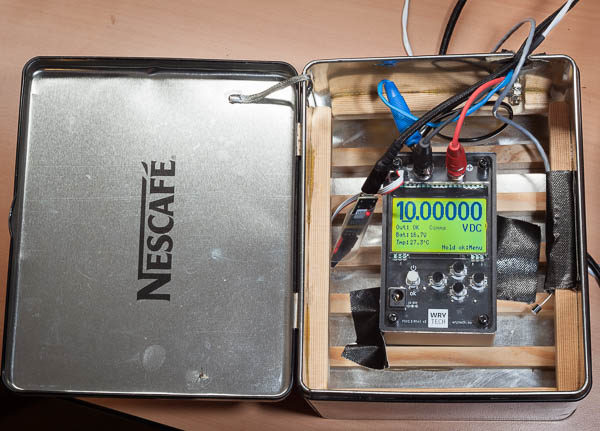

IMG_4527_PSDVS2mini_v2_tempco_setup-2000pix.jpg

The cookie tin is placed in a cool box, with a 12V Peltier element and fan. It is placed in a way that the air can flow around it, but it is shielded from direct air flow from the fan. The cabling was also shielded / isolated from the air flow, to minimise thermal voltages.
By reversing the power to the Peltier, one can also heat the contents of the cool box.
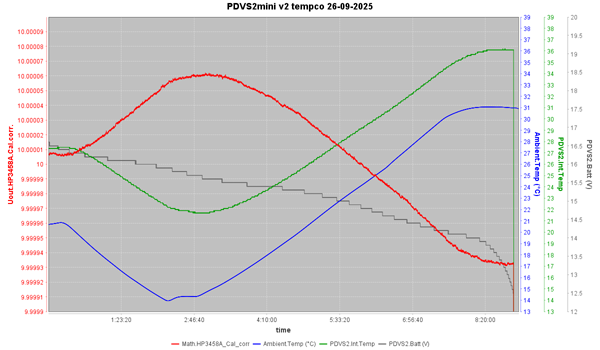

Full size graph: PDVS2mini-v2-tempco-26-09-2025-1200pix.png

Blue is the ambient temperature. After some stabilizing time, the temperature goes down to ≈ 14°C.  The temperature dwells at ≈ 14°C, to let the PDVS2mini internal temperature (and output) catch up. Then the temperature rises slowly to ≈ 31°C.  Unfortunately, by then the battery was almost empty...  So I let the temperature dwell at this temp, to get nice stable internal temp and output voltage values.
Green is the internal PDVS2mini temperature, tracking the ambient with a some delay.
Red is the resulting output voltage of the PDVS2mini v2. One vertical division is 10uV = 1ppm.

Battery intermezzo
The grey curve is the PDVS2mini v2 battery voltage. Unintended this measurement was also a battery test. The measurement started with fully charged EBL 6F22 batteries, and after 8:50 hours they were empty. Earlier then promised / expected.
So I ran capacity tests on 2 EBL 6F22 batteries, and got ≈ 450mAh. I posted test & results in the EBL 9V battery topic.

Back to tempco
Even though I could not complete my temperature sweep because of empty batteries, there is enough info to calculate tempco.

Using the boxed method I calculate a tempco  of -0,77ppm/°C related to the outside temperature.
Related to the PDVS2mini internal temperature, I got a tempco of -0,89ppm/°C

This is the same measurement, transferred to Excel:
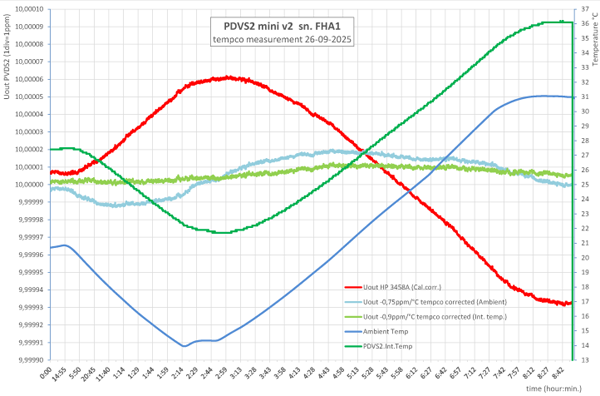

Full size graph: PDVS2mini-v2-tempco-26-09-2025-Excel-1500pix.png

Here I have added two traces, showing the PDVS2mini output voltage with the tempco calculated out of it. For each trace, I nudged the tempco figure to get as flat lines as possible.

The added light-blue trace is the PDVS2mini v2 output, with the ambient tempco calculated out of it. I found an optimum using -0,75 ppm/°C tempco.
The reason that this line is not flat is the delay between a change in ambient temperature, and the resulting output change.

The added light-green line is the PDVS2mini v2 output, with the tempco referred to the PDVS2mini internal temperature calculated out of it. This line is much flatter, because of the good coupling between internal temp and output voltage. With this correction of -0,9ppm/°C the PVDS2 mini v2 output would only deviate ±1ppm over the 15°C ….31°C temperature range!

Conclusions
The Tempco figures found with the boxed method correlate well with the figures found in the Excel graph.
My findings in the warm-up measurement were correct: my PDVS2mini v2 output is more sensitive to temperature then expected.

The bad news is that the tempco I found of -0,75 ppm/°C is much worse than the Wrytech spec of “Typically < 2 ppm across a 10K temperature change”.

The good news is that the light-green trace in the Excel graph shows that it is quite possible to calculate this tempco out in the PDVS2 mini v2 software, and removing it from the output. The temp sensor is already there.
This could be done in the next PDVS2 mini v2 firmware.....

I will run a second tempco measurement to verify my findings.

Regards, Gertjan.
« Last Edit: October 02, 2025, 06:29:20 pm by Gertjan »
 
The following users thanked this post: Mickle T., Andreas

Online IanJ

  • Supporter
  • ****
  • Posts: 2142
  • Country: scotland
  • Full time EE & Youtuber/Creator
    • IanJohnston.com
Good test. I wonder if you could make improvements though.

1. If the tin is mostly sealed the air inside will stratify, I.e. temperature layering causing issues, especially since the PDVS2mini generates heat itself.

2. If going below ambient the tin may condensate causing temperature and humidity issues.

I think changing out the tin and using a different material to barrier from direct airflow would be better.

Here's my home made test chamber, removal door same material.
I draped a thin cloth over the PDVS2mini. The peltier fans on the inside are very small so little airflow, just enough to move the air around to try and avoid gradients.

Ian
« Last Edit: October 03, 2025, 08:42:59 am by IanJ »
Ian Johnston - Original designer of the PDVS2mini || Author of WinGPIB
Website: www.ianjohnston.com
YouTube: www.youtube.com/user/IanScottJohnston, Odysee: https://odysee.com/@IanScottJohnston, Twitter(X): https://twitter.com/IanSJohnston, Github: https://github.com/Ian-Johnston?tab=repositories
 
The following users thanked this post: Gertjan

Offline Andreas

  • Super Contributor
  • ***
  • Posts: 3541
  • Country: de
Hello,

a diagram with internal temperature as x-axis would be interesting.
And also if there is a difference between ramp up vs. ramp down (to see wether there is any hysteresis).

with best regards

Andreas


Share me

Digg  Facebook  SlashDot  Delicious  Technorati  Twitter  Google  Yahoo
Smf