I am using the Adesto AT45DB321E 4MB FLASH, 512 byte pages.
For a particular project, there is a requirement to start with an erased page (all 1s) and then set individual bits down to 0. This is for optimising the 100k write endurance (in a 512 byte page, you can drop a 1 to a 0 with 512x8=8192 writes, but each bit should still see only 1 write for the purpose of reaching the 100k write endurance) and for best resilience for a power failure. The normal (with pre-erase) programming time is 15ms but the without-pre-erase programming time is 3ms.
The interface supports writing only whole bytes, and for standardisation reasons I am always writing the whole 512 byte page.
It seems to work. This test code
	static uint8_t buf[512];
                static uint8_t buf2[512];
                char buf3[20];

		for (int i=0;i<512;i++)
		{
			buf[i]=0xff;
		}
		page_write(0,buf);  // test on page 0

		page_read(0,buf2);
		sprintf(buf3,"%02x%02x%02x%02x%02x",buf2[0],buf2[1],buf2[2],buf2[3],buf2[4]);
		buf3[10]=0;
		debug_thread_printf("%s",buf3);

		buf[0]=0x00;
		buf[1]=0x80;
		buf[2]=0x01;
		buf[3]=0xaa;
		buf[4]=0x55;

		page_write_NoErase(0,buf);
		page_read(0,buf2);
		sprintf(buf3,"%02x%02x%02x%02x%02x",buf2[0],buf2[1],buf2[2],buf2[3],buf2[4]);
		debug_thread_printf("%s",buf3);

		buf[2]=0x10;
		page_write_NoErase(0,buf);
		page_read(0,buf2);
		sprintf(buf3,"%02x%02x%02x%02x%02x",buf2[0],buf2[1],buf2[2],buf2[3],buf2[4]);
		debug_thread_printf("%s",buf3);

		buf[4]=~0x40;
		page_write_NoErase(0,buf);
		page_read(0,buf2);
		sprintf(buf3,"%02x%02x%02x%02x%02x",buf2[0],buf2[1],buf2[2],buf2[3],buf2[4]);
		debug_thread_printf("%s",buf3);
produces this
ffffffffff
008001aa55
008000aa55
008000aa15
which is correct i.e. setting one '1' bit to '0' does work and does not affect other bits.
This is how one would expect FLASH/EPROM devices to work, but is it universal? The data sheet is silent on it, and states this
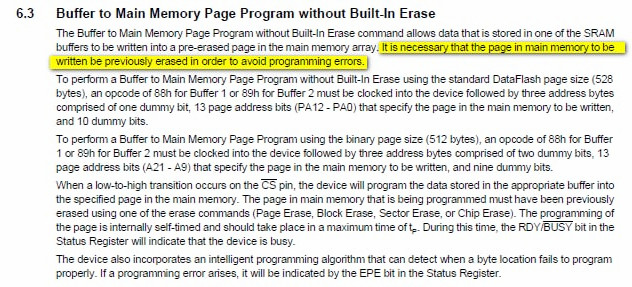
which kinda suggests this scheme is not really supposed to work.
OTOH EPROM programmers have been doing exactly this ever since we came out of the swamp

The raw access functions do allow single byte (not single bit) writing, because the address is a byte-level address and if you just write one byte and then raise CS, that starts the programming cycle after just the one byte, but I am not using that mode; 512 bytes are always written.
Any thoughts would be much appreciated.

 Home
 Help
 Search
 Login
 Register


