-
I am doing a "power down data save" feature, where ADC1 is used to measure a 5V rail (which feeds the 3.3V reg which drives the CPU etc) and if below say 4.5V it saves a 512 byte buffer into a dedicated Adesto AD45DB321 FLASH page. This page has already been pre-erased so I can use the "write without pre erase" FLASH function, which takes 3ms instead of the normal 15ms. I actually measure this programming time at 2.5ms.
The problem is that the rate at which the power disappears is a little too great. It all works superbly but it is marginal. The 3.3V falls to about 2.3V just before the 3ms is up. Well, 2.3V is the min VCC for this device
So I am looking for ways to reduce the system current, right after the FLASH write command has been issued to it.
The most obvious is to shut down the CPU. Looking around various articles and appnotes, this is actually really complicated, with so many options. Eventually I found
HAL_PWR_EnterSTANDBYMode();
which doesCode: [Select]void HAL_PWR_EnterSTANDBYMode(void)
{
/* Select Standby mode */
SET_BIT(PWR->CR, PWR_CR_PDDS);
/* Set SLEEPDEEP bit of Cortex System Control Register */
SET_BIT(SCB->SCR, ((uint32_t)SCB_SCR_SLEEPDEEP_Msk));
/* Request Wait For Interrupt */
__WFI();
}
but for some weird reason it makes little or no difference. Maybe it is taking too long?
Is there something else which needs to be done beforehand? I saw some low power modes are exited by an interrupt, which could be the problem. Is there no simple "shut down" bit? I again see various options in the RM but nothing obviously simple. The RTC and the RTC RAM need to be preserved.
-
Simple test application:
- Start up as normal
- Toggle a pin then enter standby mode
Measure the current with a shunt and the pin on an oscilloscope.
https://www.st.com/resource/en/application_note/an4365-using-stm32f4-mcu-power-modes-with-best-dynamic-efficiency-stmicroelectronics.pdf
Most likely something is waking up the micro. -
I now have the following code which - looking at the slope at which the 5V rail falls - is definitely workingCode: [Select]
		CLEAR_BIT(PWR->CSR, 0x00000100U);		// disable WKUP pin, just in case
		#define portNVIC_SYSTICK_CTRL_REG ( * ( ( volatile uint32_t * ) 0xe000e010 ) )
		portNVIC_SYSTICK_CTRL_REG = 0UL;		// stop systick, just in case
		HAL_PWR_EnterSTANDBYMode();
Interestingly it doesn't do a whole lot, but that's because I have other stuff running
The systick disable should stop the RTOS though. -
The funny thing about coding is that one can spend a day googling and finding mostly
- BS which was obviously never tested because it doesn't work
- people asking for help and getting none
- people asking for help and eventually solving it but not posting the solutions (developed in company time, etc)
- videos which are mostly dross
I posted about this also here
https://www.eevblog.com/forum/microcontrollers/32f417-any-way-to-do-a-hardware-only-adc-measurement-and-threshold-detection/msg4059118/#msg4059118
and here
https://community.st.com/s/question/0D53W00001QfVvzSAF/is-this-the-right-way-to-shut-down-a-32f417
and eventually, a little crumble at a time, one gets it working...
I've got it working (source code posted) but I still can't find a complete list of what things can terminate a standby mode ending with __WFI. I suspect some class of interrupts can. The WKUP pin can but you can disable that.
-
The CPU should stop executing instructions as soon as it hits WFI. How long it takes for the voltage regulator to ramp off I don't know, the datasheet only lists the wake-up times. I assume it's probably fairly "instant".
The resume options for standby on the STM32F4 lists, ch2.2.19 of datasheet, as (or see reference manual 5.3.6):QuoteThe device exits the Standby mode when an external reset (NRST pin), an IWDG reset, a rising edge on the WKUP pin, or an RTC alarm / wakeup / tamper /time stamp event occurs.
The standby stops all HF OSC and regulators, so no peripheral except for the RTC and IWDG are running. Disabling systick, or any other peripheral that's generating IRQs shouldn't make a difference, because it has no clock to work from.
This is different than in Idle, which only halts CPU executing instructions.
Most STM32s has different levels of stop modes (this chip only has 1 stop mode), which has intermediate variations on the level of peripherals that are stopped and/or are still accessible. For example, on some of the low power STM32L chips the deepest stop mode can be used to wake up the device on I2C address match, while in standby it is not capable of doing this.
Unfortunately since the F series is not really targetted at complicated low power operation, the datasheet does not specify a neat table which has an overview of all the power modes and peripherals that can resume it's operation. -
I am confused now. I asked a similar Q on the ST forum and the answer was
All interrupts cause wakeup, so you have to disable all those you don't want to cause wakeup. It's your program, you surely know what interrupts you have enabled. You would want to "deinitialize" (stop, disable, whatever) most of peripherals causing interrupts, before entering sleep, anyway.
Alternatively, use WFE. Events can be caused by interrupt sources which go through EXTI, see External interrupt/event line mapping subchapter of EXTI chapter in RM, as enabled in EXTI_EMR register.
Surely there must be some way to simply "kill" the CPU? Well, short of having a P channel MOSFET on the power supply
-
The conditions which wake up the CPU, depend on the power saving mode. This STM32 has 3 modes:
- Sleep: CPU stops executing instructions, but rest of the system is alive. Any IRQ will wake up the system.
- Stop: HF OSC shuts down, but voltage regulators do not. This means that only a very limited set of peripherals can generate interrupts to wake up, for example the RTC or EXTI/wake-up pins, but also in some cases more complex protocols (such as USB or Ethernet)
- Standby: HF OSC shuts down, voltage regulators shut down. All SRAM and register state is lost, except for in RTC domain. Only hard reset, RTC, IWDG, WKUP event can wake up the CPU.
(Also see Table 23 of the reference manual)
Maybe the person responding confused the sleep and standby modes. (Rant: IMO the power saving naming scheme is not really intuitive at all. For one, intuitively from reading the words I would rank "Stop" as a deeper saving state than "standby". I prefer EFM32s naming of EM0 through EM4 better, although they also started adding several "sub versions" of power saving mode)
WFI is Wait-for-interrupt, and WFE is Wait-for-event. Both are similar, but I prefer to use WFI.
I presume you're not using one of the wake-up, exti, rtc, iwdg peripherals/pins for any other purpose? If so disable them, clear flags, etc. before entering standby. I see one mention in the errata on standby, that if multiple wake-up sources in standby are enabled, it could cause an instant reset.
-
Thank you.Quote
I presume you're not using one of the wake-up, exti, rtc, iwdg peripherals/pins for any other purpose? If so disable them, clear flags, etc. before entering standby. I see one mention in the errata on standby, that if multiple wake-up sources in standby are enabled, it could cause an instant reset.
The WKUP pin (PA0) is disabled with CLEAR_BIT(PWR->CSR, 0x00000100U); It is initialised to be an input, with a pulldown.
The RTC is being used but not with interrupts.
The watchdog is on, but is set for a 1.6 second period and the FLASH write takes just 3ms.
No external pin interrupt sources.
USB and ETH are used and do use interrupts, and while I can disable USB int withCode: [Select]#define USB_CF *(volatile uint32_t*) (USB_OTG_FS_PERIPH_BASE+GAHBCFG)
USB_CF &= ~1
I am not sure how to disable the ETH one (the code is huge and I didn't implement it).
There is also Systick (which I disable)Code: [Select]#define portNVIC_SYSTICK_CTRL_REG ( * ( ( volatile uint32_t * ) 0xe000e010 ) )
portNVIC_SYSTICK_CTRL_REG = 0UL;
and TIM6 (not disabled yet but can do).QuoteOnly hard reset, RTC, IWDG, WKUP event can wake up the CPU.
In that case I must be OK. Well, assuming WKUP is PA0.
-
Another gotcha: IIRC, if you hit that __WFI() with a masked interrupt pending of *any* type, the __WFI() effectively becomes a NOP. So you have to be a bit methodical about tidying up particularly if you want to sleep *now*.
-
Does that not conflict with the post further aboveQuote
Standby: HF OSC shuts down, voltage regulators shut down. All SRAM and register state is lost, except for in RTC domain. Only hard reset, RTC, IWDG, WKUP event can wake up the CPU.
AIUI, the __WFI is never executed.
The code sequence I have isCode: [Select]SET_BIT(PWR->CR, PWR_CR_PDDS); // select standby mode
SET_BIT(SCB->SCR, ((uint32_t)SCB_SCR_SLEEPDEEP_Msk)); // Set SLEEPDEEP bit
__WFI();
Why is this so complicated? There seems to be no clear description of a procedure to simply shut down the CPU. If you google for it, you get hundreds of hits of people trying to work it out.
I have put in some GPIO waggle code in various places:Code: [Select]
CLEAR_BIT(PWR->CSR, 0x00000100U); // disable WKUP pin, just in case
SET_BIT(PWR->CR, PWR_CR_PDDS); // select standby mode
TopLED(true); // this pulse comes out
TopLED(false);
TopLED(true); // this pulse comes out
TopLED(false);
SET_BIT(SCB->SCR, ((uint32_t)SCB_SCR_SLEEPDEEP_Msk)); // Set SLEEPDEEP bit
TopLED(true); // this pulse comes out, and DAC outputs are seen floating at this point
TopLED(false);
TopLED(true); // this pulse doesn't come out
TopLED(false);
__WFI // this is obviously never reached
Clearly it takes many CPU clocks to execute the deep sleep selection. This doesn't matter; it's just interesting. But if the main oscillator stops, there is no point in disabling Systick, is there And you can't possibly get any internal interrupts. Which confirms the quoted text above is probably spot on.
However, then I did another test:Code: [Select]
SET_BIT(SCB->SCR, ((uint32_t)SCB_SCR_SLEEPDEEP_Msk)); // Set SLEEPDEEP bit
__WFI();
TopLED(true); // this pulse doesn't come out
TopLED(false);
I suspected that due to the long delay after setting the deep sleep bit, the __WFI does get executed, but that last pulse does not come out, so presumably the __WFI blocked execution.
More tests show that __WFI is required; the sleep bit does nothing otherwise. And no instructions get executed after __WFI; checked with thisCode: [Select]
__WFI();
TopLED(true);
TopLED(false);Quoteif you hit that __WFI() with a masked interrupt pending of *any* type, the __WFI() effectively becomes a NOP
It doesn't appear to be as simple; I have not disabled e.g. a TIM6 1kHz interrupt, but it does not terminate the Standby mode. Perhaps you mean if one executes __WFI and at that instant there is an interrupt pending, the __WFI is skipped. But how could one avoid that? If I clear all "IP" bits (lots of them around) there is no guarantee that one of them won't get set when I then execute the __WFI. One would have to disable all interrupts individually, clear the IP bits, and wait a bit. Is that really the procedure?? -
"Masked" interrupt could be where an interrupt still occurs, even if the handler is disabled.
For example, on PIC32MX the DMA controller is triggered by peripheral interrupts instead of dedicated DMA events. This means that the peripheral is firing interrupts to the CPU/DMA, but that the interrupt handler is not enabled and so the CPU won't react on it. The data is handled by the DMA controller and should clear the interrupt condition.
I suppose that's what bugnate means with pending unhandled IRQs that could block the CPU entering power saving mode. Unfortunately it's impossible to tell how exactly the power saving works. All we observe is Run > Standby in 1 step, but for all we know the CPU executes a statemachine that goes through Run > Sleep > Stop > Standby steps over multiple cycles..
Power saving code on MCUs can be quite tricky to get right. Before you know, something can stay left on, or incorrect wake intervals (or it doesn't wake up anymore).
Perhaps something to check if it helps:
Go to the NVIC and clear all pending IRQ vectors.
Go to the RCC bits and turn off all peripherals.
By the way, do you also observe current measurements of your system? A 168MHz CPU going to effectively a shutdown state should show some difference in power state of the system. Perhaps that's a way to know if it's working (plotting current vs sleep trigger on o'scope could also be useful). -
Another gotcha: IIRC, if you hit that __WFI() with a masked interrupt pending of *any* type, the __WFI() effectively becomes a NOP.
What do you exactly mean by "masked"?
JW -
Quote
Go to the NVIC and clear all pending IRQ vectors.
Go to the RCC bits and turn off all peripherals.
One could do that, but
- I haven't seen it mentioned anywhere
- it just seems bizzare that such a weird thing would really be neededQuotedo you also observe current measurements of your system? A 168MHz CPU going to effectively a shutdown state should show some difference in power state of the system. Perhaps that's a way to know if it's working (plotting current vs sleep trigger on o'scope could also be useful).
I don't do Icc measurement directly but I can see it from the slope of the VCC decline, and yes the CPU is going to "sleep". What concerns me is the reliability of this whole thing.
If this "__WFI becomes a NOP if there an int pending" is real, one could do
__WFI
__WFI
which indeed is seen in some code relating to __WFE. That would deal with the case where an int is pending but at the time of __WFI execution has not yet generated the vectoring to the ISR (is that even possible - I mean is it even possible for foreground code to "see" an IP bit set, assuming the interrupt is not prevented from executing?).
However, more tricky would be an int pending because a higher priority int is blocking it. That could be a long time. For example in my system I have a USB interrupt which is disabled around some foreground code, for either ~200us (if reading the USB drive) or ~15ms (if writing the USB drive). The latter case I don't need to deal with because the power fail data save will fail anyway (the 3.3V dies well before 15ms). The former case could be dealt with by
__WFI
wait 300us
__WFI
Anyway, this is the end result so far, which is satisfactory. I just need to be sure that the CPU won't come out of Standby under some rare circumstances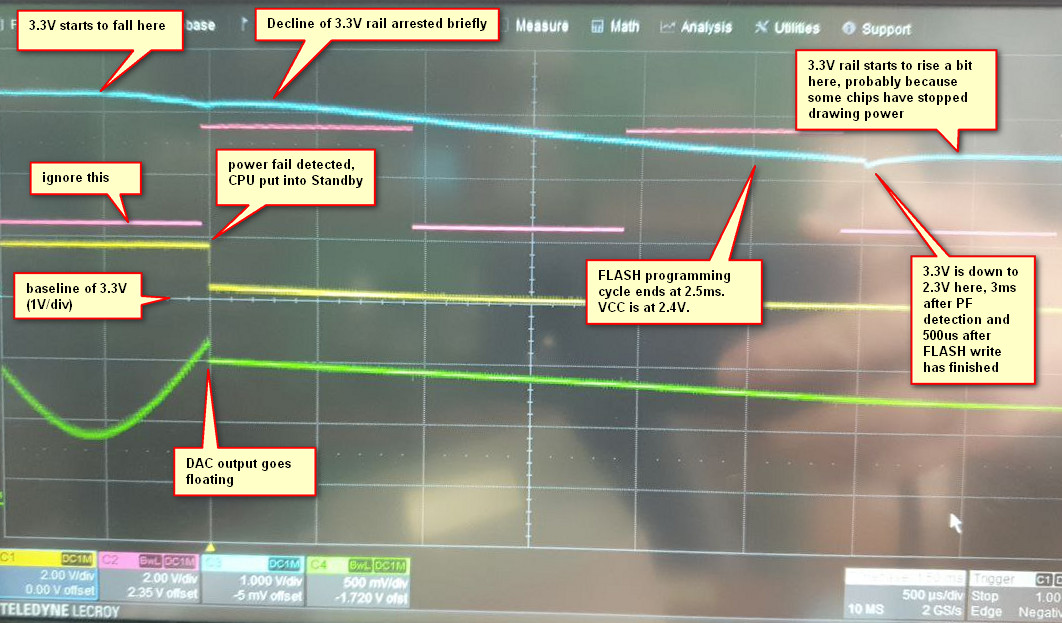 Code: [Select]
// Enter CPU standby mode. Some is out of HAL_PWR_EnterSTANDBYMode().
CLEAR_BIT(PWR->CSR, 0x00000100U); // disable WKUP pin, just in case
SET_BIT(PWR->CR, PWR_CR_PDDS);			// select standby mode
SET_BIT(SCB->SCR, ((uint32_t)SCB_SCR_SLEEPDEEP_Msk));	// Set SLEEPDEEP bit
__WFI();
// CPU clock stops, DAC outputs float, etc
// ** Code after this point is not executed (checked by waggling GPIO) **
hang_around_us(500);
__WFI(); // 2nd one to handle some weird cases
// Should never get here, but if we did, we want to start with a freshly
// initialised unit
reboot(); -
Quote
satisfactory
But is it?
How's this 3 ms time guaranteed?
I don't know the details of you system, but what if electrolytic caps degrade with time and or temperature? Or the input to the PSU is at a lower than expected voltage so they hold less available charge? And this are just the first two things that came to mind, there might of course be many others.
A 16% margin seems very tight, especially considering the datasheet gives 3-4 ms for a page write operation. -
Check the 3.3V rail on the scope pic. It remains above 2.3V for plenty long enough.
All relevant caps are ceramics.
My main concern is whether the Standby is being done the right way.
-
All relevant caps are ceramics.
Which lose significant amount of capacitance due to aging, easily 20-30%.
Add to that unit-to-unit variation which can be also around 20%.
This is far from satisfactory. I would consider doubling the amount of capacitance. -
I can easily add capacitors But what you can't see on the above trace is how long the VCC remains above 2.3V. It is a long time... because everything else has died. Also the above pic is from pulling out the USB cable, which kills the 5V rail almost instantly and the 3.3V rail starts to drop within ~100us of that. In normal circumstances the "power failure" will be a loss of 24V DC input to a switch mode PSU which generates its outputs down to about 10V DC in. The USB power option is really just for mucking about on the bench, config after the box was opened, etc. Parts of the product are non-functional with just USB power, for complicated reasons. And if I want to do a better power fail detect off the DC IN (which is isolated, btw) I can do that with a $0.10 optoisolator and then I will have ~100ms warning.
Another thing I can do, to gain 1ms, is not poll the ADC on the 1kHz tick but use the window ADC feature to interrupt (see other thread here). That is a "slicker" method but not without some trickery to prevent a barrage of interrupts.
I am still looking for input on the Standby code, on which no two people agree - here or elsewhere
-
Quote
if you hit that __WFI() with a masked interrupt pending of *any* type, the __WFI() effectively becomes a NOP
It doesn't appear to be as simple; I have not disabled e.g. a TIM6 1kHz interrupt, but it does not terminate the Standby mode. Perhaps you mean if one executes __WFI and at that instant there is an interrupt pending, the __WFI is skipped. But how could one avoid that? If I clear all "IP" bits (lots of them around) there is no guarantee that one of them won't get set when I then execute the __WFI. One would have to disable all interrupts individually, clear the IP bits, and wait a bit. Is that really the procedure??
I meant the latter. A non-wakeup event (where a wakeup event is from the RM table 23) cannot terminate a standby mode, but it can prevent one (the NOP thing) if it comes at a bad time and other conditions are ripe. "Bad time" could be if the interrupt is masked or it happens in some vulnerable moment in the process of going to standby, which you have discovered takes non-zero time. (I don't have any insight on that particular bit and I don't use standby, I'm more of a Stop mode guy).
I don't think the procedure is quite as gruesome as you list, but yeah it's something like that. That is async for you. Of course the sensible thing to do is to live with it and write some code to check that the expected sleep occurred (you have the RTC after all) and try again if something spurious happened. But if you need a guarantee that you will go to standby on that exact cycle, you are in for a bit of a bad time (and strictly speaking, 100.0% may not be possible). Honestly in that case I'd think about working a NVIC_SystemReset() in there before sleeping to help with cleaning the slate.
By "masked" I lazily meant PRIMASK / __disable_irq() but with an interrupt pending bit set in the NVIC. I did not mean merely having the source enabled. -
Quote
Honestly in that case I'd think about working a NVIC_SystemReset() in there before sleeping to help with cleaning the slate.
That's a really interesting approach.
Set a "Standby required" flag in RAM and reboot the CPU, with thisCode: [Select]static inline void reboot(void)
{
// Ensure all outstanding memory accesses including buffered write are completed before reset
__ASM volatile ("dsb 0xF":::"memory");
// Keep priority group unchanged
SCB->AIRCR = (uint32_t)((0x5FAUL << SCB_AIRCR_VECTKEY_Pos) |
(SCB->AIRCR & SCB_AIRCR_PRIGROUP_Msk) |
SCB_AIRCR_SYSRESETREQ_Msk );
__ASM volatile ("dsb 0xF":::"memory");
// wait until reset
for(;;)
{
__NOP();
}
}
and then you know there won't be any interrupts pending.
Where in the RM does it say that a __WFI is skipped if there is an int pending? This is a 32F417.
EDIT: found it
page 127 RM.
This is a bugger! Looking for simple ways around this, one could put __WFI in a loop so if it gets skipped a few times, eventually a __WFI will get executed properly.
Just realised that NVIC_SystemReset() is my Reboot code above. -
Where in the RM does it say that a __WFI is skipped if there is an int pending? This is a 32F417.
I saw the edit where you already found it, but FYI the reference for this sort of thing is the processor / architecture manual and not the SoC RM, although I guess it did have it after all, and in clear language.
Also see attachment from page 562 of Arm®v7-M Architecture Reference Manual. Note than an interrupt is a type of exception.
Also see this guy saying basically the same thing: https://stackoverflow.com/questions/46934649/arm-wfi-wont-sleep
-
Amazing, because in your page above it states

which is the conclusion I came to also. If the 1st __WFI gets skipped, eventually you will hit one which works.
Completely bizzare.
Fortunately I have an easy job here, because I need the CPU to shut down for only a few ms, after which I don't care.
So now I have thisCode: [Select]CLEAR_BIT(PWR->CSR, 0x00000100U); // disable WKUP pin, just in case
SET_BIT(PWR->CR, PWR_CR_PDDS); // select standby mode
SET_BIT(SCB->SCR, ((uint32_t)SCB_SCR_SLEEPDEEP_Msk)); // Set SLEEPDEEP bit
__WFI(); // This actually does the "shutdown"
// CPU clock stops, DAC outputs float, etc
// ** Code after this point is not executed (checked by waggling GPIO) **
// But sometimes __WFI can fail - if e.g. there is an interrupt pending
// e.g. USB serial FLASH read interrupt can be blocked for 200-300us.
hang_around_us(500); // wait for a bit longer than a FLASH read
for (uint32_t i=0; i<100000; i++)
{
__WFI();
}
// Should never get here, but if we did, we want to start with a freshly
// initialised unit
reboot(); -
Amazing, because in your page above it states
I think that is a mis-interpretation. I read it as 'the WFI instruction may not be implemented in all hardware'. Remember that ARM delivers a CPU core with options that can be enabled / disabled. If you write universal software that is supposed to run on different ARM implementations, you may encounter systems that do not implement WFI. The scope of the ARM documentation is very wide; you should overlay the documentation of the microcontroller manufacturer to figure out what is actually implemented.
which is the conclusion I came to also. If the 1st __WFI gets skipped, eventually you will hit one which works.
For a microcontroller which has a working WFI instruction the way to use WFI is to disable / clear any interrupt sources, execute a few NOPs (3 or so) to make sure all pending interrupts (from before disabling the interrupts) are handled and then execute the WFI instruction.
-
Did more work on this today and gained another 2ms "early warning". There was a too-slow lowpass filter on the ADC used to measure the 5V rail
 So a lot more margin.
That rail already has a 470uF capacitor on it, plus a load of ceramics, and looking at the rate of fall on powerdown, it corresponds to a current draw of about 150mA after CPU shutdown.
Disconnecting the debugger (which is isolated so target-powered - STLINK V3 ISOL) also helps. Maybe 20mA or so.
I think I need to look at shutting down ETH but I don't know how to. Removing the cable reduces the 150mA to 100mA. I am using the reduced interface, to a LAN8742, but the whole ETH subsystem was implemented by someone else and is a mystery to me. There is stuff like HAL_ETH_MspDeInit() but it seems to be empty. It is just the LAN8742 which needs doing because the CPU will be shut down. Looks like TE and RE bits in MACCR. This led me to thisCode: [Select]/**
* @brief Disables the MAC transmission.
* @param heth pointer to a ETH_HandleTypeDef structure that contains
* the configuration information for ETHERNET module
* @retval None
*/
static void ETH_MACTransmissionDisable(ETH_HandleTypeDef *heth)
{
__IO uint32_t tmpreg1 = 0U;
/* Disable the MAC transmission */
(heth->Instance)->MACCR &= ~ETH_MACCR_TE;
/* Wait until the write operation will be taken into account:
at least four TX_CLK/RX_CLK clock cycles */
tmpreg1 = (heth->Instance)->MACCR;
ETH_Delay(ETH_REG_WRITE_DELAY);
(heth->Instance)->MACCR = tmpreg1;
}
which has a mysterious delay of 1ms which is completely useless. Are MACCR values pushed out to the LAN8742 at 2400 baud?
I tried the obvious; no effect
ETH->MACCR = 0x00008000;
but the above code snippet shows one has to then read back MACCR and write it back in after that long delay. 1ms is way too long for my purpose.
I can see there is some sort of "USART" link along which this stuff gets sent. The 8742 data sheet describes the registers. 2 wires: data and clock. Its "SMI timing" shows a max clock of ~2MHz.
Anyway, stepping through the ETH init code, I find that the clock field in ETH->MACMIIAR is set to 100 which with a 168MHz clock is a MDC clock of ~1.6MHz, which is fine. So I reckon the comment in the above ST code above the 1ms delay is BS. And nobody ever discovered it...
I guess to do this fast, you need a MOSFET to turn the supply to various things.
Looks like I will have to settle for this
-
Quote
mysterious delay
It's not too mysterious if one reads the errata, chapter 2.11.5.
Agreed, using HAL_Delay is a waste of time, they should have provided a tailored busy wait.
(Also: marked the HAL code as part of an errata!)