-
Well I did move the 7A13 to my 7603 because the screen is bigger than the 7613.
And I fed it a 26MHz 4Vpp signal, because at 1KHz you have all the time to sample that. Also because the only FG I have (Tek FG504) gave up it's magic smoke and my attempts to fix it have not succeeded yet. (Back plane transistor failed taking out who knows what on the module, fixed the backplane and replaced a on board fuse and more smoke came from somewhere else)
Anyways, the 7A13 had no trouble at all with the 26MHz signal, I even use the x10 magnification on the time base to look at the signal in detail with 5ns divisions. Probe is still a x10 probe so the voltage divider is set at 100mV and the signal is AC coupled.
Looks good, so I took the probe bnc and attached it to the Rigol, but to make things fair I did set it to 100MHz bandwidth limit.
The signal looks very similar, other than the Rigol starts with a sharper rising edge and a sharper falling edge, other than that, pretty close, if you don't take into account the extra 4 horizontal divisions and that the Rigol can still go to 2ns and 1ns per division.
So I took the bandwidth limit off and I see closer to the square wave I'm expecting from the 26MHz OCXO.
I know, they do make mainframes and modules that can go to a higher time base but the 7A13 is limited to 100MHz and the 7A22 which is nice that it can do 10uV per division, but is limited to 1MHz.
But then again at 10uV, 1 us per division should be plenty.
Btw I'll receive a 7A22 sometime this coming week since I did purchase it a few days ago along with a couple of dual trace amplifiers. Got all three for $12 a pop including shipping Only thing is that the 7A22 is missing the pull tab.
-
SOME of the old analog scopes definitely have nice to have features but how many analog scopes out there you can find with 10uV/div sensitivity?
This side of the pond ie. tek 7000 is nearly impossible to find, I have yet to see mainframe scope in their natural habitat. Your situation in US might be better.
Back then I had to use external preamp with my analog tek 475 and still have to use external preamp with my current DSO.
I got a 7613 for under $50 and extra modules for about $12 a pop shipped and I already had a 7603. Nobody seems to want them because they are heavy and bulky and unless you find one locally it would be too expensive to ship.
The thing is that I don't know how usefull 10uV/div is at just 1MHz, but I guess I'll find out since I have a 7A22 heading my way.
Btw, my plan for the 7613 (rackmount) is to get it all nice and calibrated and giving it away to the local hackerspace. (That is if they want it, if they don't I'll see what I do with it). But I'm keeping the 7603 and of course the best modules.
-
unless you find one locally it would be too expensive to ship.
This. Last time I checked the shipping to europe would have been something like 600 USD
Vertical amplifiers would be small enough for transport if there is a reasonably easy hack to use them on the dreaded DSO's -
Blimey, a bloke asks about buying an old Ford Cortina, which will do the job ok providing he can wield an oil can and a set of spanners and we get pages of discussion about the various merits of a Ford RS200 vs a Toyota GT86
-
But one thing is for sure, my DSO is lying to me on the BW limiting to 100MHz because it seems it's only filtering part of the signal.
I do like both analog and digital scopes but I have no need for just an analog one because most of the things I do require time precision and memory to see all those fast bits going by on current protocols. No Ethernet nor USB yet and for that maybe an analog scope will be better than an expensive DSO that can do a good eye diagram, I know mine is slow as molasses for that task.
So here are some pictures merging both technologies and that shows my DSO is not filtering the signal:
Sorry they are not 100% squared because I didn't want to take time correcting for the angle of the 7603 picture, but it's close enough, and the truth is not in between those signals
-
Check for shorted dipped tantalum capacitors in that FG504. Tek gear from that era was notorious for using short prone tantalum capacitors (those blue blobs that short can get hot and surprise).
About 100Mhz is pretty what the 7600 series will do The attraction of the 7603 is CRT display size. Using a wider BW plug-in will not increase the effective overall system BW. A 7603 or 7633 or 7623 makes a nice host for the 7A13, 7A22, 7A18 with the 7B53A dual time base. These also work well with the sampling, TDR, logic analyzer, digitizing vertical and spectrum analyzer plug ins. It's limitations is BW. IMO the ideal 7000 series is the 7904A and 7104 or if dual beam is needed 7844.
Careful if the pull tab is missing, that is the locking latch. If it is missing and the plug in is installed into a MF, it can get stuck and not fun to remove. Replace the pull tab, make a similar pull tab in place of the original or remove the locking latch parts and spring on the bottom of the plug-in.
If the dual trace verticals have what appears to be intermittent attenuators, I have the cure. The cure is not cleaning the switches alone. Let me know.
BerniceWell I did move the 7A13 to my 7603 because the screen is bigger than the 7613.
And I fed it a 26MHz 4Vpp signal, because at 1KHz you have all the time to sample that. Also because the only FG I have (Tek FG504) gave up it's magic smoke and my attempts to fix it have not succeeded yet. (Back plane transistor failed taking out who knows what on the module, fixed the backplane and replaced a on board fuse and more smoke came from somewhere else)
I know, they do make mainframes and modules that can go to a higher time base but the 7A13 is limited to 100MHz and the 7A22 which is nice that it can do 10uV per division, but is limited to 1MHz.
But then again at 10uV, 1 us per division should be plenty.
Btw I'll receive a 7A22 sometime this coming week since I did purchase it a few days ago along with a couple of dual trace amplifiers. Got all three for $12 a pop including shipping Only thing is that the 7A22 is missing the pull tab. -
Don't hack up a 7A22 just to be used with a DSO (DSO's are NOT dreaded, they have their place and are invaluable for specific measurement needs) get a Tek AM502 for use in a TM500 main frame. These have the same identical innards as the 7A22, 1A7A, 5A22N except configured to be used as a stand alone amplifier.
http://w140.com/tekwiki/wiki/AM502
These have much the same performance and relevant features as the Stanford Research Instruments SR560.
http://www.thinksrs.com/products/SR560.htm
The Tek AM502 has adjustable DC offset the SR560 does not, it has more filter options as feature fillers IMO.
Bernice
Vertical amplifiers would be small enough for transport if there is a reasonably easy hack to use them on the dreaded DSO's -
The DSO is not quite "lying", it is more the, "Mr. Gibbs" effect. Information systems that reconstruct information from points of data will need to have these points of data connected in some way (filtering) to re-construct the the information that was acquired. Once the BW is limited in these systems, the Gibbs phenomenon becomes reality and becomes more pronounced when the required information to be reconstructed approaches the Nyquist limit (two samples). For DSO's that have plenty of reserve BW, they can be tailored to deliver Gaussian response at the trade off of absolute BW capability. This is why DSO's can "lie" and true Gaussian response analog CRT O'scopes do not have this issue. In the case of this Rigol DSO, some one in the design process had to decide and make a choice between BW limit and displayed response. With the BW limit on, the Mr. Gibbs ears appear on the trailing edge of the step response and the leading edge is not quite Gaussian response.
The BW limited images with notes:
The full BW image with notes. The near identical match of sweep linearity between the analog Tek and Digital Rigol says much about how good the sweep generator is in the 7B53A as they are near identical in length and overall linearity. Mr. Gibbs is clearly visible on the leading and falling edges of the DSO trace. Does this matter, it depends. For doing digital stuff where timing precision matters, measurement ease and features are key, those Gibb ears often make NO significant difference at all. For high speed, wide BW analog designs, it can be a serious limitation rendering this DSO mostly useless as it would be extremely difficult to know if the Gibb ears are adding or subtracting from or to the DUT's actual response. Beyond this, user must be be extremely aware if the aberrations are test set up related, instrumentation issues or meaningful information.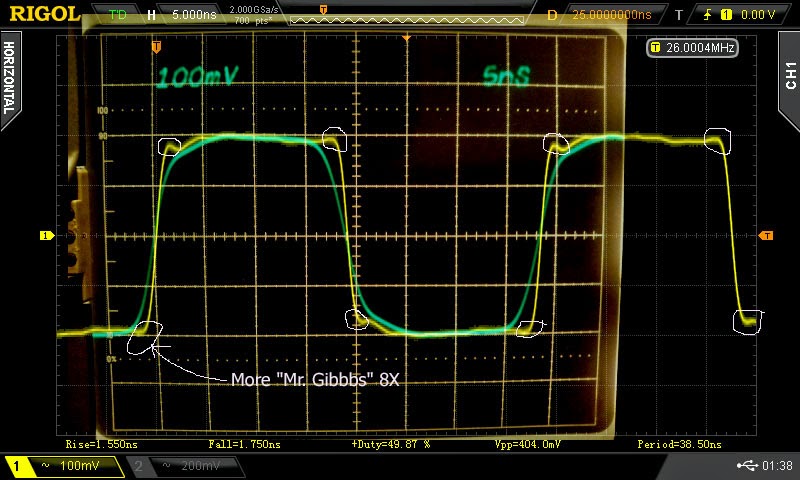
This is a 10mV, 25Mhz step (square wave) from a Tek 2101 pulse generator to the Tek 7104, 7A29 & 7B10 with proper cables and terminations . This system offers 1Ghz real time true Gaussian response. Note the symmetry of the step response up/down and low noise even at 10mV/Div.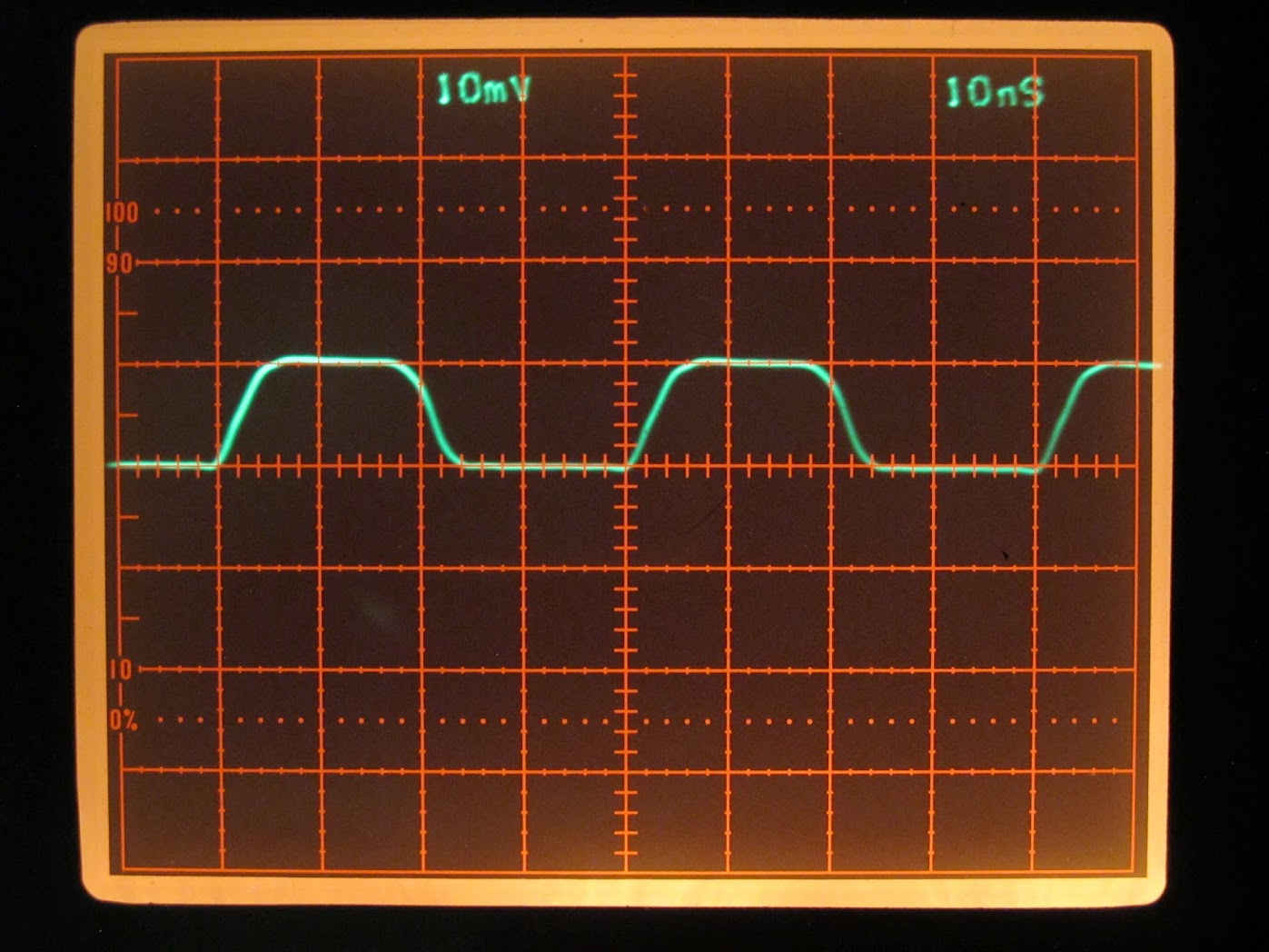
On the Tek 7603 image, that bump at the top of the step response could be due to probe reflections or other test set up related.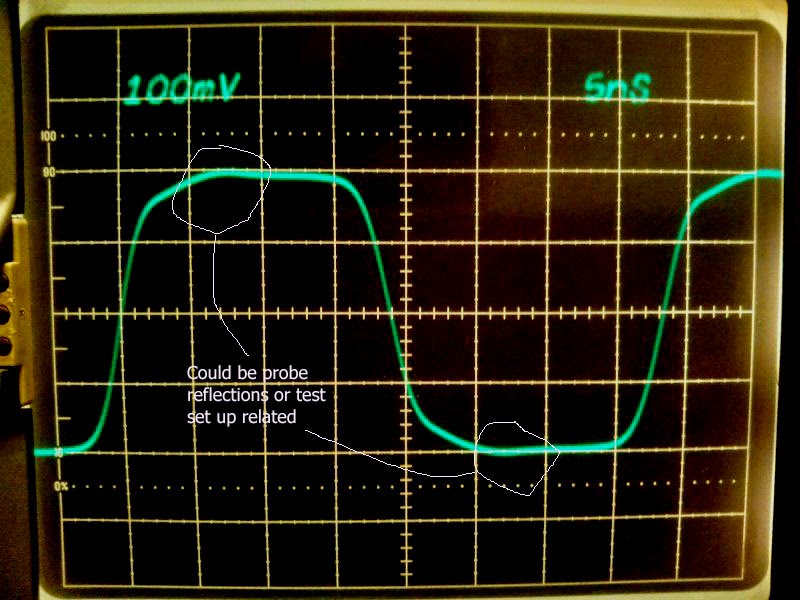
BerniceBut one thing is for sure, my DSO is lying to me on the BW limiting to 100MHz because it seems it's only filtering part of the signal.
I do like both analog and digital scopes but I have no need for just an analog one because most of the things I do require time precision and memory to see all those fast bits going by on current protocols. No Ethernet nor USB yet and for that maybe an analog scope will be better than an expensive DSO that can do a good eye diagram, I know mine is slow as molasses for that task.
So here are some pictures merging both technologies and that shows my DSO is not filtering the signal:
Sorry they are not 100% squared because I didn't want to take time correcting for the angle of the 7603 picture, but it's close enough, and the truth is not in between those signals -
Great stuff Bernice. Thank you!
No longer will I think of that guy from Pirates of the Caribbean when I hear "Mr Gibbs" -
7A22, 1Mhz, 10uV not just for audio.
*Electro-mechanical systems.
*HUGE array of sensors from microphones, hydrophones, optical sensors, vibration sensors and...
*Thermocouple effects including their time constants.
*Current sensing resistor testing.
*Dielectric testing of materials.
*Biological-electical phenomena.
*Chemical-elecrical phenomena.
*Power supply noise and regulation testing.
*Low noise amplifier design.
*Charge pump design.
*Frequency discriminator design.
And a whole lot more limited by imagination, creativity and a deep understanding of how to apply an instrument with these capabilities. Beyond all that, the specific measurement needs and how to gain accurate and useful information about the DUT becomes what matters.
Bernice
BW ?
Not much beyond audio. -
With an external amplifier you can do the same low level stuff with a DSO. And since most have FFT and other goodies life is much easier when using a DSO.
It's great you are enthousiastic about your analog scope. IMHO the modular system Tektronix offered in the past where a great way to turn a mainframe into a versatile tool. Nowadays most of the useful features are integrated into a DSO. For example: I wouldn't want to live without cursors which tell me the time difference, frequency and amplitude of a signal as a number. -
Check for shorted dipped tantalum capacitors in that FG504. Tek gear from that era was notorious for using short prone tantalum capacitors (those blue blobs that short can get hot and surprise).
Thanks I might get around fixing it, it's a pretty good FG, and the TM503 is not a monster size-wise.About 100Mhz is pretty what the 7600 series will do The attraction of the 7603 is CRT display size. Using a wider BW plug-in will not increase the effective overall system BW. A 7603 or 7633 or 7623 makes a nice host for the 7A13, 7A22, 7A18 with the 7B53A dual time base. These also work well with the sampling, TDR, logic analyzer, digitizing vertical and spectrum analyzer plug ins. It's limitations is BW. IMO the ideal 7000 series is the 7904A and 7104 or if dual beam is needed 7844.
It is what I have, a 7603 that had a busted dual trace that I just repaired:
https://www.eevblog.com/forum/repair/repairing-tektronix-7603-oscilloscope/
And a 7613 that I just got at auction last week (with a 5110) that were in pretty bad shape:
But I just finished cleaning them:
My purpose for the 7613 is to donate it to the local hackerspace, I still need to calibrate it and decide what modules to give with it.
The 7603 I'm keeping
The 5110 will go to the hackerspace as well as soon as I find a time base module for it. As I got it, it has an amplifier (2MHz) driving the horizontal. No idea how they where using this thing without a time base module, it doesn't work that great as an X-Y low frequency tracer. I mean it does work somewhat but it's a weird configuration how it came.
That would be good for Audio or to use it as an X-Y display or a curve tracer. The display is pretty nice and big.Careful if the pull tab is missing, that is the locking latch. If it is missing and the plug in is installed into a MF, it can get stuck and not fun to remove. Replace the pull tab, make a similar pull tab in place of the original or remove the locking latch parts and spring on the bottom of the plug-in.
I have long pair of straight and narrow tweezers that can reach the release button via the pull tab hole and press it up to release, but I have an extra 7A15A module that I'm using the tab that it had on modules that don't have a tab.
Found tabs online but not with the pin or the spring, maybe I'll ask a friend to 3d print some for me, or make a mold and make some copies.If the dual trace verticals have what appears to be intermittent attenuators, I have the cure. The cure is not cleaning the switches alone. Let me know.
Bernice
Well, not sure about the dual trace verticals, but the 7613 intensity readout is intermittent. It mostly works but the readouts disappear when I'm changing the intensity.
The dual trace amps should be here sometime this week, probably tomorrow. I also got a 7D15 225MHz Universal Counter/Timer that I got from ebay and that will arrive sometime this week as well.
Don't get me wrong, I love old gear, and so far I did spend $160 on the 7613 and the 5110 with 7 modules, on top of the 3 that the 7613 came with and the 2 the 5110 has.
But the only reason I'm getting this is to help a bit the community a bit and because I hate equipment go to waste when it's pretty useful still.
-
7A22, 1Mhz, 10uV not just for audio.
He was not referring to the 7A22 but his 70 year old valve Philips Analog Scope:
https://www.eevblog.com/forum/testgear/my-first-oscilloscope/msg644542/#msg644542
-
The full BW image with notes. The near identical match of sweep linearity between the analog Tek and Digital Rigol says much about how good the sweep generator is in the 7B53A as they are near identical in length and overall linearity.
I'll take some of the credit for calibrating the 7B53A and adjusting the gain of the 7A13 to match the Rigol and my DMM
But yeah, they match because I used the Rigol as the reference since I don't have other references (yet).
-
Great stuff Bernice. Thank you!
No longer will I think of that guy from Pirates of the Caribbean when I hear "Mr Gibbs"
And I agree, great information!
My oscillator was 4 Vpp same probe on both readings x10 Rigol probe with ground spring, distance on the OCXO between the signal and ground was 0.4 mils (4 breadboard holes)
The OCXO is a Vectron OCO700-13B 26.000MHz powered by an HP E3615A set at 4V 0.65A current limit and my DMM UT71B was reading 4.04V out of the PS, same reading as the Rigol at full bandwidth.
At 100MHz BW limit the Rigol was showing 4Vpp so I adjusted the 7613 to match it.
-
Simple, easy test to try with the 7A13, power supply testing.
*Put a 10x (compensated to the 7A13's input) or 1X probe to the + input of the 7A13.
*Ready a power supple for test, note it's voltage to be tested.
*Set the Volts/Div on the 7A13 to two or so Volts/Div of the power supply's output voltage.
*Set the trace to a reference line using the 7A13 vertical position knob. There is a button in the center of the vertical position knob that puts both inputs to zero. Depress this button and set the trace to a reference line position.
*Select DC coupling on the +input for the input probe.
*Set the comparator voltage control to zero.
*Select Vc for the -input.
*Connect the probe to the power supply output. This should cause the trace to move to the power supply output voltage.
*Adjust the reference voltage control (+/- switch to + for positive volts to be measured) to offset the trace back to the reference line position.
*Increase the vertical sensitivity per division using the volts/div knob.
*Adjust the reference voltage control to offset the input's test voltage to a high a sensitivity as required.
*Further 10X magnification can be had by pulling on the red center knob of the volts/div switch. Doing this increased the voltage comparator volts by 10X. There is a mechanical stop at 10mV when the red knob is pulled.
The voltage reference display decimal point will move/scale depending on the volts/div setting and if the red center knob is pulled out.
*If the noise becomes excessive apply the 5Mhz BW limiter.
*When the desired sensitivity and display configuration is reached, the small changes in power supply voltage and it's regulation response will be easily visible along with all the stuff living on the power supply's output.
*If the power mains is on a variac, wiggle the power mains voltage up/down to see how well it regulates line-load.
Why all this instead of simple using AC coupling at the input, using the 7A13's voltage comparator feature is allows precision measurements of power supply regulation, noise and related. This is the same measurement capability as the LeCroy-Teledyne-Preamble 1855 diff amplifier add on at a small fraction of it's cost. The 7A2s is capable of this same test without the precision voltage reference.
There is a test request.
Would it be possible to connect one of the 7A13's input to the input of the Rigol's input to look for A/D switching and related digital switching noise coming out of the DSO's input?
Bernice
I got a 7613 for under $50 and extra modules for about $12 a pop shipped and I already had a 7603. Nobody seems to want them because they are heavy and bulky and unless you find one locally it would be too expensive to ship.
The thing is that I don't know how usefull 10uV/div is at just 1MHz, but I guess I'll find out since I have a 7A22 heading my way.
Btw, my plan for the 7613 (rackmount) is to get it all nice and calibrated and giving it away to the local hackerspace. (That is if they want it, if they don't I'll see what I do with it). But I'm keeping the 7603 and of course the best modules.
-
That worked a treat, so as long as my UNI-T is calibrated right I have the 7A13 agreeing with it, the HP E3615A is out of cal according to the Rigol and the UNI-T so I should calibrate it one of these days.
There is a test request.
Would it be possible to connect one of the 7A13's input to the input of the Rigol's input to look for A/D switching and related digital switching noise coming out of the DSO's input?
Bernice
Do I have to terminate them both? at the moment I can only find a single 50 Ohm terminator.
But if not I see nothing if I connect both inputs together with a 4ft coax, what am I expected to see? and do I have to do anything else other than just hooking both up together?
-
How much "stuff" was found on that power supply under test and how good was it's regulation?
This why the LeCroy-Teledyne_Premable diff amplifier add on is made today, for test like this. To think having this identical test capability for $20 USD? not too bad eh..
There are a LOT more test that can be done with the 7A13. Do make up a set of matched probes for it. The probes will need to be attenuation matched and frequency response matched and probe length matched. The goal is to preserve as much of the common mode performance at the 7A13's input connectors? Once the matched set of probes are found (shorter probe cable length is better if possible), make up a equal length of sizable copper braid for a ground strap with a banana plug on one end and a nice stout copper clip on the other end. Tie wrap all three together as a single bundle with the smallest grouping that fits at the 7A13 input connectors and the smallest reasonable grouping (about 6" probe spread or less if possible) at the probe end. This is done to help reduce field pick up and help preserve CMMR. Clip the ground strap to the DUT chassis ground and/or tie the probe ground leads together or keep them separate depending on what is needed for a specific test set up. Compensate each probe individually, then tie the probes together and drive them common mode. Tweak one of the probes to balance out CMMR as much as reasonable, It will never be ideal, but can be quite good.
No 50 ohm termination initially for that test. If switch noise or etc is found, then try adding the 50 ohm termination to see if there is any difference. Run the volts/div to 1mV at full BW if needed or possible.
Use a short a BNC cable as possible. Low capacitance matters here. Ideally, a much wider BW analog scope would be used with a FET probe to the DSO's input. Roll the input attenuator controls up/down and repeat with the other panel control to see if all that makes any difference.
BerniceThat worked a treat, so as long as my UNI-T is calibrated right I have the 7A13 agreeing with it, the HP E3615A is out of cal according to the Rigol and the UNI-T so I should calibrate it one of these days.
There is a test request.
Would it be possible to connect one of the 7A13's input to the input of the Rigol's input to look for A/D switching and related digital switching noise coming out of the DSO's input?
Bernice
Do I have to terminate them both? at the moment I can only find a single 50 Ohm terminator.
But if not I see nothing if I connect both inputs together with a 4ft coax, what am I expected to see? and do I have to do anything else other than just hooking both up together? -
How much "stuff" was found on that power supply under test and how good was it's regulation?
This why the LeCroy-Teledyne_Premable diff amplifier add on is made today, for test like this. To think having this identical test capability for $20 USD? not too bad eh..
The regulation was good, but the power supply displayed output was and has been off. I did rely on my DMM for accuracy.
I kind of didn't follow the instructions to the letter.
I did trim the voltage gain in the 7A13 to match what the DMM was reading, but once I did that, it tracked the power from 4 V to 0.01V just fine.
The Comparison Voltage higher digit rolls back on the higher digit but I just ensured that both knobs were at their full counterclockwise position.There are a LOT more test that can be done with the 7A13. Do make up a set of matched probes for it. The probes will need to be attenuation matched and frequency response matched and probe length matched. The goal is to preserve as much of the common mode performance at the 7A13's input connectors? Once the matched set of probes are found (shorter probe cable length is better if possible), make up a equal length of sizable copper braid for a ground strap with a banana plug on one end and a nice stout copper clip on the other end. Tie wrap all three together as a single bundle with the smallest grouping that fits at the 7A13 input connectors and the smallest reasonable grouping (about 6" probe spread or less if possible) at the probe end. This is done to help reduce field pick up and help preserve CMMR. Clip the ground strap to the DUT chassis ground and/or tie the probe ground leads together or keep them separate depending on what is needed for a specific test set up. Compensate each probe individually, then tie the probes together and drive them common mode. Tweak one of the probes to balance out CMMR as much as reasonable, It will never be ideal, but can be quite good.
I do have extra probes around and I always get them in pairs. I also have some old tek probes but not sure if I'll find two alike in my bag. As for copper braid I do have desoldering braid but I'm running short of it, maybe I should pick up more. But one thing what is CMRR used for in practicality? I guess I can look it up but it's late now so by the time you reply I might have read about it.No 50 ohm termination initially for that test. If switch noise or etc is found, then try adding the 50 ohm termination to see if there is any difference. Run the volts/div to 1mV at full BW if needed or possible.
Use a short a BNC cable as possible. Low capacitance matters here. Ideally, a much wider BW analog scope would be used with a FET probe to the DSO's input. Roll the input attenuator controls up/down and repeat with the other panel control to see if all that makes any difference.
Bernice
I do have a FET probe (7A11 but unsured of it's calibration, even if it has a green round sticker over a Rejected sticker with reason: Balance DC Noise Problem, dated 11/12/93), it's the middle module on the cleaned up 7613 scope. But it's late so it must wait.
Tomorrow back to work so I'm not sure how much time I'll have to check this.
-
My purpose for the 7613 is to donate it to the local hackerspace, I still need to calibrate it and decide what modules to give with it.
You should keep the 7613 if you think you might get a curve tracer (7CT1N or external) or a spectrum analyzer w/o storage (7L12 or 7L13)... the analog storage is very helpful for that kind of low rep rate display.
Get another 7603 for the hackerspace
-
Blimey, a bloke asks about buying an old Ford Cortina, which will do the job ok providing he can wield an oil can and a set of spanners and we get pages of discussion about the various merits of a Ford RS200 vs a Toyota GT86
LOL This gives new meaning to the term "hijack". Not only has OP failed to respond in this thread but probably soured on the forum as a whole. Well done dudes. -
last active tomorrow
He got his answer and probably made his mind, as for the merits of Analog vs Digital, what is so wrong talking about it since it relates to the OP's question.
So if he was only going to look at:QuoteI want to use the oscilloscope to measure the ripple at the output of a linear power supply.
What device is better? He might never have the need for the extra capabilities of a DSO
And I'm learning as well to appreciate the Analogs that I usually put aside.
-
The reference voltage control knob is not too difficult to use, intuitive and quite accurate. Inside of that assembly lives a bunch of matched 0.1% or better resistors with very low TC. To keep things accurate there is high precision and temperature compensated zener diode. The stability and accuracy of this internal VR will surprise many who delve into it.
Take the side cover off to reveal the gold plated pc boards with every active device on high reliability sockets and every component is designed to be serviceable. The input source follower's gate pin is soldered to a teflon standoff to keep that node away from stray currents in the pc board. This is how the 7A13 can achieve very, very low input bias currents. The inputs are voltage clamped with a extremely low leakage diode to limit damage to the input FET from input over drive.
This level of quality design and construction and attention to detail is not practiced often at all today's world of disposable techno widgets.
Here is what a set of differential probes looks like using hewlett packard miniature probes. This is a x1 set about 1 meter long. x1 probes only require matching attenuation (measure the resistance from probe tip to BNC connector for match) and equal length and manufacture model. x10 probes require matching more parameters and they must be adjusted to achieve proper common mode rejection at HF. Tradeoff, the x1 set has much higher loading with increasing frequency as there is no lead-lag network to aid in reducing probe tip capacitance. For the x10, loading is less with increasing frequency trading off lower common mode rejection (CMMR or CMR) due to the difficulty with keeping the probes and probe assembly matched.
The ground braid is about 1/2" wide copper with a banana plug soldered on the 7A13/7A22 end with the hefty clip on the other end. This ground strap must be hefty. Solder wick will not do, that is WAY too small and thin. The probe grounds can be tied together as shown here and the Ground strap tied to the DUT chassis ground.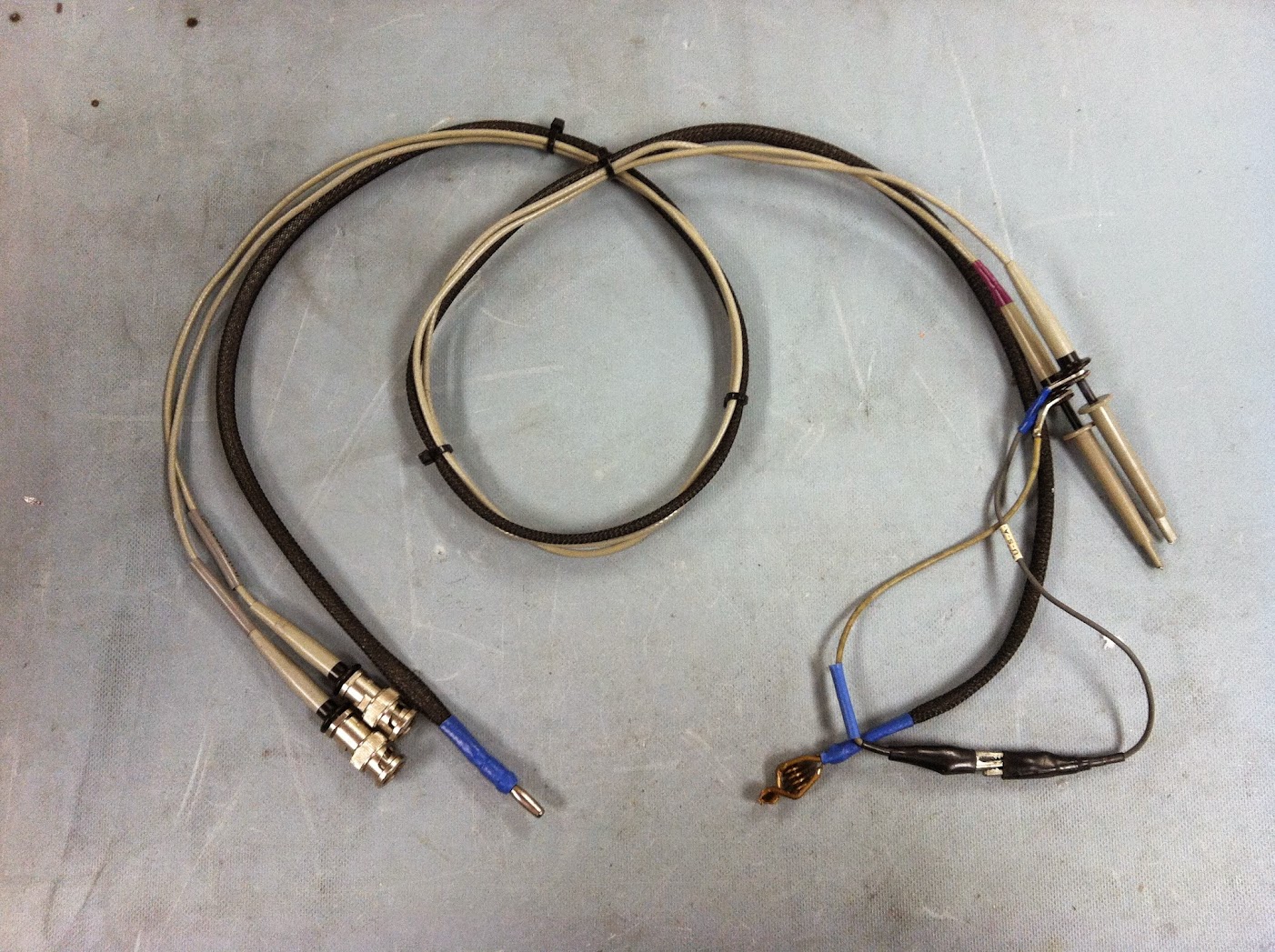
An alternative is to leave the probe grounds off using the common mode rejection ability of the diff amp (7A13/7A22) to sort out the common mode noise and mess. This tends to subject the diff amp to more difficulties, but can work better under some test conditions.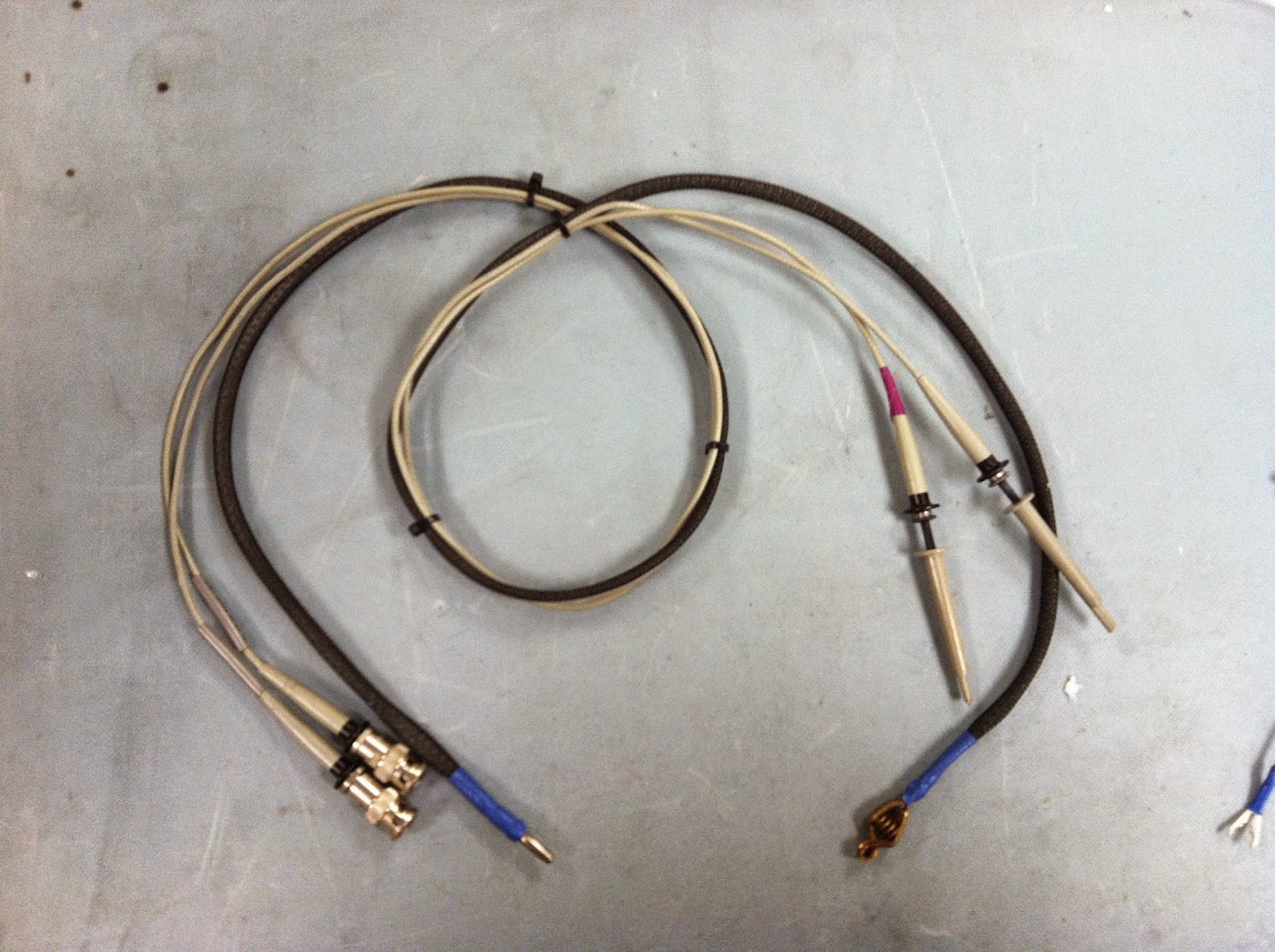
The FET probe would be better as it would reduce the loading on what could be HF noise and etc coming out of the DSO's input connector. If the FET probe has DC offset problems, it is often due to the input FET at the probe tip getting zapped by the previous user. This is a very common problem with active probes as the input device is quite fragile and can be damages easily. Quick check is to put a DVM on the FET probe tip and probe ground shell to check for DC. If the FET's gate has been damaged significantly, there will be some DC present at the probe tip (Gate pin of the FET).
For now, the easies and simplest test is to connect the two together with the shortest possible coax and go looking for switching and other HF transients and noise.
Bernice
How much "stuff" was found on that power supply under test and how good was it's regulation?
This why the LeCroy-Teledyne_Premable diff amplifier add on is made today, for test like this. To think having this identical test capability for $20 USD? not too bad eh..
The regulation was good, but the power supply displayed output was and has been off. I did rely on my DMM for accuracy.
I kind of didn't follow the instructions to the letter.
I did trim the voltage gain in the 7A13 to match what the DMM was reading, but once I did that, it tracked the power from 4 V to 0.01V just fine.
The Comparison Voltage higher digit rolls back on the higher digit but I just ensured that both knobs were at their full counterclockwise position.There are a LOT more test that can be done with the 7A13. Do make up a set of matched probes for it. The probes will need to be attenuation matched and frequency response matched and probe length matched. The goal is to preserve as much of the common mode performance at the 7A13's input connectors? Once the matched set of probes are found (shorter probe cable length is better if possible), make up a equal length of sizable copper braid for a ground strap with a banana plug on one end and a nice stout copper clip on the other end. Tie wrap all three together as a single bundle with the smallest grouping that fits at the 7A13 input connectors and the smallest reasonable grouping (about 6" probe spread or less if possible) at the probe end. This is done to help reduce field pick up and help preserve CMMR. Clip the ground strap to the DUT chassis ground and/or tie the probe ground leads together or keep them separate depending on what is needed for a specific test set up. Compensate each probe individually, then tie the probes together and drive them common mode. Tweak one of the probes to balance out CMMR as much as reasonable, It will never be ideal, but can be quite good.
I do have extra probes around and I always get them in pairs. I also have some old tek probes but not sure if I'll find two alike in my bag. As for copper braid I do have desoldering braid but I'm running short of it, maybe I should pick up more. But one thing what is CMRR used for in practicality? I guess I can look it up but it's late now so by the time you reply I might have read about it.No 50 ohm termination initially for that test. If switch noise or etc is found, then try adding the 50 ohm termination to see if there is any difference. Run the volts/div to 1mV at full BW if needed or possible.
Use a short a BNC cable as possible. Low capacitance matters here. Ideally, a much wider BW analog scope would be used with a FET probe to the DSO's input. Roll the input attenuator controls up/down and repeat with the other panel control to see if all that makes any difference.
Bernice
I do have a FET probe (7A11 but unsured of it's calibration, even if it has a green round sticker over a Rejected sticker with reason: Balance DC Noise Problem, dated 11/12/93), it's the middle module on the cleaned up 7613 scope. But it's late so it must wait.
Tomorrow back to work so I'm not sure how much time I'll have to check this. -
7A22, 1Mhz, 10uV not just for audio.
*Electro-mechanical systems.
*HUGE array of sensors from microphones, hydrophones, optical sensors, vibration sensors and...
*Thermocouple effects including their time constants.
*Current sensing resistor testing.
*Dielectric testing of materials.
*Biological-electical phenomena.
*Chemical-elecrical phenomena.
*Power supply noise and regulation testing.
*Low noise amplifier design.
*Charge pump design.
*Frequency discriminator design.
And a whole lot more limited by imagination, creativity and a deep understanding of how to apply an instrument with these capabilities. Beyond all that, the specific measurement needs and how to gain accurate and useful information about the DUT becomes what matters.
Bernice
BW ?
Not much beyond audio.
I was replying to a question about my 1940's Philips oscilloscope.