What is the best way to repair a HP knob like this?
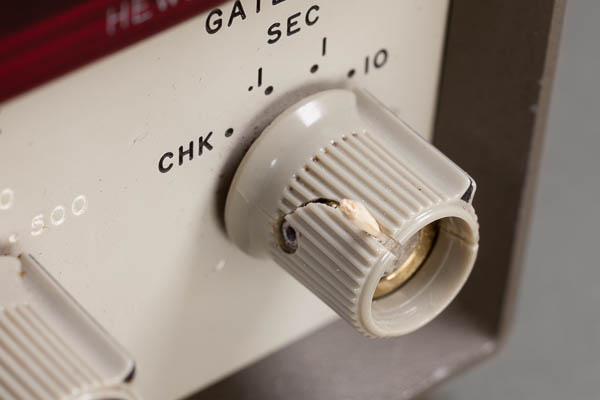
https://www.miedema.dyndns.org/co/2025/IMG_4757_Broken_HP_knob-2000pix.jpg
I tried before using epoxy glue (Bison Combi snel/rapide). But that did not work too well. So I am curious what you are using...
Today I glued this knob.
It had an old crack that I had previously tried to glue with epoxy, and a fresh crack.
When I tried to remove the old epoxy, the knob broke into two halves:
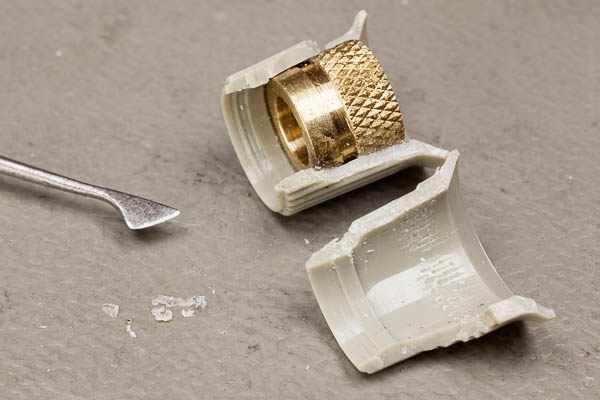 IMG_4786__HP_knob_broken_into_2_halves-2000pix.jpg
This was actually a good thing, because it was now much easier to scrape the old epoxy glue off.
I was surprised how bad the bonding of the epoxy with the plastic of the knob was. Epoxy and ABS is certainly not a good combination. (Or maybe I did not clean the surfaces well enough before glueing?)
After scraping away as much epoxy as I could, the surfaces of this old crack were still not perfectly matching. so I decided to glue this crack wit the Loctite 401 superglue:
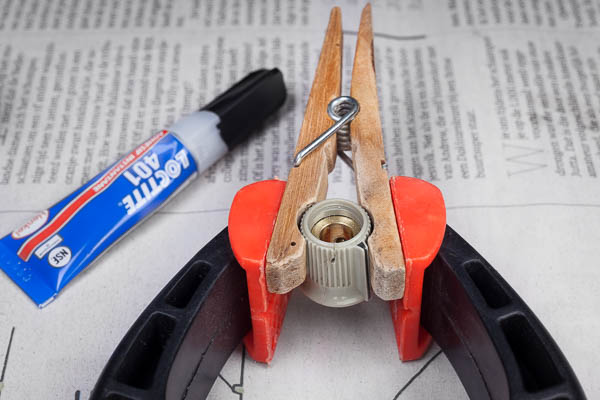 HP_knob_glued_with_Locktite_401-2000pix.jpg
I used just a tiny bit of glue to avoid spilling it over the outside of the knob, and that worked out very well. Also, I was afraid that the superglue would harden before I got the parts in position, but this was no problem at all. I let the glue dry for 2 minutes while I pressed the two halves together with my fingers, and then clamped the knob as in the photo.
The other (new) crack had very clean, well fitting surfaces. So I decided to try the EMA plastic weld (Dichloromethane).
I did not have a glass syringe, and was afraid a plastic one would be dissolved by the glue. So I followed the tips of Robert763, and used a a short length of tiny PTFE tube.
I think the idea is to fill the tube with Dichloromethane, put your finger on top of the tube, and let it go when in position near the crack.
This worked, but the tube also functioned as just a stick, when dipped into a liquid, some drops will stick to it.
What ever, it worked fabulously:
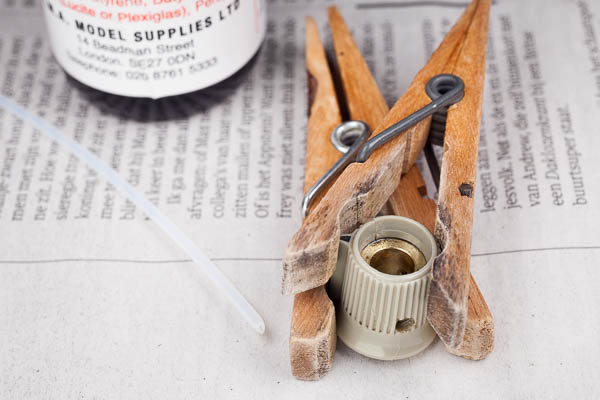 IMG_4788__HP_knob_glued_with_EMA_plastic_weld-2000pix.jpg
With the knob clamped as in the photo, I applied a few drops on the inside of the crack. The water-thin fluid wicked between the plastic and the brass, and into the crack. Like magic, and very easy to do.
For good measure, I turned the knob over, and also applied a few drops into the other side of the crack.
This EMA plastic weld is really nice stuff!
It is not as highly volatile squadchannel warned me for. I had the time to carefully put the drops in the right place, without evaporating in front of my eyes. But then this is not pure Dichloromethane, it is plastic weld
containing Dichloromethane. So I suppose the stuff is optimised for the job in hand.
The result, the cleaned and glued knob:
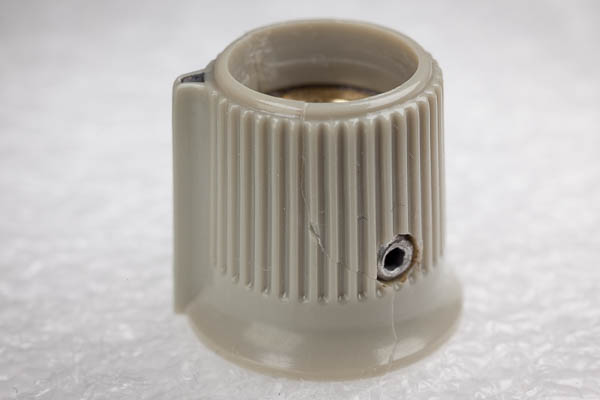 IMG_4791__HP_knob_glued_with_EMA_plastic_weld-2000pix.jpg
This is the crack, glued with the Dichloromethane. With the naked eye it is nearly invisible.
The crack glued with the Locktite 401 it a bit more visible, because the less good matching surfaces. Still, with the naked eye hardly visible.
I am happy

. And I learned a bit more about gluing plastic. I will use both glues more often. So thank you all!!
regards, Gertjan.

 Home
Home Help
Help Search
 Login
Login Register


