Author Topic: K2001 ADC  (Read 10715 times)

0 Members and 3 Guests are viewing this topic.

Offline GigaJoeTopic starter

  • Frequent Contributor
  • **
  • Posts: 749
  • Country: ca
Re: K2001 ADC
« Reply #25 on: April 10, 2026, 02:06:05 am »
hook OPA140 ... I would like to say it about the same ....

Im still thinking that zero detector still a culprit for a noise generation,   triggering a bit different time it produce timing inconsistency.
may happens due to dif. input voltage level.

LM311:


some offset correction added, but i have no idea how well it, due to non symmetrical power, or natural offset correction .....
 

Offline Kleinstein

  • Super Contributor
  • ***
  • Posts: 16936
  • Country: de
Re: K2001 ADC
« Reply #26 on: April 10, 2026, 05:48:12 am »
The zero detector is only relevant for the final charge. This is normally only a rather small part of the result and the importance changes with the integration time. The comparison of 1 PLC and 10 PLC mode would tell if the final charge (comparator+slope amplifier) or more the low frequency noise (e.g. integrator) is more relevant.

For the final rundown step there is a consistant ramp for the comparator.

The divider between the OP-amps is there to adjust the speed of the slower OP-amp. So one may have to adjust that divider when the OP-amp(s) are changed. The GBW of the slow OP-amp divided by the resistors should be at most 1/6 of the GBW of the fast OP-amp in the integrator. Otherwise the integrator can oscillate or ring excessive.
Another point is the time needed for settling. There one has the 2 options:
a) fast compared to the short reference pulses: e.g. ADA4077 and divide by 3. This kind of needs a fast 2nd OP-amp.
b) rather slow (like the OPA177 and divide by 11), so that the settling is slow compared to the modulation period.

A speed setting in between may cause INL issues. It still depends on other details how bad it would be.

The OPA140 as single OP-amp integrator should give quite some advantage over the OPA602.
The 2 OP-amp version would not be much lower noise. The low frequency noise (e.g. 3 Hz as main frequency for 10 PLC mode) of the OPA140 is comparable to the ADA4077 and only slightly higher than OPA205 noise. So the OPA140 (or OPA141) would also be a viable option for the precision OP-amp in the integrator.

There is still the resistor Johnson noise as a major noise contribution. So there are limits on how much can be done without a complete redesign of the ADC.

With the more complex AZ loop (to include the 2nd reference) there can be a higher importance of the OP-amp noise, also from rather low frequencies (e.g. down to 0.03 Hz where the hump in the Allan dev. curve is). So there could still be an advantantage from a good BJT OP-amp over the OPA140.
 

Online miro123

  • Frequent Contributor
  • **
  • Posts: 298
  • Country: nl
Re: K2001 ADC
« Reply #27 on: April 10, 2026, 09:46:11 am »
Thanks for valuable comments.
I am really curious why even faster opamps like OPA828/827 are not purposed to use for the composed integrator.
 

Offline Kleinstein

  • Super Contributor
  • ***
  • Posts: 16936
  • Country: de
Re: K2001 ADC
« Reply #28 on: April 10, 2026, 11:37:39 am »
An even faster OP-amp could be used. The difference would not be in the noise, but linearity.
However the original OPA602 is only 6.5 MHz and the ADC should be OK with this. The relatively large integration capacitor suggests slow modulation and thus no need for super fast settling.

The OPA1655 (55 MHz) could still be an option, though overkill - maybe a thing for a faster ADC with an OPA140 for the precision OP-amp.

 
The following users thanked this post: miro123

Offline GigaJoeTopic starter

  • Frequent Contributor
  • **
  • Posts: 749
  • Country: ca
Re: K2001 ADC
« Reply #29 on: April 11, 2026, 10:46:11 pm »
I have another question if someone can answer:

reference to the same schematic:
https://i.ibb.co/840yf0s1/ADC-K2001.png

left top corner ...  reference voltage source that generate suppose to very low noise +V , -V   voltage reference.
R805 ,  R803 - base transistors hook to positive and negative ±15 power ...
A - I don't understand why it there ...
B - it significantly decrease PSRR

so  i simulated to test, even ...  injecting 1V AC 1Khz  in power ±15 in a simulator - that give me 8mV P-P on positive and 16 mV  P-P  negative (definitely as it relative)

cut off both resistors:  +Vref - 3 mcV ...  -Vref - 7 mcV - noise .... ands DC decreased to 20 microvolts ( insignificant )

I think i should remove resistors  ...
 

Offline Alex Nikitin

  • Super Contributor
  • ***
  • Posts: 1523
  • Country: gb
  • Femtoampnut and Tapehead.
    • A.N.T. Audio
Re: K2001 ADC
« Reply #30 on: April 12, 2026, 12:17:55 am »
I think i should remove resistors  ...

I think you better not, at least not without providing an alternative way to avoid an unwanted condition in the reference circuit - an accidental reversal of the output polarity and reverse biasing of BE junctions on Q800 and Q801.

Cheers

Alex
 

Offline Kleinstein

  • Super Contributor
  • ***
  • Posts: 16936
  • Country: de
Re: K2001 ADC
« Reply #31 on: April 12, 2026, 06:46:04 am »
R805 also helps with start up of the reference. Without it, there could be a 2nd stable point with zero reference voltage. The offset of the OP-amp U810 could be enough to make it start the right way, but this would not work for a production run. How the power rails come up could also be enough.
One could get away with chaging the negative supply of U810 to GND (still tricky which ground to use).
The negative side should follow and would be less critical one.

The ramp / step of some 6 µV could come from popcorn noise of the K2001 LM399 reference. The LM399 commonly show popcorn noise in the form of 2 possible voltage values about 4 µV appart and jump roughly (still rather random) on the minute to hour rate. Scaled to 10 V thus would give some 6 µV.
 

Offline GigaJoeTopic starter

  • Frequent Contributor
  • **
  • Posts: 749
  • Country: ca
Re: K2001 ADC
« Reply #32 on: April 12, 2026, 03:09:15 pm »
yeah it seem starting ....

Another problem,  I think it related to wandering and basically everything ...
I cover the fan filter by paper for 20 seconds ...  reading immediately start rising to 50-70 microvolts, and then back when open ....
fan a bit rattling , and probably a bit uneven airflow....
i have no idea what part is so sensitive to the airflow, consider a large plastic cover inside....
the thing that i thinking about ... most elements are emitting the heat are voltage regulators, (and transformer) and they outside that plastic cover , but may transfer heat by legs,  so surrounding components affected ...   

the only solution i see , modify VR TO220 to more efficient heatsinks and optimize airflow a bit ...

"one battle after another"

and yeah ..  on reference part i remove resistors add diodes,  and 10uf ceramic capacitor on positive and negative, it seems doesn't affect the noise.
 

Offline Kleinstein

  • Super Contributor
  • ***
  • Posts: 16936
  • Country: de
Re: K2001 ADC
« Reply #33 on: April 12, 2026, 06:35:19 pm »
There are quite some parts that can be sensitive to a change of air flow / temperature. I would not so much think of the power supply but more the ADC, the amplifier (gain of -0.5 stage), the amplifier, the input protection.

In my DMM I use a somewhat similar input protection and I can see some thermal effect - though more in the 5 µV range, though with only moderate heat . 10 x more would be quite a lot.

A question is if the air flow effect is measured with an external 10 V or under short conditions. If the test was with an extra 10 V (or similar), it would makes sense to repeat the test with a short, as this removes some of the possible sources. One could also compare to the short in the 2 V or 200 mV range. This would still habe the same protection part, but less weight (due to the gain) to the ADC and a slightly different amplifier part.


A rather sensitive part is an interesting finding. The bump in the noise at the 30 seconds is a range where thermal fluctuations could happen.
 

Offline GigaJoeTopic starter

  • Frequent Contributor
  • **
  • Posts: 749
  • Country: ca
Re: K2001 ADC
« Reply #34 on: April 12, 2026, 10:30:38 pm »
Thermo Effect:
i did shorted:
on every range LSD's moving up about the same rate on every range,  1000V a bit slower but still moving up when fan closed.


spent a Sunday,
fix a fan ,  a everything need to disassemble , and fix front panel buttons , it became very unsensitive ...

so. of course someone been there ...   flux and resoldering there and there ...  never noticed, but LM399H (not AH)  , very close to how China reclaimed  looks like,  no "usual" PILLIPINES on side, and NS logo. (but in 93 it should be linear logo) I pretty certain Keithley using selected with a similar, mumbo-jumbo index like HP  ....   well ..  well ..  How can i be certain for ADC zener same , or it something different with skewed tempco and current flow, right now do not match wit minimal tempco .... I think i need to think about .....  ( i have 1 selected Lm399 from HP3478A ... )

here an experiment:   it running for 2 hours and shows...
7.056,280,0  OK ...
turn off,   the immediately turn on back ...  and it shows same numbers? ...  no
7.056,228,7
then about for 30 seconds it reach
7.056,260,0
and stay there ...  -20 microvolts.
( return to 280 after 20 min )

so ADC   has a zener  to make +10 and -10 for ADC ,   then -10 inverting and using to feed LM399 to make +7V and +1.7V , capacitance divider ,not resistors.  then a while ago I probe input on ADC for 20V range - each cycle of measurement has a packet of "spikes"  +10V +7V (as ref) , measured value and "0"  from all this it calculated actual #.##### .   it also has LM75 ... Yep ... it funky calculator

and finally i did something weird ..   it definitely ADC area for sensitive component , so I toss  some paper towel under and around  ADC, it kinda band-aid,   a bit help ..
« Last Edit: April 13, 2026, 02:48:00 am by GigaJoe »
 

Offline Kleinstein

  • Super Contributor
  • ***
  • Posts: 16936
  • Country: de
Re: K2001 ADC
« Reply #35 on: April 13, 2026, 07:07:15 am »
The HP3478 may well have no selected LM399 ref. It is only a 5.5 digit meter and the LM399 is already overkill in that class. So it could even be the left overs (still OK) when selecting good ones for 3457 / 3456.

If the LM399 ref. was replaced, than likely because it was bad. A recycled LM399 still has a chance to be OK and at least is likely well aged - so old is actually good. Finding a LM399 without the typical popcorn jumps is extremely rare and searching for one is not practical, as rare jumps are even worse. With the extra zener and smoothing the K2001 may even want an LM399 that shows the popcorn jump rather frequent.

AFAIK the ADC ref. is a low noise zener diode. The don't fail very often and I would not really expect the zener to be replaced. One may get a glimpse of the noise with an AC coupled low noise amplifier and measuring the 0.1 ... 10 Hz noise of the reference.

The warm up and reading after 30 seconds (~ 3 PPM) looks not that bad, especially given that the meter runs relatively hot. Also the 7 V reference readings may well be averaged over some time (e.g. 1 min) to make good use of the separate, lower noise reference at the ADC.
For a reading with a shorted input the reference voltage should no contribute to the thermal drift.

With the meter using the AZ mode to suppress an input offset it is odd that the temperature at the ADC should effect the zero reading (= offset). It may happen for transients (if the meter uses averaging also for the zero), but should still not give a longer time effect.


Offline GigaJoeTopic starter

  • Frequent Contributor
  • **
  • Posts: 749
  • Country: ca
Re: K2001 ADC
« Reply #36 on: April 13, 2026, 01:51:39 pm »
i need to set a data reading to analyze behavior ..
 

Offline GigaJoeTopic starter

  • Frequent Contributor
  • **
  • Posts: 749
  • Country: ca
Re: K2001 ADC
« Reply #37 on: April 15, 2026, 02:58:08 pm »
somehow at morning an apt approach appearing, kind of brain behaving ..
that was with replacing NE5534 , now i got a second similar and significant flaw in ADC design ..

Q812 -  L7805   ( TO-92 , +5V regulator) , see link for schematics at the previous post:
I always look at as just a small voltage regulator to feed LM311 positive for adjusting TTL level ... right ?  wrong ...

it give a +5 rail for comparators.
it a reference for circuit to skewed comparators level , if output high or low  (3 resistors connected to pin-5 )
it a reference to trigger 3 comparators , ( see connection up to R861 and so )  , and follow up all this logic of triggering everything ....

it source of instability :   
a bit warm up  and everything going up drastically
generate noise that cause a random triggering -   C814 , add 1000 uF -  you wouldn't believed how behavior changed ,   it  slowly up , and stay very calm just right after power up .... no any funky few hundreds microvolts jiggering ...

somehow need extremely stable +5V  ( LT1021 ish ),   and i have no idea where that "+5V_OUT" can be in use ....
one comparator - 5ma at positive   , so 10ma + something else ,   I assume 20-25 mA consumption ....

ANY  IDEAS WELCOME !!!!
( replace L78L05 , + it on edge of the board ,  - space tight )
 

Offline Kleinstein

  • Super Contributor
  • ***
  • Posts: 16936
  • Country: de
Re: K2001 ADC
« Reply #38 on: April 15, 2026, 04:19:50 pm »
According to the plan I have, the 5 V_out is a separate supply. It also supplies the FF (AC74) to sychronize the control signals. This could make the supply a bit noisy / EMI infested.
The voltage is also use to provide trigger levels to comparators, but these should not be critical (drivers for JFET control and comparator for run-up part).
A bad (e.g. too much ESR, dried out) C814 electrolytic capacitor could be an issue for the regular.
It may not be a question of the DC stablity but maybe high frequency ringing.
 

Offline GigaJoeTopic starter

  • Frequent Contributor
  • **
  • Posts: 749
  • Country: ca
Re: K2001 ADC
« Reply #39 on: April 15, 2026, 09:48:25 pm »
C814 - tantalum , i added 560uF polymer ...
so if i heat L78 up the output +5V decreasing down at 80 microvolts, and on display +7.XX V a bit increasing.
much more sensitive are set of resistors for comparator connected to Pin-5 , and JFET transistors - that really sensitive , especially Q808 , 9, 10

seem my jumping around L78 a bit overexcitedly  -  incorrect.
( but still better than before .. )

here is current status:
20V , 10NPLC , no any filter ,
vertical scale 10.0 microvolt , 100 - 10.0µV  , 150 - 15.0µV
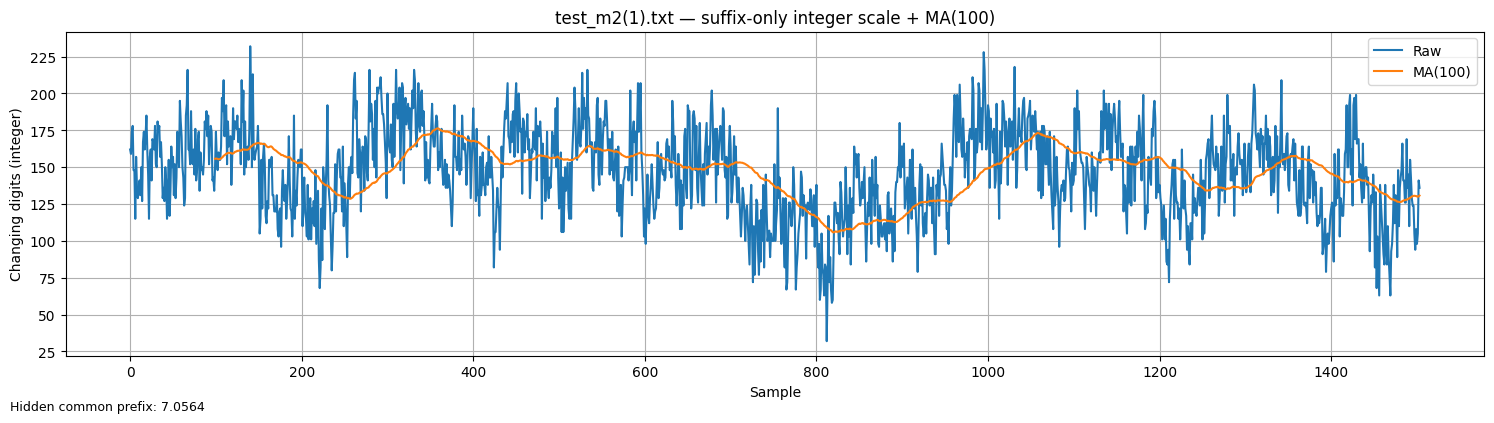

I visualize 20K measurements , it 20K pixels wide PNG:
https://limewire.com/d/vgSLw#nyDosaPeRq
seems it maximum that possible to squeeze from this device, it still x20 better as it was before
mostly, i think, it a processing software, all this waves remind me an oscillating process to find equilibrium ... ; even such artefacts like below:

87474 +7.0564125E+00NVDC,   +12115.014430secs, +23065rdng#, 00extchan
87473 +7.0564109E+00NVDC,   +12115.564474secs, +23066rdng#, 00extchan
87472 +7.0564106E+00NVDC,   +12116.113902secs, +23067rdng#, 00extchan
87471 +7.0564106E+00NVDC,   +12116.663287secs, +23068rdng#, 00extchan
87470 +7.0564106E+00NVDC,   +12117.212746secs, +23069rdng#, 00extchan
87469 +7.0564099E+00NVDC,   +12117.762524secs, +23070rdng#, 00extchan

87451 +7.0564193E+00NVDC,   +12127.652682secs, +23088rdng#, 00extchan
87450 +7.0564172E+00NVDC,   +12128.202087secs, +23089rdng#, 00extchan
87449 +7.0564172E+00NVDC,   +12128.751649secs, +23090rdng#, 00extchan
87448 +7.0564172E+00NVDC,   +12129.300998secs, +23091rdng#, 00extchan
87447 +7.0564170E+00NVDC,   +12129.850759secs, +23092rdng#, 00extchan

I think it need a cleanup of soldering mess, an do recalibration ...
« Last Edit: April 16, 2026, 01:33:18 am by GigaJoe »
 

Offline Kleinstein

  • Super Contributor
  • ***
  • Posts: 16936
  • Country: de
Re: K2001 ADC
« Reply #40 on: April 16, 2026, 07:13:31 am »
When measuring something like 7 V, there can still be quite some noise from the meters reference. This still just a LM399, that ususally come with popcorn noise (e.g. 2 values some 4 µV apart).  The low noise zener at the ADC and digital low pass filtering (the not so well understood software in the background) would still leave some waveiness with some 4 µV amplitude. That could explain much of the variations in the orange curve.
Even though the LM399 reference is likely selected and pre-aged, it may make sense to change the reference to a ADR1399, with the small extra changes needed (more current and 5 ohm 1 µF or similar snubber). After all the LM399 ref. is limiting for a 7 digit meter.

To test just the ADC part, a short at the input is the better test case. To keep things easy to compare I would stick to 10 PLC and no filtering.

Q808 and Q809 should not be that sensitive. Q810 and Q807 should be the 2 that have some effect, but should still compensate to a large part if the temperature is the same.  The AZ cycle that includes a measurement of the 7 V ref. should be very good in correcting slow variations.
 

Offline Le_Bassiste

  • Frequent Contributor
  • **
  • Posts: 321
  • Country: de
Re: K2001 ADC
« Reply #41 on: April 16, 2026, 08:24:14 am »
... somehow need extremely stable +5V  ( LT1021 ish ),   and i have no idea where that "+5V_OUT" can be in use ....
one comparator - 5ma at positive   , so 10ma + something else ,   I assume 20-25 mA consumption ....

ANY  IDEAS WELCOME !!!!
( replace L78L05 , + it on edge of the board ,  - space tight )

idea: disconnect the junction R828*R861 (call it junction "A")  from the output of Q812. connect "A" via trimpot to emitter of Q108. adjust trimpot to give 5.xx V at "A". if that works, replace trimpot w/ resistor divider.
An assertion ending with a question mark is a brain fart.
 

Offline GigaJoeTopic starter

  • Frequent Contributor
  • **
  • Posts: 749
  • Country: ca
Re: K2001 ADC
« Reply #42 on: April 16, 2026, 01:42:28 pm »
it an option to use some 5V reference (like, ad586 SOIC + capacitor ) , then reroute signal and left +5 power as is .... maybe ... it kinda a lot of meticulous work , and im not sure if it help ...

Replace LM399 I'm also skeptical , I think actual output averaged and keep in a memory as a reference.  otherwise no reason to do 2 separate reference.

Shorted:
20V range ,  10NPLC ,no filter:  ( seems the same as with 7V )


Offline Kleinstein

  • Super Contributor
  • ***
  • Posts: 16936
  • Country: de
Re: K2001 ADC
« Reply #43 on: April 16, 2026, 03:45:59 pm »
The noise in the shorted case is indeed not much lower. At times there is still quite some low frequency noise. It is know that most Keithey meters show such off extra low frequency noise even in AZ mode. In the Allan deviation curve one can see this as the kind of plateau from some 1 -100  seconds.
The short time noise is OK, but that extra LF noise really hurts. The "Period" of some 100-150 seconds could be something thermal, but could also by on the timescale where LM399 popcorn noise happens or the ADC gain is averaged.

Some other investigations (https://www.eevblog.com/forum/metrology/dmm-adc-noise-comparison-testing-project/msg1366061/#msg1366061) showed that triggering could make a difference and part of the LF noise could be from the way the AZ loop is doing averaging.
It makes sense to use longer time averaging for the ADC gain / the 7 V ref. measurement step. This gives some digital low pass filtering for the LM399 reference, a way to fight LF noise there. However for the simple ADC and amplifier offset averaging over a longer time is not that good. It reduces the short time noise of the zero reading, but it lower the effective chopping frequency and this way lets more 1/f noise through.

1/f noise can come from many sources (input amplifier / buffer, the OP-amp at the integrator, the inverter part of the reference amplification (U811) and also the from excess noise in resistors). The highest noise gain (look like some 5.x)  would be from the precision amplifier in the integrator. On top of that there is the factor 2 from the input amplifier gain and the AZ mode taking the difference of 2 readings adds a factor of sqrt(2) for 2 readings. So referred to the input the integrator LF noise would be amplified some 15 times.

The OPA602 specs are some 0.95 µV_pp for the 0.1-10 Hz noise. The relevant frequency range could however be a bit different, but is a bit unclear with unknown extra averaging. With the noise gain this could be a good part of the observed noise.
 

Offline GigaJoeTopic starter

  • Frequent Contributor
  • **
  • Posts: 749
  • Country: ca
Re: K2001 ADC
« Reply #44 on: April 16, 2026, 05:59:03 pm »
there is no OPA602,  it replaced by TI OPA140

consider my experience with NE5534 replacement, I would definitely say timing of that logic signals are critical part.  if there an additional noise reduction, need to look at   more precise timing for  ZCOMP CBCOMP .  I think it logically correct , as essentially ADC measuring time period,  and jittering of TTL signal recalculating to the noise level ... I'm still curious C817 cap. ; what exactly they tried to compensate ... there no such cap for U804 comparator , but same compensation resistors ...

for low noise like waives I still pointed to +5 source from L7805,  when i added cap it does decreased.  And yes thermal fluctuation on top ...

i probably try in-place replacement for this regulator ...  something (tiny board soic AD586 + OP07 + transistor )


Offline Kleinstein

  • Super Contributor
  • ***
  • Posts: 16936
  • Country: de
Re: K2001 ADC
« Reply #45 on: April 16, 2026, 07:17:06 pm »
The resistor to pin 5 of the LM311 comparator and the resistors around are likely there to create some hysteresis. They may also speed up things a little.
The extra capacitor C817 would make the hysteresis initially even larger and thus avoid ringing even more. For a slight speed up of the comparator one would also connect pin 6 to the positive supply.

On the downside C817 causes quite some current spike to the 5 V regulator - this could be some issue and why the extra capacitor at teh 5 V can help.
An alternative to C817 could be lowering R806 (e.g. 5 K range). This would give a larger hysteresist all the time and not just for a short time.

With an OPA140 at the integrator the integrator should be less of an issue.

The 5 V regulator has 2 properties that can matter:
1) low frequency noise
2) settling speed and tolerance to fast transients
 

Offline GigaJoeTopic starter

  • Frequent Contributor
  • **
  • Posts: 749
  • Country: ca
Re: K2001 ADC
« Reply #46 on: April 16, 2026, 07:47:17 pm »
another question: 
integrator opamp U809:  R826 (3K) connecting output (pin6) to -15V
is it something for offset \ precise measurement ,  or safety resistor to minimize swing on positive side  , or inject -15V noise  ??
i'm wonder ..
 

Offline Kleinstein

  • Super Contributor
  • ***
  • Posts: 16936
  • Country: de
Re: K2001 ADC
« Reply #47 on: April 16, 2026, 09:43:14 pm »
The resistor is likely there to make the integrator output stage run in class A mode. So avoid the output stage cross over and reduce the dependence of the GBW on the current.

If one is worried about the noise injected from the -15 V side, one could replace the resistor with a JFET constant current source ( ~ 2-4 mA).
Normally the -15 V should not be that noisy - if so check where the noise / interference comes from.
 

Offline GigaJoeTopic starter

  • Frequent Contributor
  • **
  • Posts: 749
  • Country: ca
Re: K2001 ADC
« Reply #48 on: April 17, 2026, 12:58:41 am »
ah , interesting ....  to improve linearity , i guess ...

I added 470 uF in parallel to every tantalum 10uF  , 6 in total

0_A - before (green)
0_B - after (blue)
same 20V , 10 NPLC, no filter , shorted


standard deviation:
test_m_NOISE_0_A.txt:  2.716 × 10⁻⁶
test_m_NOISE_0_B.txt:  2.378 × 10⁻⁶


so i feed 20K lines to calculate Power Spectrum Distribution

that basically tell me nothing new , very slow drift and interference on the frequency of measurement cycle ...

Noise density ≈ 9.8 × 10⁻⁷ V/√Hz  = 0.98 µV/√Hz   , basically noise floor - 1 µV/√Hz


and this one:
some bins , missing , so some value as fraction of microvolts doesn't exist, like 0.000,220,1 ;  ,220,3 ; ,220,5; not really true 8.5 digit mode ... it also shows .. something , my thought not completely formed ...
« Last Edit: April 17, 2026, 03:20:01 am by GigaJoe »
 

Offline Kleinstein

  • Super Contributor
  • ***
  • Posts: 16936
  • Country: de
Re: K2001 ADC
« Reply #49 on: April 17, 2026, 07:00:37 am »
It is a bit surprising that the extra 470 µF capacitors seems to help a little with low frequency noise. The frequencies are too low that it would have an effect as normal RC filter.  Maybe this is more a thermal effect with capacitors acting a thermal shield. If the extra LF noise is from thermal effects, it could also be just randomly more stable airflow.

The noise spectrum shows a peak at 0.5 Hz. With a sampling speed of 2 SPS this would be 4 readings period.
The other point noting is that the noise density goes up over the whole range. If the software doing the AZ mode is done right, the kind of chopping action (alternate between zero and the signal) should suppress 1/f noise quite well. I am afraid this is a firmware thing an nothing that is easy to fix. I doubt that Keithley would fix this for the very old meter - if lucky they might for new meters (e.g. DMM6500 , 7510, K2010) that seem to have the same issue.
Ideally they would add alternative AZ modes, without averaging for the zero and maybe also without the ref. step (more gain drift, but less noise).
One might get an idea of the ADC performance if this would be fixed by looking at the 10 PLC non AZ mode, take the difference of consecutive readings and calculate the RMS noise of this (like the 1st point of the Allan deviation). This would correspond to a simple HP like AZ mode.

The missing bins in the histogram are roughly equally spaced and there is no extra hight in the neighboring bin (like expected for DNL issues). So this should reflect the actual internal resolution. After all this is not a 8 digit meter but a 7 digit one (noise wise barely).


Share me

Digg  Facebook  SlashDot  Delicious  Technorati  Twitter  Google  Yahoo
Smf