Author Topic: Transistors - die pictures  (Read 364634 times)

0 Members and 4 Guests are viewing this topic.

Offline NoopyTopic starter

  • Super Contributor
  • ***
  • Posts: 2239
  • Country: de
    • Richis-Lab
Re: Transistors - die pictures
« Reply #950 on: December 28, 2025, 04:17:55 am »


The BUZ100 is an n-channel power MOSFET. There is no datasheet available for the BUZ100T in the D2PAK package. The old TO220 variant blocks up to 50V and conducts up to 60A with a resistance of 18mΩ. This transistor family was developed by Siemens, hence the name SIPMOS (Siemens Power MOS). The above model was already produced by Infineon.


The edge length of the transistor is 4,5mm. The large source metal area was connected with two bondwires. A bondwire with a thinner cross-section was used for the gate potential. The bright rectangle in the upper left corner is obviously a contact area that could be used to connect an auxiliary source contact.


The metal layer contains round contacts with a diameter of approximately 10µm.


In the “SIPMOS Components Data Book 1987/88,” Siemens shows the structure of SIPMOS transistors. I have colored the drawing for a better understanding. The openings to the substrate and thus also the recesses in the metal layer are squares. This has either changed over time or was deliberately not depicted entirely correctly.


https://www.richis-lab.de/FET55.htm

 :-/O
 
The following users thanked this post: RoGeorge

Offline NoopyTopic starter

  • Super Contributor
  • ***
  • Posts: 2239
  • Country: de
    • Richis-Lab
Re: Transistors - die pictures
« Reply #951 on: January 09, 2026, 02:42:29 pm »


The International Rectifier IRCZ44 is an n-channel Power MOSFET that provides additional outputs for current measurement. The design and functionality of this MOSFET are described in more detail in the IRCZ34 (https://www.richis-lab.de/FET39.htm). The IRCZ44 blocks up to 60V and conducts up to 50A continuously. The typical Rdson is 0,028Ω. At a case temperature of 25°C, up to 150W can be dissipated.


International Rectifier has defined different die sizes for this HEXFET family. While the IRCZ34 has a die size of 3, the IRCZ44 uses a die size of 4. The dimensions are 5,8mm x 4,3mm. The large source contact is on the right. The gate potential reaches the transistor on the left. In the middle, a bondpad contacts a small isolated area. The current through this area is 1/2400 to 1/2840 of the total current. A current measurement done with this area is not overly accurate, but it is sufficient for many applications. The additional source contact in the middle of the die ensures that the current measurement is not distorted by the load current through the large bond wire.


The structures match those of the third generation of HEXFETs, which one would expect to find in an IRCZ44. The design dates back to 1987.


https://www.richis-lab.de/FET56.htm

 :-/O
 
The following users thanked this post: exe, RoGeorge, iMo, magic, D Straney

Offline NoopyTopic starter

  • Super Contributor
  • ***
  • Posts: 2239
  • Country: de
    • Richis-Lab
Re: Transistors - die pictures
« Reply #952 on: January 15, 2026, 04:11:56 am »


The ST Microelectronics STN0214 is a bipolar transistor that can block up to 1200V. With a short-circuited base-emitter path, the blocking voltage is even 1500V. A collector current of 200mA is permissible continuously and 400mA for short periods. The high blocking voltage ensures a low gain factor. This is typically 20 with 1mA collector current and 3 with 100mA collector current. Up to 1,6W can be dissipated via the SOT-223 package.


The dimensions of the die are 1,9mm x 1,7mm. Most of the surface area is taken up by round, concentric structures that control the potential gradient toward the edge, preventing problematic high field strengths from occurring.


https://www.richis-lab.de/BipolarA72.htm

 :-/O
« Last Edit: January 16, 2026, 10:11:24 am by Noopy »
 
The following users thanked this post: exe, RoGeorge, magic, D Straney, AnalogTodd

Offline NoopyTopic starter

  • Super Contributor
  • ***
  • Posts: 2239
  • Country: de
    • Richis-Lab
Re: Transistors - die pictures
« Reply #953 on: January 18, 2026, 04:14:28 am »


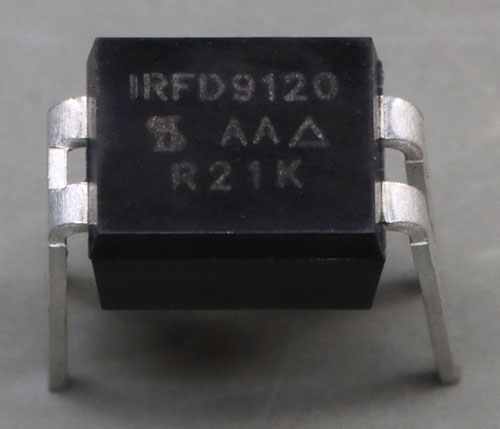
The Siliconix IRFD9120 is a p-channel power MOSFET in a DIP-4 package. The IRFD9120 blocks up to 100V. The current carrying capacity is 1A continuously and 8A peak. The typical resistance is in the range of 0,6Ω. At room temperature 1W can be dissipated. The datasheet also specifies an IRFD9123 with slightly poorer characteristics (60V, 0,8A, 6,4A, 0,8Ω). These are probably two different grades.

As will become apparent shortly, this is most likely a counterfeit component. It is not immediately apparent from its appearance.
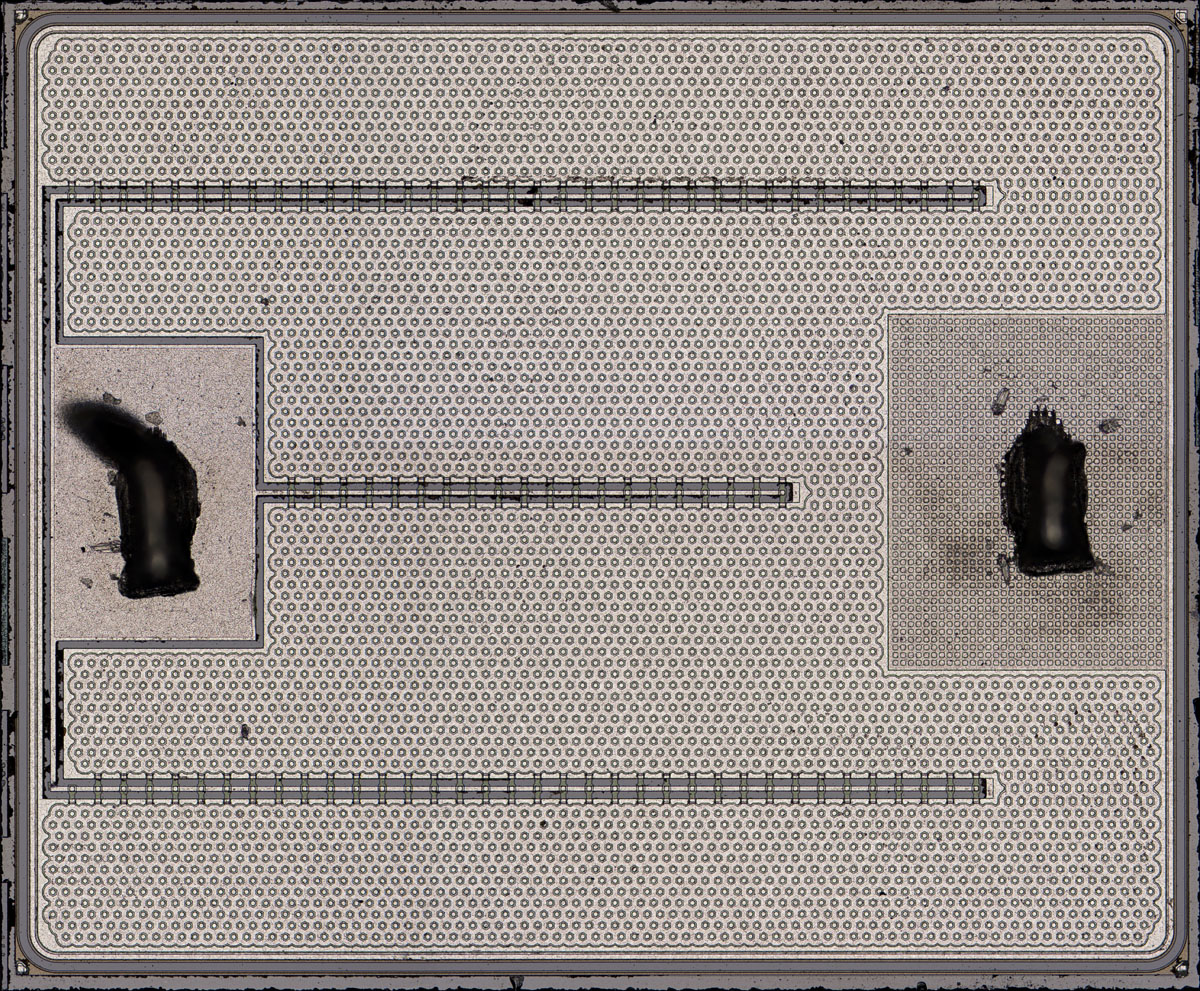


The package contains a die measuring 2,8mm x 2,3mm. The gate potential is distributed across the surface via three low-resistance stub lines.
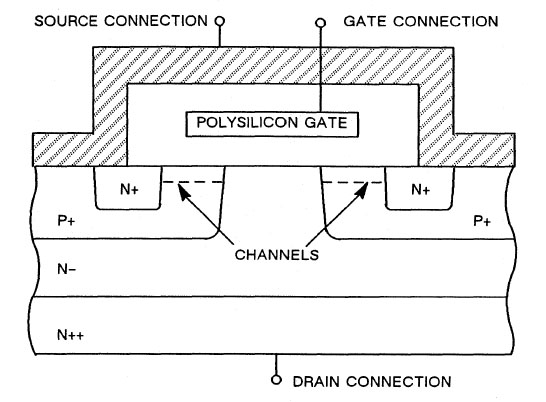


The Siliconix IRFD9120 is a so-called MOSPOWER transistor. In the MOSPOWER Databook, Siliconix shows the typical structure of such a MOSFET, whereby the illustration shows an n-channel MOSFET.
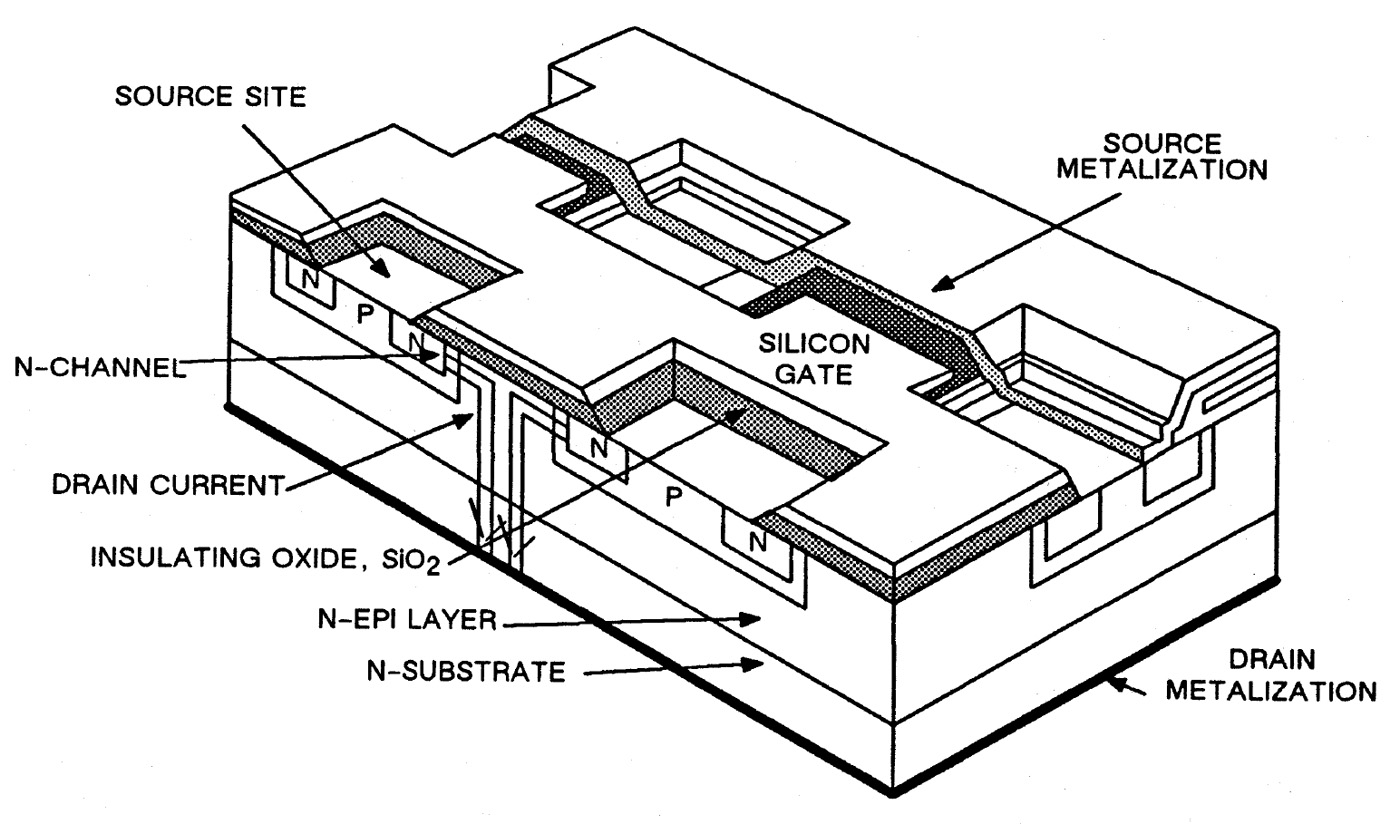


The MOSPOWER Databook also contains the above illustration. The rectangular contacts are clearly visible. The rectangles are formed in the metal layer of these transistors: IRF640 (https://www.richis-lab.de/FET08.htm), IRFD120 (https://www.richis-lab.de/HDD_Seagate_ST-177I.htm#IRFD120), IRFD9020 (https://www.richis-lab.de/HDD_Seagate_ST-177I.htm#IRFD9020).
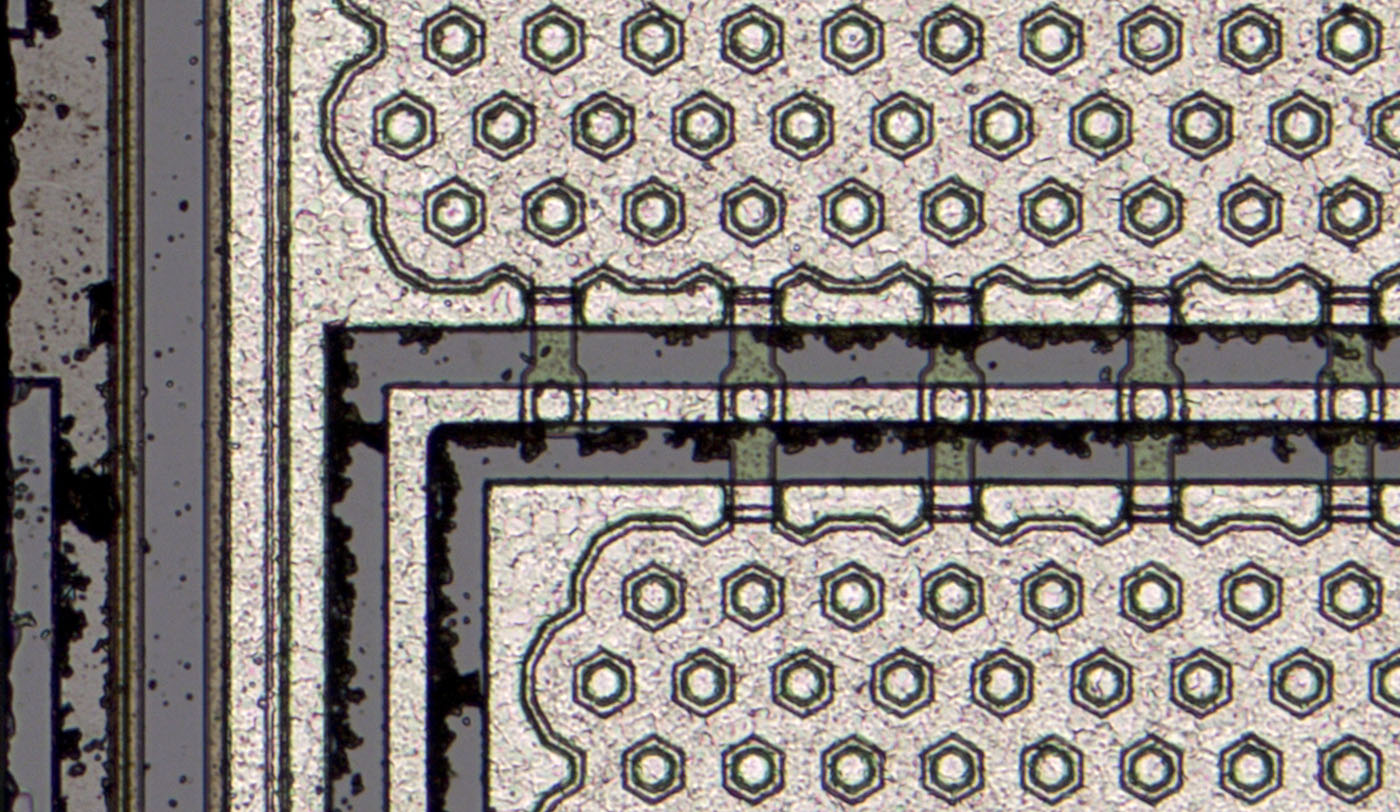


The contacts in the metal layer of the IRFD9120, on the other hand, are round, each surrounded by a hexagonal structure. This must be a third-generation International Rectifier HEXFET. Its design is documented in more detail in the IRC540 (IRCZ34) (https://www.richis-lab.de/FET39.htm). It appears that a MOSFET from International Rectifier has been converted into a Siliconix MOSFET.
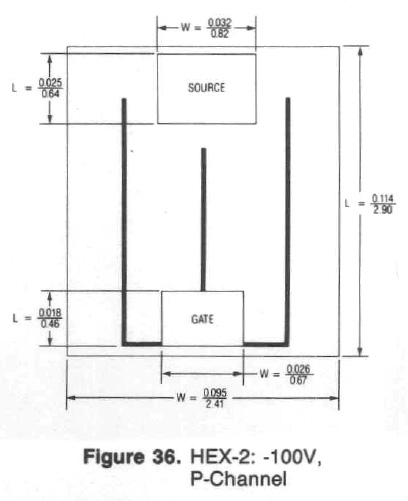


The “HEXFET Power MOSFET Designer's Manual” from International Rectifier reveals that it is probably the size HEX-2.


https://www.richis-lab.de/FET57.htm

 :-/O
 
The following users thanked this post: RoGeorge

Offline NoopyTopic starter

  • Super Contributor
  • ***
  • Posts: 2239
  • Country: de
    • Richis-Lab
Re: Transistors - die pictures
« Reply #954 on: January 18, 2026, 08:21:53 am »
It seems that Siliconix did put HEXFETs in their parts.  ???
Does anybody have more information about that?

Offline NoopyTopic starter

  • Super Contributor
  • ***
  • Posts: 2239
  • Country: de
    • Richis-Lab
Re: Transistors - die pictures
« Reply #955 on: January 18, 2026, 02:22:01 pm »
Someone gave me the missing information:

Vishay (owner of Siliconix) bought some discrete semiconductors technology from International Rectifier and used it with the Siliconix Label.  :-+

https://www.sec.gov/Archives/edgar/data/103730/000120677407000865/vi71964ex991.htm

Offline NoopyTopic starter

  • Super Contributor
  • ***
  • Posts: 2239
  • Country: de
    • Richis-Lab
Re: Transistors - die pictures
« Reply #956 on: January 20, 2026, 08:07:14 pm »


Now International Rectifier IRFD9120.


Yes, that´s a third generation HEXFET.  :-+


https://www.richis-lab.de/FET58.htm

 :-/O
 
The following users thanked this post: RoGeorge

Offline NoopyTopic starter

  • Super Contributor
  • ***
  • Posts: 2239
  • Country: de
    • Richis-Lab
Re: Transistors - die pictures
« Reply #957 on: Yesterday at 11:05:06 am »


And another IRFD9120! This one is from Motorola.


The dimensions of the die are 3,0mm x 2,4mm. Motorola used a technology called TMOS. The structures shown in the datasheet are the same as those documented by Siliconix for its MOSPOWER transistors.


There are unusual structures directly in the bond area of the gate potential and at the end of the gate stub lines. These appear to be contacts from the source metal layer to the gate potential. Direct contacts won´t make sense. In addition, the structures have one more edge than the stub lines of the gate potential. The most likely explanation is that these are protection zener diodes. However, the datasheet does not mention any protective diodes.


https://www.richis-lab.de/FET59.htm

 :-/O
 
The following users thanked this post: RoGeorge


Share me

Digg  Facebook  SlashDot  Delicious  Technorati  Twitter  Google  Yahoo
Smf