Haven't powered them up, yet. But I think (hope?) this will be the last test equipment acquisition for a while. This should fill in the gaps I had while still scratching the itch for the wonderful old HP stuff.
Yes, I had already acquired a HP339A distortion analyzer, but when it arrived it was so beat up I was afraid I would not be able to get it working properly. I pulled the trigger on an HP8903B, figuring I would throw the lesser of the two on the trade pile, but this one works so differently I think I will keep it (assuming it works or can be made to do so) and enjoy the 339A's oscillator source for other activities. For example, I could see mixing the two oscillators for an IMD test using an FFT display. Oscillators this clean are worth keeping.
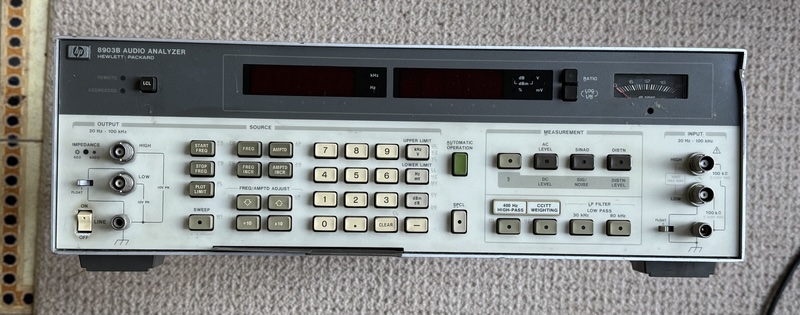
To take advantage of the programmability of the 8903, I have also acquired an HP 82350B PCI HPIB card and five HPIB pass-through cables. If I can figure that bit out, my plan is to run the Keysight I/O libraries, WinGPIB, and Pete Millett's 8903 automation program. I'm replacing my main photo-editing workstation which will free up an old Xeon workstation-class computer that I can move to the shop.
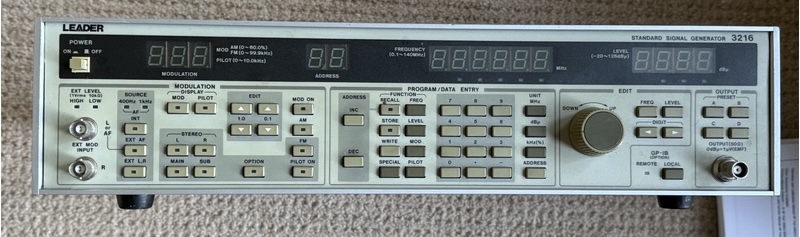
And I've always been interested in FM radio, for some dumb reason, and have a bevy of tuners that are oldish and potentially in need of tuning up. They are all solid-state and most have digitally synthesized VFO's, so they may not need anything, but at least I can confirm that. And I can start trawling the local marketplace for restorable stereo junk to repair and sell if the motivation strikes. To that end, I picked up this Leader 3216 FM stereo generator. I think it will be pretty handy coupled to the distortion analyzers. These seem similar to Panasonic and especially Kenwood units of similar function, making me wonder who actually made what, or if they all just copied each other.
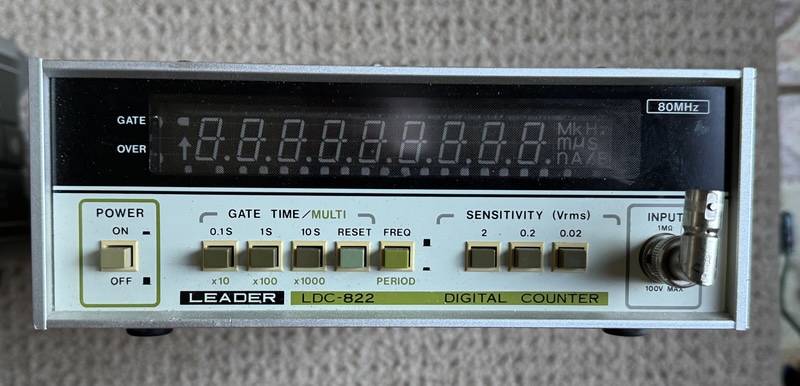
That sale came with a Leader LDC822 counter without the option. I already have a Tektronix CFC250 (made, I think, by Kenwood), which is probably in the same class, and an HP5334B, which is far better. This one does not appear to have the OCXO, and the specs call for a standard ceramic crystal accuracy of 5PPM. That's not really quite good enough for calibrating ham radios. But I can tweak it up now that I have a GPSDO reference (and a 5334B validated by that reference). Either it or the Tek will go, unless I find it useful on the ham radio table somehow. The word is out on the 3216 and the cheapest examples are uncommon--I certainly didn't get a screaming deal on this one--so selling one of these counters wouldn't bring much but it would take the edge off.
It is nice looking, though.
In other news, I have figured out which 200K precision resistor is bad in the highest decade of my General Radio 1434B Decade Resistor reported upthread, and have ordered a replacement. I went through the servicing procedure and except for that resistor it's exactly on spec.
Rick "still looking for the bottom of this rabbit hole" Denney

 Home
Home Help
Help Search
 Login
Login Register


