Disappointing.
Why? Because I was hoping he'd explain how his random-pixel image-reconstruction thingie worked. That's the fascinating part here.
It is called compressed sensing
https://en.wikipedia.org/wiki/Compressed_sensing, and roughly said, it's some ugly math that fits a waveform through a set of samples you have. Which waveform it fits, out of all the infinite possible waveforms? The one with the minimum number of spectral components. How is this done, or how to find that particular waveform of a minimum spectrum? With mathematicians and computers, something like this:
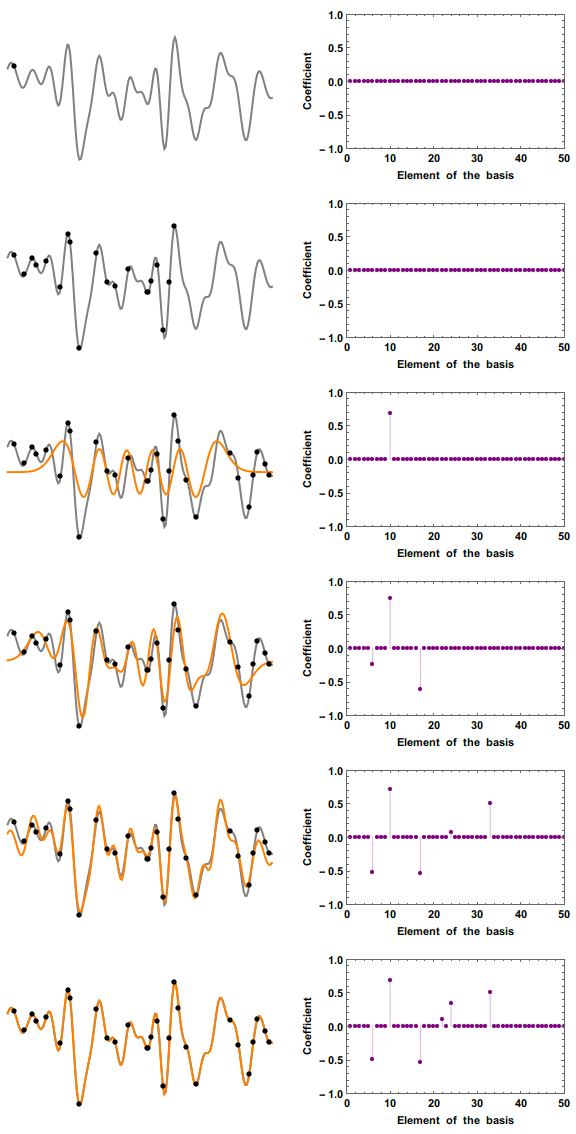
Why that particular choice, out of all possibilities of "connecting" our samples with a line, why only that waveform with the minimum number of spectral lines works the best? Why does it restores the original, and not some other image? Nobody knows, but it works. A lot of statistics and philosophy and hand-waving.
My interpretation is, because the human mind assigns meaning to correlation/structure/patterns, and correlations are
compressible information. Why a brain is about finding corelations? Because the brain is a processor meant to predict the future. One can only predict structured information, by definition randomness can not be predicted. Why did we evolved a future-prediction machine? To be more successful at staying alive, to avoid stepping into shitty situations.
Predicting the future is not a goal in itself, it's just the result of natural selection. The dumbest of our ancestors didn't notice the tiger stripes from the grass stripes, and "dieded" faster than those able to "see it coming and avoid the tiger".

In conclusion, compressed sensing.

Because of lions and tigers and bears!


 Home
 Help
 Search
 Login
 Register


