Author Topic: Fun for nerds  (Read 342475 times)

0 Members and 30 Guests are viewing this topic.

Offline RoGeorgeTopic starter

  • Super Contributor
  • ***
  • Posts: 8502
  • Country: ro
Re: Fun for nerds
« Reply #750 on: July 19, 2025, 08:05:28 am »
Disappointing.
Why? Because I was hoping he'd explain how his random-pixel image-reconstruction thingie worked. That's the fascinating part here.

It is called compressed sensing https://en.wikipedia.org/wiki/Compressed_sensing, and roughly said, it's some ugly math that fits a waveform through a set of samples you have.  Which waveform it fits, out of all the infinite possible waveforms?  The one with the minimum number of spectral components.  How is this done, or how to find that particular waveform of a minimum spectrum?  With mathematicians and computers, something like this:
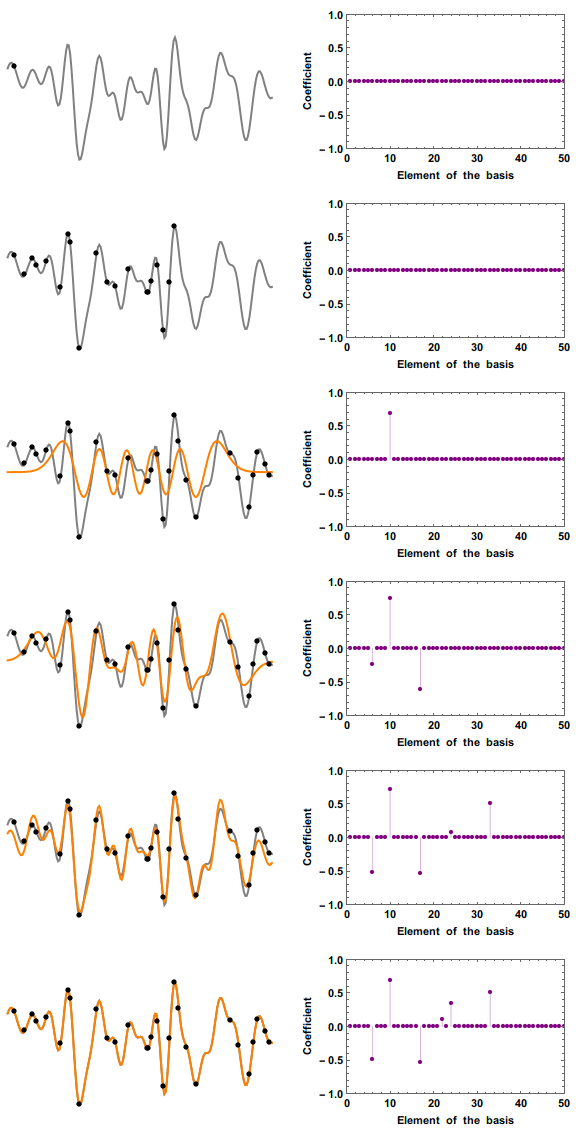


Why that particular choice, out of all possibilities of "connecting" our samples with a line, why only that waveform with the minimum number of spectral lines works the best?  Why does it restores the original, and not some other image?  Nobody knows, but it works.  A lot of statistics and philosophy and hand-waving.

My interpretation is, because the human mind assigns meaning to correlation/structure/patterns, and correlations are compressible information.  Why a brain is about finding corelations?  Because the brain is a processor meant to predict the future.  One can only predict structured information, by definition randomness can not be predicted.  Why did we evolved a future-prediction machine?  To be more successful at staying alive, to avoid stepping into shitty situations.

Predicting the future is not a goal in itself, it's just the result of natural selection.  The dumbest of our ancestors didn't notice the tiger stripes from the grass stripes, and "dieded" faster than those able to "see it coming and avoid the tiger".  :scared:

In conclusion, compressed sensing.  :-//
Because of lions and tigers and bears!  ;D
« Last Edit: July 19, 2025, 08:36:25 am by RoGeorge »
 
The following users thanked this post: BrianHG

Offline coppercone2

  • Super Contributor
  • ***
  • Posts: 13719
  • Country: us
  • √Y√... 📎
Re: Fun for nerds
« Reply #751 on: July 19, 2025, 09:37:10 am »
 

Offline RoGeorgeTopic starter

  • Super Contributor
  • ***
  • Posts: 8502
  • Country: ro
Re: Fun for nerds
« Reply #752 on: July 19, 2025, 01:35:53 pm »
Playing Snake with water
Steve Mould


 :D
 
The following users thanked this post: BrianHG, radiolistener

Offline BrianHG

  • Super Contributor
  • ***
  • Posts: 8795
  • Country: ca
    • LinkedIn
Re: Fun for nerds
« Reply #753 on: July 19, 2025, 02:16:40 pm »
Real X-Ray vision....

Disappointing.
Why? Because I was hoping he'd explain how his random-pixel image-reconstruction thingie worked. That's the fascinating part here.
Funny, that's the easiest part to understand.  Though, I did design FPGA based image/video enhancement processors 15 years ago when CPU and GPUS weren't fast/or/programmable enough.

All complete missing data, or voids are filled in with approximations between surrounding data.  Think of all missing pixels where absolutely no reflected X-rays were received at all generates a mask overlay image defining a map of where you need to generate the pixels underneath.  All other pixels are considered true, or accurate.

Note that the math used today is far more sophisticated than what I was doing 20 years ago (We could not imagine using sophisticated floating-point math on images at the time which would involve 2D FFT image interpretation):

     For the a film restoration project I did 2 decades ago, we used red, green, and blue light for the true colors, then IR light at an off angle which illuminated just the scratches and dirt on the film.  With some math, we could then stencil out a negative of those pixels scanned with the IR light and rendered those masked out pixels by their surrounding true accurate colored pixels with nothing more than an average and mix algorithm from the surrounding data.  Even though we didn't do sophisticated interpreted resampling of the stenciled out missing image data, for a lot of the old 8mm and 16mm film movies, the final results were still astounding.

Offline Analog Kid

  • Super Contributor
  • ***
  • Posts: 5005
  • Country: us
  • DANDY fan (Discretes Are Not Dead Yet)
Re: Fun for nerds
« Reply #754 on: July 19, 2025, 05:15:09 pm »
Disappointing.
Why? Because I was hoping he'd explain how his random-pixel image-reconstruction thingie worked. That's the fascinating part here.

It is called compressed sensing https://en.wikipedia.org/wiki/Compressed_sensing, and roughly said, it's some ugly math that fits a waveform through a set of samples you have.  Which waveform it fits, out of all the infinite possible waveforms?  The one with the minimum number of spectral components.  How is this done, or how to find that particular waveform of a minimum spectrum?  With mathematicians and computers, something like this:


Thanks. That's what I'm talkin' 'bout.

I'd like to know more about this, understand the details of how it's implemented. Perhaps in another thread.
Apparently the guy programmed this in his little PIC/Arduino/whatever μC he used, so it can't be all that complicated.

According to his video, the solution is the least number of frequency components that fit the points. Pretty elegant.
 

Offline RoGeorgeTopic starter

  • Super Contributor
  • ***
  • Posts: 8502
  • Country: ro
Re: Fun for nerds
« Reply #755 on: July 19, 2025, 10:12:14 pm »
My guess is the Arduino was used only to move the sensor and to sample the data, (so to collect those black dots seen in the above animated waveform).  Then, those collected samples are sent from Arduino to a PC, where the best guessed image is calculated and displayed.

Pretty sure the algorithms for compressed sensing reconstruction are already implemented, and available as free software, but I never tried any.  There are a few documenting links in the video description (if you click "watch on YouTube", and on the YouTube page of the video, unroll the text description underneath the video).


Other fun things that can be done with compressed sensing is that you can indirectly "see" around a corner, for example.  By looking at the light diffused by a wall (non-line-of-site vision), so by looking at the scattered light from different angles or from different illuminating patterns, it is possible to reconstruct the image of an illuminated object using just a fotoresistor, and without pointing it towards the object.  The fotoresistor is facing toward another wall.  ;D

(a demo at the minute 9:10 of the second video linked here: https://www.eevblog.com/forum/chat/fun-for-nerds/msg5963141/#msg5963141 , and even funnier, that sensor is not a webcam with millions of pixels, it's just a single photoresitor, so a 1 pixel camera can reconstruct the image of an object it can not see, by staring at a blank piece of paper  :o ).
« Last Edit: July 19, 2025, 10:13:49 pm by RoGeorge »
 

Offline electr_peter

  • Supporter
  • ****
  • Posts: 1617
  • Country: lt
Re: Fun for nerds
« Reply #756 on: July 20, 2025, 08:14:56 am »
Other fun things that can be done with compressed sensing is that you can indirectly "see" around a corner, for example.  By looking at the light diffused by a wall (non-line-of-site vision), so by looking at the scattered light from different angles or from different illuminating patterns, it is possible to reconstruct the image of an illuminated object using just a fotoresistor, and without pointing it towards the object.  The fotoresistor is facing toward another wall.  ;D
I do not agree that this is "see around the corner" type of thing, or at least not without multiple caveats which make it much less useful. It is a compressed sensing type approach where object is directly lighted with specific structured light patterns and synchronized sensor detects average reflected light value. Average reflected light can be sensed direct, or bounced from many walls, but it still retains average value. But initial synced light patterns are direct, so it is a slight of hand to call it "see around the corner".
Other approaches use lasers and ultra fast light sensors, which is closer to "see around the corner" idea.
 
The following users thanked this post: Phil1977

Offline BrianHG

  • Super Contributor
  • ***
  • Posts: 8795
  • Country: ca
    • LinkedIn
Re: Fun for nerds
« Reply #757 on: July 20, 2025, 11:20:53 pm »
Playing Snake with water
Steve Mould


 :D
OK, that looks like fun...

Offline coppercone2

  • Super Contributor
  • ***
  • Posts: 13719
  • Country: us
  • √Y√... 📎
 

Offline coppercone2

  • Super Contributor
  • ***
  • Posts: 13719
  • Country: us
  • √Y√... 📎
Re: Fun for nerds
« Reply #759 on: July 26, 2025, 05:22:07 pm »
how accurate is this?


Offline David Hess

  • Super Contributor
  • ***
  • Posts: 19225
  • Country: us
  • DavidH
Re: Fun for nerds
« Reply #760 on: July 26, 2025, 06:29:27 pm »
how accurate is this?

The angular diameter is about right, but TON 618 would be 200 times brighter than the sun.

« Last Edit: July 26, 2025, 06:31:06 pm by David Hess »
 

Offline coppercone2

  • Super Contributor
  • ***
  • Posts: 13719
  • Country: us
  • √Y√... 📎
Re: Fun for nerds
« Reply #761 on: July 31, 2025, 06:49:43 am »
OK so you need a good filter

I found a equivalent mechanical of disinformation bots

It's like you put on of these, but on your computer monitor instead of an axle


« Last Edit: July 31, 2025, 06:52:59 am by coppercone2 »
 

Offline Phil1977

  • Frequent Contributor
  • **
  • Posts: 824
  • Country: de
Re: Fun for nerds
« Reply #762 on: July 31, 2025, 07:55:05 am »
Absolutely stunning to see bridge wire detonations in SloMo:


Offline RoGeorgeTopic starter

  • Super Contributor
  • ***
  • Posts: 8502
  • Country: ro
Re: Fun for nerds
« Reply #763 on: July 31, 2025, 08:50:59 am »
Replicating The Physics Behind Sandstorm Lightning (ft. 3D Printing Nerd)
Plasma Channel


 :)

Offline coppercone2

  • Super Contributor
  • ***
  • Posts: 13719
  • Country: us
  • √Y√... 📎
Re: Fun for nerds
« Reply #764 on: July 31, 2025, 06:08:53 pm »
https://www.science.org/content/article/peacock-feathers-can-be-lasers

I often wondered if my zirconium coated furnace (reflective coating) acts as a weak laser
 

Offline coppercone2

  • Super Contributor
  • ***
  • Posts: 13719
  • Country: us
  • √Y√... 📎
Re: Fun for nerds
« Reply #765 on: August 02, 2025, 09:58:38 pm »
 

Offline RoGeorgeTopic starter

  • Super Contributor
  • ***
  • Posts: 8502
  • Country: ro
Re: Fun for nerds
« Reply #766 on: August 05, 2025, 12:28:52 pm »
The curious origins of imperial and metric units
RobWords


 :)

Offline BrianHG

  • Super Contributor
  • ***
  • Posts: 8795
  • Country: ca
    • LinkedIn
Re: Fun for nerds
« Reply #767 on: August 06, 2025, 05:19:48 pm »
For those who just need 8 minutes of computational peace...


I realize I or someone else must have posted this years ago, but, it needed refreshing...

Offline SteveThackery

  • Super Contributor
  • ***
  • Posts: 3381
  • Country: gb
  • 50 year novice
Re: Fun for nerds
« Reply #768 on: August 07, 2025, 11:17:09 am »
Fantastic! I love it.

The sound effects are vaguely reminiscent of my days as a Strowger* maintenance guy.

*For newbies, an electromechanical telephone exchange technology.
 
The following users thanked this post: BrianHG

Offline BrianHG

  • Super Contributor
  • ***
  • Posts: 8795
  • Country: ca
    • LinkedIn
Re: Fun for nerds
« Reply #769 on: August 07, 2025, 05:21:54 pm »
Fantastic! I love it.

The sound effects are vaguely reminiscent of my days as a Strowger* maintenance guy.

*For newbies, an electromechanical telephone exchange technology.
I know.  To me, it is like a pleasant pace of thought stepped in slow motion.
Sort of like a metronome for the brain.

Offline BrianHG

  • Super Contributor
  • ***
  • Posts: 8795
  • Country: ca
    • LinkedIn
Re: Fun for nerds
« Reply #770 on: August 09, 2025, 10:25:10 pm »
The Math Problem That Defeated Everyone… Until Euler


Offline RoGeorgeTopic starter

  • Super Contributor
  • ***
  • Posts: 8502
  • Country: ro
Re: Fun for nerds
« Reply #771 on: August 10, 2025, 10:15:42 am »
Why Deep Learning Works Unreasonably Well
Welch Labs


 :-+


But how do AI images/videos actually work? | Guest video by ‪@WelchLabsVideo‬
3Blue1Brown


 :o


Offline BrianHG

  • Super Contributor
  • ***
  • Posts: 8795
  • Country: ca
    • LinkedIn
Re: Fun for nerds
« Reply #773 on: August 13, 2025, 08:30:01 pm »
Another relay piece of art:


Offline SteveThackery

  • Super Contributor
  • ***
  • Posts: 3381
  • Country: gb
  • 50 year novice
Re: Fun for nerds
« Reply #774 on: August 14, 2025, 11:21:40 am »
Another relay piece of art:

What a wonderful achievement.


Share me

Digg  Facebook  SlashDot  Delicious  Technorati  Twitter  Google  Yahoo
Smf


-->