-
Richiem, I took the liberty of plotting your data. See attachment. Jan
I mentioned on the LTZ1000 thread that I was interested to see what Awesome14's D-105 could do so I was buying one. It came yesterday. In the interest of more light and less heat, here is what I've found so far. The results are not metrology lab measurements -- they are a guide only, but I've provided enough info to make the results useful. One note -- I have thought for a while that my HP 3458A is reading 10VDC about 6ppm high, although it is in spec....
Calibratory D-105 10V standard evaluation, started on 2-7-15
Instruments used in evaluation:
— HP 3458A, calibration checked on 7 Aug. 2014, by Keysight in Loveleand — no adjustments made, found to be completely in spec; this is the standard model — 8ppm ref board. Used to monitor 10V standard outputs. 3458A powered on for last 6 days; internal temp 36.5 °C. ACAL 1 (DC) run at 4:30PM. NPLC=60, NDIG=8
— HP 3456A, cal’d against HP 3458A. Used for monitoring ambient temps with Pt100 RTD.
— Heath 2718 Linear Triple Bench Supply — each 20V supply powering one standard..
— Geller SVR (not the temp comp unit), purchased in 2007, used for approximately 12 hours total since then up to this time. On for the last 8 hours (included in total of 12), since 8AM with 15VDC power. Geller’s 2007 certificate says 10.000 00V, Tolerance 5ppm/°C, 15ppm/1k hrs. Cal’d at 23°C ambient.
D-105 unboxed in lab at 4PM. Connected to bench supply at 14.5VDC, initial ambient temp at case 23.0 °C. Ambient measured immediately adjacent to and in between the two standards, all sitting on top of an HP 8904A that was powered off — makes a handy stand with some thermal mass.. D-105 output started a few hundred microvolts below 10V, quickly rose to 10.000 05VDC. Calibratory’s certificate says 10.000 0014V, cal’d at 20°C ambient.
Both the Geller SVR and the D-105 outputs are connected with 24ga. solid copper insulated wires (old-school telephone extension wire) to gold flashed dual banana plugs to ease connections to the 3458A. The wires are soldered to the Geller SVR and clamped in the gold-flashed bindind posts of the D-105.
Elapsed time Ambient Geller SVR D-105
for D-105 °C
0.6 hr 23.5 10.000 060 10.000 058
3.4 hr 22.9 10.000 071 10.000 068
5.3 hr 23.6 10.000 060 10.000 066
6.4 hr 23.8 10.000 053 10.000 068
Overnight break in measurements with lab cool-down to thermostat set 66°F, reheat in AM to 71°F; standards left powered on.
20.1 hr 22.4 10.000 092 10.000 078
22.5 hr 22.5 10.000 088 10.000 078
Moved to warmer location on top of HP 3456A, standards and RTD grouped as before.
22.8 hr 28.9 10.000 017 10.000 047
23 hr 29.3 10.000 002 10.000 042
24 hr 29.5 9.999 997 10.000 043
Standards powered down. Will begin from room ambient start in 18 hours or so.
At this point, a simple "box" of drift v. temp shows that average drift for the D-105 is approximately 0.5ppm/°C; the Geller SVR average drift is approximately 1.4ppm/°C (pretty good).
-
The obsolete metal can version of REF102, REF102BM are avaliable on the open market, sellers have been asking $30. Some where listed on Ebay yesterday. High price but I bought two and will post results when they arrive. Jan
-
I think that about covers it, unless I neglected something? Can anyone think of additional features and characteristics this device should have?
I have build and sold some voltage references, and I think it is very hard to achieve all of your items on the list. Most of the specs will be met through the chosen reference. All circuity around it will worsen the reference.
What you have missed are some "practical" things:
- it should be easy to package and send, without getting damaged in the mail.
- it should be easy to manufacture and reproduce.
etc. etc. -
4 and 11 are a little bit contradicting, aren't they? (Sorry, non-native english speaker)
18. A rechargeable battery is preferrable, but Lithium Ion chemistry is to be avoided in new designs due to air freight problems.
19. In addition to pt. 17, each device shall have a globally unique ID. Preferrably, the comparison labs also should have one. A QR code on the label might contain either the device history or a link to a website dedicated to the device.
I didn't want to tell so early as i am not behind the idea stage, but 19. is exactly something I intended to do, related to the LTZ1000A thread - set up a website which is like a common history file for voltage and resistance standards.
Don't check out http://wildvolttaming.schaffenburg.de/ yet. There is nothing to see. Still.
-
Good idea with such a list.
Your list; some things I'd like to see:
- "no need for high precision / stability voltage supply"
- polarity protection
- output overload protection
Some means of historical data would be useful to see how stable the thing has been....what the SVR-T and D-105 are supposed to be.... *NOT* something that you would use to maintain a stable volt in your laboratory long-term.
Do the sellers say that? I think most users that look for budget un-documented references don't require sub-1 ppm calibrations. But there is surely a need for a check-up of your hand-held and 4-5-6 digit DMMs. NOT saying the SVR-T and D-105 cant be used as pure short-term transports and that some users could use them as such. -
Sorry, I read "5." as if it was intended to run on mains adapters as well.
Widely available cheap batteries of course the best solution. Maybe good o'l 9V "PP3, 6LR61", one if a 5V version, two for a 10V? -
@richiem:
That's a bit unfair to the Geller design, because you are not using the temperature compensated SVR-T, so you are comparing apples to oranges. I suspect the Geller SVR-T would be almost a straight line with temperature, as that is what he obtained for each unit in his micro-chamber after adding the thermistor and "tuned" resistor. Note that the TC of resistors [and therefore monolithic voltage reference outputs] does not change with time unless they are severely abused [like super high temperature exposure, etc.]. So, once a TC is obtained and set, there is no reason to do it again, any only the voltage offset will need trimming from time to time, and this is mainly due to resistor absolute value drift.
Can you borrow an SVR-T from someone and run the test again of the D-105 vs. SVR-T?
FWIW, my comparison of the SVR-T against a Fluke 731B is here:
https://www.eevblog.com/forum/testgear/geller-labs-svr-and-svr-t/msg282582/#msg282582
If the link works...
They were within 1ppm over 3.8 deg K.
-
The price of the D-105 is US $97.95 today....
-
@ Diligent -- I used the SVR because it's what I have. Since getting the 3458A, I just trust that it is good enough for nearly anything I might want to do, so I haven't invested in any real standards. I never even knew about the SVR-T, which I would gladly have bought. I'm out in the boonies of Western Washington on Puget Sound, and I don't know any volt-nuts around here anywhere at all, so no joy on getting an SVR-T unless you have one to ship me. But I don't really think that's necessary -- I suspect that the Geller unit would be at least equal to the D-105 and quite possibly better. Sorry that Joe quit making them.
BTW, I checked noise output in a 10Hz to 10kHz band and the SVR and the D-105 are comparable at around 10uVavg, as measure by an HP 400GL with modded filter. The more important measure would be at lower frequencies, but I don't have any gear that will go into the sub 10Hz region at such low levels. I used my Tek 7A22 with DC-100Hz BW, and they both had noise in the 25-30uVp-p region, but the 7A22 has 10uVp-p noise all by itself...
I do now have a fully characterized 10k R standard (unlimited and effusive thanks to Dr.Frank for some serious work), and I also have a spare ref board from a 3458 that I'm going to turn into a 7.1xxx and 10V standard. So at some point I'll have something more precise to compare to. You know how these things go... -
The price of the D-105 is US $97.95 today....
My guess is that the sales went to zero after Awesome14 raised the price, so he put it back. This is good to know-- it seems the "threshold of pain" for the "Arduino crowd" appears to be about US$100 for this kind of device.
If the target audience is the "Arduino" crowd, why do they need a voltage standard anyway? If I was gong to build or participate in building one of these things, it would be primarily to understand the techniques and tools necessary for achieving high-precision and stability. I suspect the lessons learned would serve me well, as it would others. The practical need and use of such a device (for me) is beside the pint. If I really need a standard, I would almost certainly buy a known good design from a reputable manufacturer.
The idea of creating an electronics experiment that spans many people around the world over a long period of time is really intriguing. I just would not want to put a tiny price tag on it to be appealing to those that would never want it or even know what it is. I would say, make the target performance first price second. -
Either I had some browser cashing issues or the price goes up and down. US $157.95 for the 2ppm version now?
He also lists a 6ppm version for $59.95 -
Either I had some browser cashing issues or the price goes up and down. US $157.95 for the 2ppm version now?
He also lists a 6ppm version for $59.95
I think there are 2 listings for D-105 2ppm, one US and the other International, I guess to cover shipping cost, etc.
-
Yes, the one for $157 is listed as USPS Int. Shipping.
-
Ah! I have one US and one EU shipping address.... Listings change when I change address :-|
-
@Awesome14:
Just curious, how much did Fox Valley charge you for the calibration for the 732A?
400.00USD -
Quote
Before I post any thing on line I do a quick check, "would I say that to my boss or a friend?"
I strongly support peer review and positive criticism, but it should always be done in a objective way preferably supported by analysis or prior art.
It should never be an attack on the person, his believes or his culture.
I feel the same way, but here it's a different story. It's plain and simple: scam.
No problem if a guy is using a sloppy breadboard reference in his own lab and believes in magic and unrealistic specs. But selling a black box with false claims (2ppm and esoteric bullshit description) for a horrendous price is scam. And I have no mercy for that, especially on ebay where you need to trust the seller when buying stuff. it's like selling 32GB USB sticks that only have 1GB chips inside. Plain and simple scam
My device promises certain performance criteria. It lives up to it's claims. If I can demonstrate financial losses due to your reckless and untruthful comments, be prepared to pay those damages. It is no scam! Until you can prove that any claim I make is false, it would be best not to dig the hole any deeper. I have research data to prove my claims. You have nothing to disprove them. Let's just stick to professional opinions and leave the rest at the door. -
I don't see any heatpipes in the teardown
Maybe he thinks all the plated holes in the perf board are heat pipes. After-all, they're metallic and kind of pipe shaped
If you look at the pictures....and try to decipher Awesome14's comment....this is what I believe he is saying....
He has glued a piece of copper foil, between a diode, and the ref IC case....he is calling that a "heatpipe". Ok it's not. I think he is saying that he is cooking that poor little diode, and expecting that a thin piece of copper foil is somehow transferring enough thermal energy from the poor little diode (which is his "heater") to "stabilize" the REF IC. The efficiency of heat transfer across that piece of foil is nil. Also the diode is right next to a shit bottom of the barrel trimmer....which hasn't even had the wiper screw glued in place. So in essence he is creating more of a problem than solving one. The majority of heat (which is hardly any) is not traveling across the copper foil to the REF innards....it's just traveling, via convection, into the case of the trimmer.
Ok fine...even then I doubt this has any significant impact on anything in this circuit. If his theory is to heat the case of the REF then why not just take some nichrome wire...zig zag it across the top of the REF IC case....bond it thermally and run some current through it? That would be far more efficient than his method....and still that isn't the proper way to ovenize this package.
This all could be avoided...by simply designing a proper PCB....with a thermal layer...bonded to a TO (can) REF IC, in the dead bug config....bond the case of the TO package to the thermal layer with some thermal "grease"....and then bond a proper controlled heater to the thermal layer....just like everyone else does....
Instead he claims this is somehow innovative, and we are all too stupid too see it....I am sorry but I am all for helping people, but not when they act like some elitist and call everyone here inferior....ESPECIALLY when they have ZERO basis in their claims...NO data to prove anything and start talking about being handed circuit designs from God himself....throw in vampires, angles, and whatever other bullshit is flying out of this guys mouth, and I just don't feel like being nice anymore....
I said back on page one, that the REF102C is in fact an excellent monolithic ref IC.....I have worked with them many times, and if you hand select (bin) the IC, you can easily get better than 2ppm per year stability....out of the plastic package. No big deal there.
What I am amazed at is that DESPITE the poor layout and construction of Awesome14's "reference" the Ti REF102C is getting anywhere near 2ppm stability (+/- so 4ppm really) for even a day or two....I still see zero data showing anything about stability over 30, 90, 180, 256,etc etc etc days....
If anything I say this whole scenario just shows how good the REF102C can be....even when someone who has no idea what they are doing slaps one together with perfboard....shit components and construction techniques....
Again I have used the REF102C in a proper ovenized enclosure design...with proper supporting components, and it's a nice little IC, for a reasonable cost.....easy to implement etc etc etc....and IF you hand select the IC you CAN get better than 1.5ppm stability over a year or more....fine, no big deal...that is not innovative, astounding or anything other than "decent".....
The claims of "heatpipes" and "revolutionary design"....and then insulting us all on the basis that since we don't agree, we are somehow mentally inferior and closed minded...is simply going past the point where I feel like lending any advice or being a nice guy....
So again the only conclusion here, is that DESPITE Awesome14's total ignorance and terrible mental disabilities, the REF102C is a half way decent REF IC....I am mainly still here reading and commenting, because I find this entire thread utterly hilarious, on the basis of the divine claims, breaking the laws of physics claims, assassination conspiracy etc etc etc....it's pure comedy at this point....nothing anyone says here is actually going to help Awesome14, he is far beyond that....
To top it off Awesome14 is SELLING these on eBAY....with bogus descriptions....no pictures of internals....and for a price that doesn't justify anything he has done. Anyone here or there could easily order the same IC from Mouser or Digikey or wherever, for not much money...slap it on a perfboard...with half way decent components....throw it in a hammond enclosure and probably have BETTER results, for under $50.
So basically this is an eBAY scam, and constitutes fraud....and that is simply shameful....there is nothing innovative or "magical" about the "product"....it's built on nothing more than an application schematic handed down from Burr-Brown to Ti and then from Ti to Awesome14....and he didn't even implement it properly....why would anyone want to help this guy? He is scum...
I am not required to show internals on eBay. Nothing in my listing constitutes fraud. People have commented in this thread that the device is "dead on" according to their meters. I'm not at all ashamed of a +-2ppm standard that works. It even holds its calibration when shipped powered down. Many people have evaluated this product, and not one has found my claims to be incorrect. I feel sorry for you. You have no ground to stand on, so you resort to unfounded personal attacks. I doesn't bother me what you think of me. But please don't level unfounded criticisms against my invention. Thank you for your kind consideration in this matter. -
And if you take a good look in this thread, you will see the firsts attacks come from awesome14.
I agree, in the start, it was looking good, with good points on how to do, and how to evaluate this kind of circuits. But when the people from this forum started to try to get real tests, then the maker came and start to try make everyone to think the same way he does.
Using non-scientific things to explain the circuit, blah blah...
Then, after he show some attacks to whom disagree from him, the things come more comedy... From some pages there is nothing but funny posts, from one side or another.
No big deal. There is somethings that we don't really say to someone, but if he is concerned about this, stop to say something to us (like all that crap about how he get the circuit from heavens, or something about vampires, about the cardiologist who know so much of electronics, about death attempts, how all this are connected to some voltage reference circuit?)
More than a scam, it is a troll.
Show me one place where I did anything but tell the truth. I didn't attack anyone. -
I would be fun to have a community effort to design an easy DiY EEVblog voltage standard.....NOW that sounds like fun, because we could all measure our "identical" standards against eachother....and log the results....which would actually be a HUGELY useful set of data to take academic indicators from.....imagine a loose comparison of a few dozen identical standards, against all the varying conditions each individual "lab" has.....that sounds like a nice statistical effort and might actually lead to some discovery, for those that don't have any experience in this field and want to learn....and even those who think they know alrady
Where do I sign up?
-
I have research data to prove my claims.
Then show those and everyone will shut-up if they check out
-
The D-105 DC will not read correctly during a change in temperature. The temp must remain constant for at least an hour. It is best to power the unit off until equilibrium has been reached. The problem arises because of the greater difference in temperature between the tempco thermistor and the IC that occurs during a temperature change.
-
Quote
Before I post any thing on line I do a quick check, "would I say that to my boss or a friend?"
I strongly support peer review and positive criticism, but it should always be done in a objective way preferably supported by analysis or prior art.
It should never be an attack on the person, his believes or his culture.
I feel the same way, but here it's a different story. It's plain and simple: scam.
No problem if a guy is using a sloppy breadboard reference in his own lab and believes in magic and unrealistic specs. But selling a black box with false claims (2ppm and esoteric bullshit description) for a horrendous price is scam. And I have no mercy for that, especially on ebay where you need to trust the seller when buying stuff. it's like selling 32GB USB sticks that only have 1GB chips inside. Plain and simple scam
My device promises certain performance criteria. It lives up to it's claims. If I can demonstrate financial losses due to your reckless and untruthful comments, be prepared to pay those damages. It is no scam! Until you can prove that any claim I make is false, it would be best not to dig the hole any deeper. I have research data to prove my claims. You have nothing to disprove them. Let's just stick to professional opinions and leave the rest at the door.
Whoa there! I would think you would let the device speak for itself! There is no need for threats on either side. If you believe in the D-105 and it really works then there is no need to defend it! So far I am quite pleased with the results. I am currently doing a long term test and so far the results are not too bad! -
I don't see any heatpipes in the teardown
Maybe he thinks all the plated holes in the perf board are heat pipes. After-all, they're metallic and kind of pipe shaped
If you look at the pictures....and try to decipher Awesome14's comment....this is what I believe he is saying....
He has glued a piece of copper foil, between a diode, and the ref IC case....he is calling that a "heatpipe". Ok it's not. I think he is saying that he is cooking that poor little diode, and expecting that a thin piece of copper foil is somehow transferring enough thermal energy from the poor little diode (which is his "heater") to "stabilize" the REF IC. The efficiency of heat transfer across that piece of foil is nil. Also the diode is right next to a shit bottom of the barrel trimmer....which hasn't even had the wiper screw glued in place. So in essence he is creating more of a problem than solving one. The majority of heat (which is hardly any) is not traveling across the copper foil to the REF innards....it's just traveling, via convection, into the case of the trimmer.
Ok fine...even then I doubt this has any significant impact on anything in this circuit. If his theory is to heat the case of the REF then why not just take some nichrome wire...zig zag it across the top of the REF IC case....bond it thermally and run some current through it? That would be far more efficient than his method....and still that isn't the proper way to ovenize this package.
This all could be avoided...by simply designing a proper PCB....with a thermal layer...bonded to a TO (can) REF IC, in the dead bug config....bond the case of the TO package to the thermal layer with some thermal "grease"....and then bond a proper controlled heater to the thermal layer....just like everyone else does....
Instead he claims this is somehow innovative, and we are all too stupid too see it....I am sorry but I am all for helping people, but not when they act like some elitist and call everyone here inferior....ESPECIALLY when they have ZERO basis in their claims...NO data to prove anything and start talking about being handed circuit designs from God himself....throw in vampires, angles, and whatever other bullshit is flying out of this guys mouth, and I just don't feel like being nice anymore....
I said back on page one, that the REF102C is in fact an excellent monolithic ref IC.....I have worked with them many times, and if you hand select (bin) the IC, you can easily get better than 2ppm per year stability....out of the plastic package. No big deal there.
What I am amazed at is that DESPITE the poor layout and construction of Awesome14's "reference" the Ti REF102C is getting anywhere near 2ppm stability (+/- so 4ppm really) for even a day or two....I still see zero data showing anything about stability over 30, 90, 180, 256,etc etc etc days....
If anything I say this whole scenario just shows how good the REF102C can be....even when someone who has no idea what they are doing slaps one together with perfboard....shit components and construction techniques....
Again I have used the REF102C in a proper ovenized enclosure design...with proper supporting components, and it's a nice little IC, for a reasonable cost.....easy to implement etc etc etc....and IF you hand select the IC you CAN get better than 1.5ppm stability over a year or more....fine, no big deal...that is not innovative, astounding or anything other than "decent".....
The claims of "heatpipes" and "revolutionary design"....and then insulting us all on the basis that since we don't agree, we are somehow mentally inferior and closed minded...is simply going past the point where I feel like lending any advice or being a nice guy....
So again the only conclusion here, is that DESPITE Awesome14's total ignorance and terrible mental disabilities, the REF102C is a half way decent REF IC....I am mainly still here reading and commenting, because I find this entire thread utterly hilarious, on the basis of the divine claims, breaking the laws of physics claims, assassination conspiracy etc etc etc....it's pure comedy at this point....nothing anyone says here is actually going to help Awesome14, he is far beyond that....
To top it off Awesome14 is SELLING these on eBAY....with bogus descriptions....no pictures of internals....and for a price that doesn't justify anything he has done. Anyone here or there could easily order the same IC from Mouser or Digikey or wherever, for not much money...slap it on a perfboard...with half way decent components....throw it in a hammond enclosure and probably have BETTER results, for under $50.
So basically this is an eBAY scam, and constitutes fraud....and that is simply shameful....there is nothing innovative or "magical" about the "product"....it's built on nothing more than an application schematic handed down from Burr-Brown to Ti and then from Ti to Awesome14....and he didn't even implement it properly....why would anyone want to help this guy? He is scum...
I am not required to show internals on eBay. Nothing in my listing constitutes fraud. People have commented in this thread that the device is "dead on" according to their meters. I'm not at all ashamed of a +-2ppm standard that works. It even holds its calibration when shipped powered down. Many people have evaluated this product, and not one has found my claims to be incorrect. I feel sorry for you. You have no ground to stand on, so you resort to unfounded personal attacks. I doesn't bother me what you think of me. But please don't level unfounded criticisms against my invention. Thank you for your kind consideration in this matter.
When you make unfounded scientific claims....I have every right to refute them with a foundation of science.....your "heatpipe" concept is bunk and simply doesn't work....sorry but that is a provable fact. Also there is ZERO long term testing data to prove your claims of +/- 2 ppm. Is it possible, sure....and that is in no part due to anything miraculous your have discovered.....you just got a "lucky" IC. Which you already know to be true....and why you sell different graded devices. Some meet spec, some don't.....however you have proven NOT once that they meet a spec over any period of time. Simply sating +/- Xppm is nonsense, as that is a static measurement.....and the real world is a dynamic environment.....not one manufacturer makes a claim of ppm drift, without adding a measurement of time to it...
So again let's see your 30 day, 60 day, 90 day, 180, day etc etc etc numbers....THEN you can make a wholesale claim of XYZppm over time.....until then it's bullshit.....
Also if it doesn't bother you what myself or others think, then why do you keep responding? Also you should be bothered by what others think, because you have a product to sell.....you rlack of data and attitude have ensured that I will never buy anything from you....if you don't care about that, then you don't care about business......instead of offering proof or data to back any claims, and convincing some of us here that we should buy your product, you have done exactly the opposite....
I don't see Fluke claiming they were handed superior designs from God, or their CEO making any claims about conspiracy theories, regarding assassination attempts.....YOU brought that stuff up, and defamed yourself....you could have said nothing and just posted data to shut us all up....but again you came here with a superiority complex....and then made wild, bogus claims about things like "heatpipe" technology....which your device clearly does NOT employ....nor would it do anything to help the ref with stability if it did.....
AND THAT IS FRAUD......if you need me to link the definition I am happy to http://legal-dictionary.thefreedictionary.com/fraud -
And if you take a good look in this thread, you will see the firsts attacks come from awesome14.
I agree, in the start, it was looking good, with good points on how to do, and how to evaluate this kind of circuits. But when the people from this forum started to try to get real tests, then the maker came and start to try make everyone to think the same way he does.
Using non-scientific things to explain the circuit, blah blah...
Then, after he show some attacks to whom disagree from him, the things come more comedy... From some pages there is nothing but funny posts, from one side or another.
No big deal. There is somethings that we don't really say to someone, but if he is concerned about this, stop to say something to us (like all that crap about how he get the circuit from heavens, or something about vampires, about the cardiologist who know so much of electronics, about death attempts, how all this are connected to some voltage reference circuit?)
More than a scam, it is a troll.
Show me one place where I did anything but tell the truth. I didn't attack anyone.
you have GOT to be kidding.....go back and read your own posts.....UN-freaking-believable
We can start with claims about your miraculous "heatpipe" technology.....how about claims of somehow bending the laws of physics, to improve Ti's technology? Face it, the ref you are selling simply proves the quality of Ti's REF102C package...DESPITE your best efforts to corrupt it's implementation.....
You have been your own worst critic and enemy here.....DESPITE many of us offering suggestions and constructive criticisms....
I have a proposal....show me the testing data, that proves your little piece of copper foil, bonded to a weak heat source, and then bonded to the CASE of the REF IC, does ANYTHING AT ALL to improve performance.....seriously ONE piece of data and I will take you seriously.
as far as I can see, you have done nothing other than meet Ti's own claims of potential stability in their IC package....nothing more and certainly less, in some cases....in case you missed the Ti lab report on this IC, here it is again.....
Show me ONE SINGLE piece of data that backs up your claims of "bettering" Ti's ref IC....if you simply made a mistake, because you don't understand what you are doing....then that is fine, admit it....be humble and some of us here might be inclined to help you.....but you need to stop posting misleading claims on your ebay listing, and stop with all of this "miraculous" technology inventions of your....they don't exist....nothing here, to me, is magic, or even "seems like magic".....in fact it follows Ti's own data sheet to the T....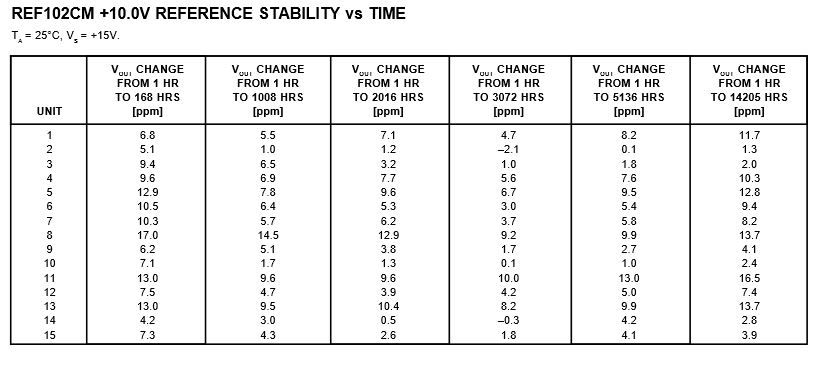
P.S. the chart above is the M package version of the REF102C....which is the TO (can) style package.....Ti claims that the plastic package achieves the EXACT SAME stability figures AFTER 168 hours stabilization time.....which I whole heatedly believe....and can attest to, through my own experiences with the REF102C (non M) package.....nothing miraculous here.....just an honest manufacturer, who makes a device with a degree or predictability, for a reasonable cost.....I.E. good science, good marketing, from a reputable company....and that is PAR for the course... -
My device promises certain performance criteria. It lives up to it's claims. If I can demonstrate financial losses due to your reckless and untruthful comments, be prepared to pay those damages. It is no scam! Until you can prove that any claim I make is false, it would be best not to dig the hole any deeper. I have research data to prove my claims. You have nothing to disprove them. Let's just stick to professional opinions and leave the rest at the door.
It is up to the person making a claim to prove it. Nobody can disprove your claim or claims. You claim that the design was a gift from your god. How does anyone disprove such an extraordinary claim? You claim that your device performs 2.5X better SVR. Prove it or shut up. I don't believe your claims of divine inspiration and if YOU claim something, YOU prove it. It is the same with every woowoo believer, they ant everyone else to prove them wrong on unclear claims. If you think your attitude here helps improve your sales then perhaps your god gave you the wrong attitude to go along with his design.
To claim damages you have to prove 3 things. You have to prove intent to damage your reputation, that the action actually damaged your reputation, and that the reputation wasn't already deserved or assigned before the action. I have an opinion, mine, for me. You are not a rational person and your design is just a basic replication of a reference design, the ideas you have are woowoo, and the construction techniques are what I would expect from a naive audiophool who has no idea of the real world and maybe a ten year old making his first circuit. In other words, I will never buy anything from you and each time you have opened your mouth here, never gets longer.