-
They are soldered. I did not see behaviour change after one desolder-solder cycle , in terms of drift. Also I do not agree on uselessness of good ADC for long term tests. Its capable to stay <1ppm over week without ACAL.
-
Hi Dr. Frank.
..
On the other hand, there was a design/implementation flaw in 3458A by using that big customize chip which contains many paring resistor with very strict requirements that often fail to meet.
Your 3458A is good today, my 3458A is good today, doesn't mean they will be good always, doesn't mean other 3458As are all good. My 3458A was bought 10 years ago 1st hand from an authorized Agilent dealer, but about two months after, I found out it was drifting all the time, they provided free repair of course - they replaced the big customize chip. I myself once try to fixed a drifting 3458A that ended up with suspecting that chip and can do nothing about. I Think TiN has the similar feeling about it.
Even with 'good' 3458As, they require frequent ACAL to cancel the drift of resistors within the big chip(better hourly), which is not possible for T.C. measurement that often automatic, continuous for several hours.
.
Hello zlymex,
I totally disagree, that this property is a design flaw., that's not correct, if you read about the design goals (see hpj 4-1989) of this instrument.
That is, that it should be a very fast A/D converter, also, or in first instance.
This demands, that the integrating resistors would have to be split in different weights (multiple of 2, in this case).
Correct, the disadvantage is, that now the stability depends on the ratio of these integrating resistors.
And I pray, that my, and also your ASIC will stay hermetically tight, so that there will be no degradation, like TiN encountered in several of his A3 PCBs.
Anyhow, my instrument, and also your instrument, are good enough to make stability measurements on the order of a few tenth ppm.
Still, it would be nice, if you would provide these statistical characterization of the 4910A and 732B, so that we volt-nuts in this thread have a baseline for our DIY references.
Frank -
@zlymex:
so it seems that these chips are available, if your friend replaced them. I always thought they are not.
can you shed some light on that please.
-
@zlymex: Are this chips soldered in, or are they in sockets? If soldered in, how in the heck do you remove them?
I refer the gentleman to Dave's previous video on the subject (and subsequent videos where he begins to appreciate it!)
Also known as the Duratool ZD-915, etc... I got mine for £30 from a fella down the road. -
So, I'm still interested on your 1..2h Standard Deviation / Noise-RMS numbers of the 732B vs. 4901, to get an idea, how well Andreas modification performs.
Hello,
I think the best would be calculating the Allan deviation over a longer time period.
Then you can see clearly the 1 hour or short time stability at one glance.
Here one 8hr measurement (1 minute averages) for my newest ADC with LT1027DCLS8-5 and LTZ#4:
At the moment the T.C. is not calibrated so I have a drift with temperature.
This also can be seen on the Allan deviation diagram.
Best stability is around 0.25 uV after 2:1 voltage divider for up to 20 minutes measurement time.
After 20 minutes with the temperature drift creates standard deviations up to 1.5uV.
This corresponds to 0.5 uV and 3uV with respect to the undivided 7 or 10 V input voltage.
So I hope that with temperature compensation of the ADC I will have the 0.5uV over the whole 8hr range.
With best regards
Andreas
-
.....
Agreed. However, there are two things that make the actual calculation difficult
I think the best would be calculating the Allan deviation over a longer time period.
Then you can see clearly the 1 hour or short time stability at one glance.
- the temperature variation like you said will affect the result
- the result is the measurement instrument and the reference combined. In order to get the pure Allan deviation of the measurement instrument or the reference, you need to test three times in a triangle, and make the calculation by solving equations. -
@zlymex:
They were coming from a service center indirectly and unofficially several years ago. HP/Agilent posses those chips before, but it seems to me that their policy had changed to replacing the whole A3 board rather than replacing U180 chip alone later.
so it seems that these chips are available, if your friend replaced them. I always thought they are not.
can you shed some light on that please.
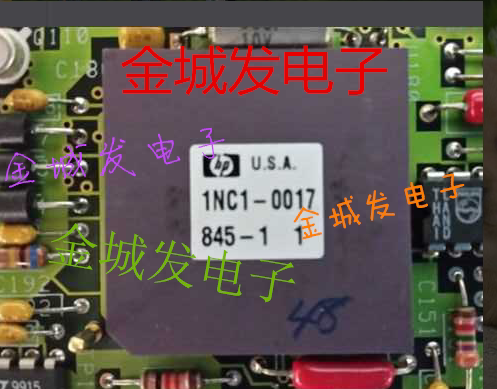
The photo shows how they replace the chip for my 3458A, leaving a lot of flux residue.
-
@zlymex: Are this chips soldered in, or are they in sockets? If soldered in, how in the heck do you remove them?
It soldered in. There are two ways they actually desolder the chip, one is use the desoldering gun like Macbeth said, the other way is to use a solder pot of the right size and fill solder to the brim and dip the pins in the pot. -
Hi Dr. Frank.
3458A was not flawless wasn't it? Having the same trouble for so many units. It just like someone designed a ladder/lift to the Moon but cannot find strong enough building materials to support it. The design of 3458A is ahead of time and cannot implement all the necessary resistor groups that satisfy the specification reliably.
That chart in my previous post was tested 5 years ago when my 3458A was still in excellent condition, but recently my 3458A at last suffered from drifting problems after all. Although I don't mind this because I always use comparison and the drift won't affect me at all. However, it is 2 out of 1 for my 3458A, that is 200% of chance. I don't think it's unluck for me, rather, it's kind of destined. There are a very large portion of 3458A that having drift problems. Many people who own 3458A just don't realize this because either they don't do tests or don't known how to test or don't have the condition to test.
Back from the beginning, the reason I suggest comparison rather than direct measurement are:
- the drift of 3458A is worse than a voltage reference in the long run
- the T.C.
The Vp-p for the comparison in the blue box is 0.168ppm, but for the measurement, it is 0.197ppm, 16.7% worse.
The Vp-p for the comparison in 16 hours is 0.243ppm, but for the measurement, it is 0.370ppm, 52% worse.
This shows that even for good 3458A, comparison is better than measurement. The longer the period, the better the comparison.
-
I picked up an LTZ1000 reference unit off of TaoBao, for about $100. There's a picture of the PCB and parts, which look like they might be pulls.
https://world.taobao.com/item/537238134609.htm?fromSite=main&spm=a1z3o.7695460.0.0.tQsd0b
Now, what you see in the picture is not what you get. You get the blue tape wrapped square aluminum case.
Inside the case is an unbuffered LTZ1000 design, with the output coming out of two of the cover screw holes. Teflon coated wire. On the end of the case is a PCB, which appears to be a heater controller. The unit has about 8 turns of heater wire under the blue tape, and warms the case to a comfortable temperature. The vendor uses Lymex' name (and yes, the initial board that you see does look like Lymex' work).
It is an interesting find. Anybody seen anything like this? Thoughts on the unbuffered output (other than, handle with great care)? It came with a little calibration note, out to 7 places. My ancient 5.5 Fluke reads it dead on, my 34401A is about 5 counts low, and flickers on the least significant digit - which I think might be noise, as the 34401A I have is usually stable on the last digit. Yes, I am a neophyte only able to work to a still-suspect 6.5 digit level.
-
The square PCB board was indeed my very first version but the major components and soldering were not mine.
The narrow PCB and all other work is certainly have nothing to do with me, guessing the seller just use my name.
Those oven-board-at-one-end thing was first used by one of my friend(thy888) in 2010.
I didn't like the idea of having an oven for LTZ1000 PCB at first, but now I accept it if the oven temperature is low(<33 degree C) and well regulated.
Back in 2008, I did sell some unbuffered board at very low price(about $25 each) among Chinese volnuts and bare PCB as well.
The unbuffered board(if same as the datasheet) has disadvantage that it cannot handle capacitive load which might be the source of the noise.
-
More pictures.
You can see the thermocouple that senses the temperature: it runs down a channel of the case. The whole thing runs lukewarm to the touch. There must be about 6 turns of heater wire under the blue tape,
There's plenty of room inside the case for a buffer board.
The LTZ1000 looks kind of beat up. Maybe that's good.
Lymex, thanks for clearing up the source. The seller links to long articles on the Chinese forums. Seems that there's quite the voltnut movement in China.
-
It is rather strange to see an thermocouple to sense the temperature, as this needs a second sensor at the outside and is not very precise. usually I would choose something like an PT100, NTC or a diode/transistor as a temperature sensor for the constant temperature part.
The position of the TC is also strange, it is rather close to the transistor that drives the LTZ heater, thus a relatively large heat source. With changing voltage the heat source could also change. At least the heater current should be relatively constant - so not that much change in the power of the transistor. Still it would be better to have the sensor more at a low power region, like in between the precision resistors.
An interesting point could be the heater current, to see how much work the LTZ1000 internal heater has to do.
There seems to be the 400 K resistor for TC compensation - I am not sure this is still the correct value and needed with this setup.
Anyway I would not change anything there, if you want to keep the "calibration" of the actual voltage.
I you want to add a buffer, one might consider having the 7 V to 10 V step (if needed) also inside the constant temperature box. The extra circuit should be reasonable low power, as extra power lowers the temperature up to which the unit can work. -
Seems to me that a thermocouple is hard work compared to the other options, although more precise. It is also about 1" down inside the screw channel in the extruded case, so the transistor should not matter too much. I wonder how they calibrate it - maybe they swap out resistors.
As a module, the case + oven is kind of clever. It is small, has room for two boards, and provides a shielded, thermally stable environment for the electronics. I've not found any other source for the heater board. Pricewise, it is pretty good - just about $100 for the full unit, which includes an LTZ1000 and the precision resistors.
A couple of questions.
1) Not sure there is any value in a PWM heater circuit, other than eliminating the power consumption of the series pass transistor. If I were thinking about doing a new oven board, I might switch to a microcontroller and see how tightly the temperature can be controlled.
2) A good 7 to 10V step up would be nice. With the right resistors, you can get close enough to use something like 5k / 11k and a 250 ohm pot. But you need about 1k of swag room to deal with the full voltage range of an LTZ1000, orgo with a much bigger pot. If the pot is only 2% of the total resistance, its TCR is not so influential. Especially in an oven - although I prefer designs that have thermal drift minimized even without the oven.
3) Best would be digital 7V to 10V adjustment. Not sure what the best approach is there, Anybody got any good ideas? Preferably, tiny surface mount stuff with minimal need for precision parts.
Like I said, I am still at a suspect 6.5 digit level, so lots of things look good. More meters, more standards all start to point to better understanding of where my numbers sit.
-
Using a thermocouple as a sensor in the oven makes no sense: the only advantages are small size an fast reaction - neither is needed here. The thermocouple way is not precise at all, as it depends on a second sensor that is not at constant temperature. Just a simple 1N4148 would have been way better: it's more precise, less drift and easier to deal with. Depending on the temperature set-point of the oven and the LTZ1000, the transistor can be quite a heater and thus a hot spot on the board. The power should be reasonably constant, but it is still about the worst place to put the sensor, as heat conduction could change by aging of the board material and maybe air pressure / orientation.
PWM for the heater saves some power, but there is also the alternative of using the transistor that controls the power also as a heater, like keeping the voltage about constant and chance the current. Also a controlled current through a string of diodes in series can be a heater that can be controlled with not that much waste heat. Both alternatives also give an about linear power control, which is good if analog regulation is used. If well shielded PWM might not be so bad, but avoidable. If the oven board is reasonably working, I see no big incentive to change it - normally the LTZ1000 can well work without it. The oven is not only about the TC but it also calls for an always low humidity, so even an really poor oven can help.
For a precision voltage ration, I would avoid classical pots as much as possible. Even choosing 1% of the shelf resistors is better than essentially any pot you can buy. So at least the first part should be more like finding the right resistor(s) and only do the very last part (< 0.1 %) with a pot - maybe even a digital pot. As a voltage divider digital pots are quite good and affordable. The down side is that they are usually just 7 or 8 bits. -
Are you sure that's a thermocouple? The junction looks so much bigger than the wires (which aren't colour coded). It looks like a tiny glass bead thermistor to me.
-
Having read Agilent's 'practical temperature measurements' [1], I got the sense that for precision temperature measurements you would want to use RTDs. Thermocouples would be used where other sensors can't be used (as they are very robust). For small temperature differences, the voltage differences of a thermocouple would be very small and difficult to measure precisely. A TC would be a odd choice here, are you sure it is one?
[1] https://www.google.com/url?sa=t&rct=j&q=&esrc=s&source=web&cd=4&cad=rja&uact=8&ved=0ahUKEwjv0OOU1fbOAhUJwGMKHeESDW0QFghbMAM&url=http%3A%2F%2Fcp.literature.agilent.com%2Flitweb%2Fpdf%2F5965-7822E.pdf&usg=AFQjCNHl8Du_x4yxRMYG4VZLZ81Le-PzTg&sig2=POaea5cDk4eERIiD6k7gcA -
I think you guys are right - looking at my original photo, the sensor looks like a smooth bead of shiny material, not a thermocouple weld. That would be a much easier solution.
Maxim has a 10-bit digital pot with 5 ppm TC in ratiometric mode. With an op amp, it should be possible to create an offset voltage for the buffer amp that is down in the last three digits of the reference. -
That friend of mine(thy888) who is very successful in making these small-case references that he sold many.
He uses NTC(bead type) as the sensor and uses both wire and a transistor as heaters.
He tried many circuits and components before, the latest is to use VHD200 as the step up of 7V to 10V.
However, the metal-case thing is just the core, a case with binding posts, power, batteries and thermal insulation are needed to complete as a reference.
-
The bashed up parts are a little worrying. On the one hand it would be great to get a well worn in LTZ1000 but on the other I've read of the people who recover these that they will snip off old legs and spot weld new ones using their cheap crap wire that becomes a load of hotspot thermal junctions and renders the LTZ unfit for purpose? 5.5 digits may be ok

-
.......
He uses analog approach, and everything is hand adjusted with foil resistors, no pot is used.
3) Best would be digital 7V to 10V adjustment. Not sure what the best approach is there, Anybody got any good ideas? .......
Well, 7001(of Wavetek/Fluke) uses digital(DAC) for fine adjustment.
-
The bashed up parts are a little worrying. On the one hand it would be great to get a well worn in LTZ1000 but on the other I've read of the people who recover these that they will snip off old legs and spot weld new ones using their cheap crap wire that becomes a load of hotspot thermal junctions and renders the LTZ unfit for purpose? 5.5 digits may be ok
Those weld-legs parts were pretended to be new that my friends and I would never buy. We buy LTZ1000 either new or with original legs and original marking.
-
Where does THY888 sell his units? They look interesting.
-
Where does THY888 sell his units? They look interesting.
Ditto, my stack of various references isn't quite tall enough either.