-
What you, and ChatGPT is stating is on the graph. P is price, and that goes up with the introduction of tariffs. P goes up, Q (quantity) goes down, it's not a sensational thing. Other representation of the crosses, which include alternative products show that the Quantity of those products go up as opposed to the tariffed product. The whole argument is that the demand (D) is quite elastic from the Chinese market, because you can import many of those products from elsewhere, or produce locally. "If the price of cofee go up, people will just buy coca cola". Demand is elastic. If the price of water goes up, people will pay more for water, because they need that. Demand then is not elastic. It's the slope of D.I'm not speculating, they used to teach this in economics 101.
Ok, so you do want to speculate (a synonym for “predict”). In your “Economics 101” class, did they also teach you how to read the Marshall Cross? I only studied Physics and Mathematics at university, but my dear friend ChatGPT, who has read quite a few books on Economics, just explained in layman’s terms the impact of tariffs on prices, according to the Marshall Cross.
It's a well understood and investigated effect. It's also on the Marshall cross.QuoteUsing the Marshall Cross to predict the impact of a tariff goes like this:
A tariff is a tax on imports, which makes those goods more expensive. As a result, the overall market supply shrinks because sellers can’t (or won’t) supply as much at the old price. On the Marshall Cross, this shows up as the supply curve shifting left or up.
What happens then? Prices go up and fewer goods get sold. That puts upward pressure on inflation, especially if these goods are things everyone uses, like steel or food. And if there aren’t good substitutes, consumers are stuck paying more - which only adds to the inflation problem.
And you are not looking at the issue holistically. The tariffs are not introduced in a vacuum, they are part of plan. Agenda 47 clearly stated this.
"Universal baseline tariffs on most foreign products, which will increase incrementally if other countries manipulate their currency or "otherwise engage in unfair trading practices", and lowering taxes."
The question is this: are a working class citizen, who occasionally buy stuff from China, do you care if the prices of those products go up, but in exchange you pay much less taxes? But local stuff like food, housing doesn't change in price?
I honestly would take this deal any time. -
Quote
The question is this: are a working class citizen, who occasionally buy stuff from China, do you care if the prices of those products go up, but in exchange you pay much less taxes? But local stuff like food, housing doesn't change in price?
But it's not that simple, is it? If the tariffs reduce the incoming goods then there will be less tax collected, and that missing income will have to come from somewhere else. Like tax on local products, so your food price will go up anyway. -
The question is this: are a working class citizen, who occasionally buy stuff from China, do you care if the prices of those products go up, but in exchange you pay much less taxes?
Because the "little people" won't get noticeable tax savings; the tax savings will be given to the ultra rich.
If you think Trump (and his backers) give a damn about the little people, then I have a bridge you might like to buy. -
That's the "dead weight loss" on the chart. But the loss of trade and the consequences is already considered. Usually the chart has two (or sometimes more) scenarios on it. This is an example of a technological progress for example.QuoteThe question is this: are a working class citizen, who occasionally buy stuff from China, do you care if the prices of those products go up, but in exchange you pay much less taxes? But local stuff like food, housing doesn't change in price?
But it's not that simple, is it? If the tariffs reduce the incoming goods then there will be less tax collected, and that missing income will have to come from somewhere else. Like tax on local products, so your food price will go up anyway.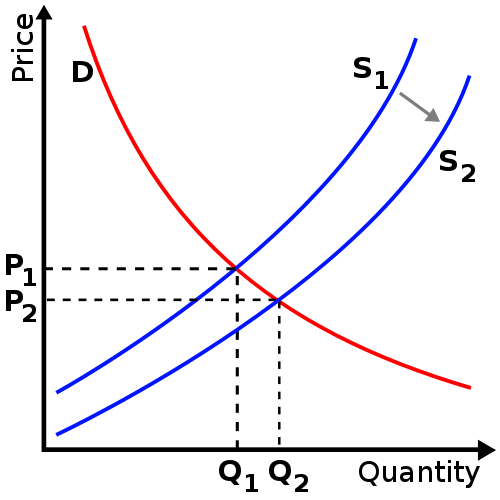
"Television became cheaper, because of better technology, the supply curve went from S1 to S2, therefore more products are being sold (Q) at a lower price (P)" Tariffs or no tariffs is on the graph, you can see what's happening. -
Sure you fool, the tax cut on overtime and tips totally benefited those people. Also the planned tax cuts that are salary dependent.The question is this: are a working class citizen, who occasionally buy stuff from China, do you care if the prices of those products go up, but in exchange you pay much less taxes?
Because the "little people" won't get noticeable tax savings; the tax savings will be given to the ultra rich.
If you think Trump (and his backers) give a damn about the little people, then I have a bridge you might like to buy.
https://www.whitehouse.gov/articles/2025/06/the-largest-tax-cut-in-history-for-working-and-middle-class-americans/
IDK why you people insist on spewing propaganda bullshit without any understanding what's actually happening. -
I thought we already bought a bridge from you Limeys???
https://en.wikipedia.org/wiki/London_Bridge_(Lake_Havasu_City)
Quote from: tggzzz on Today at 10:14:05 pmThe question is this: are a working class citizen, who occasionally buy stuff from China, do you care if the prices of those products go up, but in exchange you pay much less taxes?
Because the "little people" won't get noticeable tax savings; the tax savings will be given to the ultra rich.
If you think Trump (and his backers) give a damn about the little people, then I have a bridge you might like to buy.
-
What about the crazy financial breaks China gets from the Universal Postal Union?
There was a PBS documentary about a US manufacturer who made insulated coffee cups. He could not ship them across town for the cost of what the Chinese could deliver them (shipping and cost of item).
Whoever said that the Chinese are investing in industrial and skilled trade knowledge is absolutely correct, A family member who retired as a tool and die maker was hired to go to China and train Chinese skilled trade students. He was retired from his "big three" job and working for a small Chinese owned Machine Company in the Midwest. They paid for he and his wife to live in China while he was paid to be a teacher... The Chinese apparently value knowledge quite a bit. He made out quite well monetarily.
-
I thought we already bought a bridge from you Limeys???
https://en.wikipedia.org/wiki/London_Bridge_(Lake_Havasu_City)
I remember that happening.
A common question was "why did they buy that?", with the sotto voce sub-text "did they think they were buying Tower Bridge?" -
What you, and ChatGPT is stating is on the graph. P is price, and that goes up with the introduction of tariffs. P goes up, Q (quantity) goes down, it's not a sensational thing. Other representation of the crosses, which include alternative products show that the Quantity of those products go up as opposed to the tariffed product. The whole argument is that the demand (D) is quite elastic from the Chinese market, because you can import many of those products from elsewhere, or produce locally. "If the price of cofee go up, people will just buy coca cola". Demand is elastic. If the price of water goes up, people will pay more for water, because they need that. Demand then is not elastic. It's the slope of D.
You are making too many baseless, generic assumptions about how demand will respond to a shortage of foreign-made products, components, materials and commodities.
If imported brake pads for my German-made car get more expensive, I’ll have no choice but to bite the bullet and buy them. Your idea that this demand is elastic, and that I could just get a bicycle instead of replacing worn-down brake pads, doesn’t hold for two reasons. First, I live in the Boston suburbs and have no plans to move to Amsterdam. Second, I don’t know any manufacturer that makes bicycles in Massachusetts, and most bikes that don’t cost as much as a used car are also imported from China.
If you are so sure that inflation won’t rise by fall, you could make a ton of money in the bond market. Just buy some 10-year treasuries now, wait until the Fed cuts rates (since, according to you, tariffs won’t cause inflation), and then sell the bonds at a higher price in a few months. Sounds like a sure deal, don’t you think? I wonder what other bond investors are doing now? -
IDK why you people insist on spewing propaganda bullshit without any understanding what's actually happening.
Mirror. -
Once again, I'm not making this up, this is what they teach in economy class. If the maintenance cost of your car goes up, next time maybe you buy local cars, that have lower maintenance cost. Maybe you wont. What will happen though is that eg 5% more people will buy a Ford diesel truck with built in stereo instead of a Toyota Camry. Sorry to break the news for you but macroeconomics doesn't give one f about what you personally do. And while I give you some simplified examples trying to explain it, it is more statistical than that.What you, and ChatGPT is stating is on the graph. P is price, and that goes up with the introduction of tariffs. P goes up, Q (quantity) goes down, it's not a sensational thing. Other representation of the crosses, which include alternative products show that the Quantity of those products go up as opposed to the tariffed product. The whole argument is that the demand (D) is quite elastic from the Chinese market, because you can import many of those products from elsewhere, or produce locally. "If the price of cofee go up, people will just buy coca cola". Demand is elastic. If the price of water goes up, people will pay more for water, because they need that. Demand then is not elastic. It's the slope of D.
You are making too many baseless, generic assumptions about how demand will respond to a shortage of foreign-made products, components, materials and commodities.
If imported brake pads for my German-made car get more expensive, I’ll have no choice but to bite the bullet and buy them. Your idea that this demand is elastic, and that I could just get a bicycle instead of replacing worn-down brake pads, doesn’t hold for two reasons. First, I live in the Boston suburbs and have no plans to move to Amsterdam. Second, I don’t know any manufacturer that makes bicycles in Massachusetts, and most bikes that don’t cost as much as a used car are also imported from China.
If you are so sure that inflation won’t rise by fall, you could make a ton of money in the bond market. Just buy some 10-year treasuries now, wait until the Fed cuts rates (since, according to you, tariffs won’t cause inflation), and then sell the bonds at a higher price in a few months. Sounds like a sure deal, don’t you think? I wonder what other bond investors are doing now? -
Yeah, yeah. Since you are already out of arguments, have you already tried calling me a racist or something? Or Trump the orange man. Or taco? Or claim that you were raised in a middle class family when someone asks a hard question?IDK why you people insist on spewing propaganda bullshit without any understanding what's actually happening.
Mirror. -
Yeah, yeah. Since you are already out of arguments, have you already tried calling me a racist or something? Or Trump the orange man. Or taco? Or claim that you were raised in a middle class family when someone asks a hard question?IDK why you people insist on spewing propaganda bullshit without any understanding what's actually happening.
Mirror.
That's an attempted deflection. I was suggesting you look at a reflection. -
tggzzz:
I think you are correct, I think a lot of people thought at the time we were purchasing the Tower Bridge!!!! Obviously the purchaser knew he was not. It was a marketing ploy, I believe. But the bridge does look good!!
-
What about the crazy financial breaks China gets from the Universal Postal Union?
That's normal, and happens here too. The situation is that the stuff arrives at some country and the official post for that country takes on the delivery. Here it's the Royal Mail. It works because there is a quid pro quo: stuff going the other also benefits from the local post at that end taking on the delivery.
There is a difference in cost simply because your and my local shippers charge lots more to get the stuff to a foreign country than the shippers in China do. Once in that country the local postal service delivers gratis. Unless a non-default service is used (like FedEx or whoever) and the it's an arm and a leg whichever way the stuff goes. -
What about the crazy financial breaks China gets from the Universal Postal Union?
...
There is a difference in cost simply because your and my local shippers charge lots more to get the stuff to a foreign country than the shippers in China do. ...
The question is what's behind the very low cost to ship from China to a foreign country. A sufficient answer is state subsidies, which could be regarded as "unfair" or "economic warfare".
Changing that would, of course, require global agreement over changes to the UPU rules, which would inevitably have unintended side effects. -
What you, and ChatGPT is stating is on the graph. P is price, and that goes up with the introduction of tariffs. P goes up, Q (quantity) goes down, it's not a sensational thing. Other representation of the crosses, which include alternative products show that the Quantity of those products go up as opposed to the tariffed product. The whole argument is that the demand (D) is quite elastic from the Chinese market, because you can import many of those products from elsewhere, or produce locally. "If the price of cofee go up, people will just buy coca cola". Demand is elastic. If the price of water goes up, people will pay more for water, because they need that. Demand then is not elastic. It's the slope of D.
You are making too many baseless, generic assumptions about how demand will respond to a shortage of foreign-made products, components, materials and commodities.
If imported brake pads for my German-made car get more expensive, I’ll have no choice but to bite the bullet and buy them. Your idea that this demand is elastic, and that I could just get a bicycle instead of replacing worn-down brake pads, doesn’t hold for two reasons. First, I live in the Boston suburbs and have no plans to move to Amsterdam. Second, I don’t know any manufacturer that makes bicycles in Massachusetts, and most bikes that don’t cost as much as a used car are also imported from China.
If you are so sure that inflation won’t rise by fall, you could make a ton of money in the bond market. Just buy some 10-year treasuries now, wait until the Fed cuts rates (since, according to you, tariffs won’t cause inflation), and then sell the bonds at a higher price in a few months. Sounds like a sure deal, don’t you think? I wonder what other bond investors are doing now?
Of course, back in the day, non-original brake pads were made in the USA, so people bought & used them successfully.
Nowadays they are probably from China, & won't cost much less than the German originals.
I feel that if the USA had imposed more sensible levels of tariffs many years ago when they still made stuff in that country, they would have been effective. -
You know it very well, that these oversimplifeid ways of "who pays for tariffs" is just strawman and "appeal to ridicule" fallacies.Not to mention... the tariffs are being paid by the residents of USA... China could simply not care less..
One of the reason there is no heavy protest on the tariff, is the majority of the Trumpers or the MAGA red necks, still "strongly" believe its China who pays for the tariff.
Watched one the street interview video , one the MAGA dude even said in the interview ... "If we raise the tariff more than 100%, it means China will pay us to buy their stuff, but that is not nice isn't it ? Hence, Trump cancelled the 145% tariff, and also one of his great dealing strategy which works great ! ...".
Yeah, that shows how the education quality there that shaped some of Americans mind, great country.
There is a well understood effects of tariffs on the macroeconomics level.
<snip> ... dandy graphic chart ...
So yes, tariffs reduce consumer surplus, which means you will buy less things that you actually don't need. Most of the imported goods from China are luxury items, even if they are 1 USD luxury items. You don't import food, energy, your home or transportation from China. And you see, there is that rectangle in the middle, which is the part where China pays for it.
Still, I bet you don't have the capability to answer this simple question .. "Does China pay for the tariff ?" ...
Just ... YES .. or ... NO ... for the answer.
If your answer is YES, then do you think with 100% tariff means you get free stuff from China ? YES or NO ?
-
With this tariff mess is showing a hard fact and proof that, US and EU included, just love "China overcapacity", not hating it .... on rare earth mineral.
Proof that "China overcapacity" is much loved and rooted all over the world.
Btw, just don't understand the slander or campaign on China overcapacity matter is bad, if there is no overcapacity that the produced stuff even can not cover for domestic market, then how do you export them ?
What you see is the bad deteriorating brain in common sense / critical logic thinking, in mass.
-
With this tariff mess is showing a hard fact and proof that, US and EU included, just love "China overcapacity", not hating it .... on rare earth mineral
Which will put China in an unbeatable EV position..
Proof that "China overcapacity" is much loved and rooted all over the world.
Btw, just don't understand the slander or campaign on China overcapacity matter is bad, if there is no overcapacity that the produced stuff even can not cover for domestic market, then how do you export them ?
What you see is the bad deteriorating brain in common sense / critical logic thinking, in mass.
Already 53% is EV over there where they lead the world ...... still love my TD ICE though.... -
I already answered your first question. The second question is just asinine, as you know it damn well that the US treasury is getting the money for tariffs not you. Do you need an explanation on how percentages work?
You know it very well, that these oversimplifeid ways of "who pays for tariffs" is just strawman and "appeal to ridicule" fallacies.Not to mention... the tariffs are being paid by the residents of USA... China could simply not care less..
One of the reason there is no heavy protest on the tariff, is the majority of the Trumpers or the MAGA red necks, still "strongly" believe its China who pays for the tariff.
Watched one the street interview video , one the MAGA dude even said in the interview ... "If we raise the tariff more than 100%, it means China will pay us to buy their stuff, but that is not nice isn't it ? Hence, Trump cancelled the 145% tariff, and also one of his great dealing strategy which works great ! ...".
Yeah, that shows how the education quality there that shaped some of Americans mind, great country.
There is a well understood effects of tariffs on the macroeconomics level.
<snip> ... dandy graphic chart ...
So yes, tariffs reduce consumer surplus, which means you will buy less things that you actually don't need. Most of the imported goods from China are luxury items, even if they are 1 USD luxury items. You don't import food, energy, your home or transportation from China. And you see, there is that rectangle in the middle, which is the part where China pays for it.
Still, I bet you don't have the capability to answer this simple question .. "Does China pay for the tariff ?" ...
Just ... YES .. or ... NO ... for the answer.
If your answer is YES, then do you think with 100% tariff means you get free stuff from China ? YES or NO ?Which will put China in an unbeatable EV position.
Toyota sells EVs built in China, with 600km range, for about 24K EUR. The smallest VW with the same range is 52K EUR.
Already 53% is EV over there where they lead the world ...... still love my TD ICE though....
The only reason VW is alive is because of tariff. If you look up how much the Communist party of China spends on trying to destroy our economy, it's staggering. Cars are being sold below cost price, and manufacturers are kept alive by state funding, which is estimated at more than 45B EUR a year.
Just ask yourself, you are the manufacturer of something, are you supposed to just die, if someone decides to copy your IP and give away the same looking product for free? -
Quote
Toyota sells EVs built in China, with 600km range, for about 24K EUR. The smallest VW with the same range is 52K EUR.
The only reason VW is alive is because of tariff.
How are tariffs levelling the playing field if Toyota is still managing to sell their EV for literally half the price of the VW?
Could it be, perhaps, that they are not comparable models? Are you actually doing the equivalent of comparing a Fnirsi scope with a R&S scope? -
Quote
Toyota sells EVs built in China, with 600km range, for about 24K EUR. The smallest VW with the same range is 52K EUR.
The only reason VW is alive is because of tariff.
How are tariffs levelling the playing field if Toyota is still managing to sell their EV for literally half the price of the VW?
Could it be, perhaps, that they are not comparable models? Are you actually doing the equivalent of comparing a Fnirsi scope with a R&S scope?
Not sure if it is your point but Toyota's EV is a bit rubbish. Slow rapid charging & limited to 2-3 charging sessions per day (literally not possible to road trip in it since it will only do 7kW DC charging after 2-3 normal sessions due to battery overheating). -
Quote
Not sure if it is your point but...
Good enough
-
The 24K is the price sold in China, not here. The same model is not (yet?) on the EU market. If it comes it will see at least 45% tariff.QuoteToyota sells EVs built in China, with 600km range, for about 24K EUR. The smallest VW with the same range is 52K EUR.
The only reason VW is alive is because of tariff.
How are tariffs levelling the playing field if Toyota is still managing to sell their EV for literally half the price of the VW?
Could it be, perhaps, that they are not comparable models? Are you actually doing the equivalent of comparing a Fnirsi scope with a R&S scope?
And the design is a bit questionable. But that's besides the point.
Toyota probably also doesn't want to make every other of it's EU models outdated.
But others won't care. BYD is already building it's EU factories, they've been trying to headhunt me for those.