-
Then the 7151. As a RMS-measuring instrument, nothing out of the expected seen on AC - regardless of frequency. (The 100Hz ACV picture had a garbled display caught in a bad sync moment with a short exposure, it seems)
But the indication of 3.64mA instead of 1 mA was a bit alarming and suggested urgent intervention. Resistance again not too bad, although the 7045 fared better, when taking resolution into account.
Letting it sit reading this resistance inorder to get an impression of the stability (the complete chain was used for both R measurements shown), I turned towards the computer in order to process the pictures...the 7151 is no more.
Did you know that the sound of an exploding RIFA is almost as disgusting as the smell? But only almost : My nose, my poor tortured nose!
The lack of universally compatible olfactoric input/output output devices did unfortunately prevent that I could include you all in the experience.
This disgusting episode of the DMMCheck series will hopefully get equalized by the performance of the next candidates, which are the active Multizets (A1000/A1001).
That could really do with new LEDs for that display. -
Just went through my ribbon cables...
Looks like I have a pretty fair 50/50 split between old 34 pin MFM drive cables and 40 pin IDE ones.
Some IDE cables have a high density / 1.27mm pitch cable, can't remember why that got introduced, what was the point of it over regular 2.54mm / 0.1" cables ?!
MFM connectors are either card edge (older/original style I guess) or some are HE10 (a later revision of the standard I guess ? )
Have one 50 pin cable, I guess for SCSI drives/peripherals.
-
Just went through my ribbon cables...
Looks like I have a pretty fair 50/50 split between old 34 pin MFM drive cables and 40 pin IDE ones.
Some IDE cables have a high density / 1.27mm pitch cable, can't remember why that got introduced, what was the point of it over regular 2.54mm / 0.1" cables ?!
MFM connectors are either card edge (older/original style I guess) or some are HE10 (a later revision of the standard I guess ? )
Have one 50 pin cable, I guess for SCSI drives/peripherals.
The cable you call high density are high speed ATA/IDE cables. They have additional 0V conductors so every signal line has 0V conductor either side and between it and the next signal line. This reduces cross-talk and helps maintain a constant impedance, reducing data skew. This allows higher speed data transfer.
They are useful for making custom interface cables for some HPAK logic analysers that use 40 pin 0.1" connectors. It's not as good as the HPAK woven cable but is better than standard ribbon cable. -
uggaaaahhhh
after some hulking I got it inside ...
-
Congrats, Amazon Warrior Princess!

mnem
obviously she cared where it landed; she didn't use the 50gr accelerant.
-
This is my first day off in 4 weeks. I am actually taking several days off, and eating a broad variety of foods including a lot of raw veggies, to try and restore my gut fauna which was very obviously wiped out by the antibiotics taken for my kidney infection.
yummmm.
As always the US are all about finesse and nuance ! It's not an apple pie... it's BUCKET pie !
Take a bucket load of apple chunks, wrap it in a bag, and you're done ! Is that how you intend to tackle your diet now you have moved to Connecticut ?!
This is an apple pie in reasonable countries :
That... that... abomination is no apple pie; it is a tart. Which is a whirly, swirly sissy pie; the triumph of style over substance. It belongs at some government state dinner, and has no place on any normal person's dinner table. 
The lack of a top crust shows a complete lack of understanding of how the balance of flaky layer crust and cinnamon sugar/apples is supposed to taste. You cannot have a proper apple pie without a top crust, and "pretty" pies are almost never tasty.
If it is done right, the crust rises away from the filling as this one has done; that bubble of air underneath is what makes the best crispy, flaky layers without drying it out. When the slice is cut, the crust falls down and it looks like a "normal" apple pie.
Yes, that is my opinion, but it is the opinion of someone who grew up in apple orchard country, on a farm with its own orchards, and whose grandmomma's apple, cherry and strawberry-rhubarb pies were literally coveted over 3 counties, and every spring & fall she had a list of people to buy the several dozen pies she made to sell.
Maybe not world-class, or even "best of the county fair"... but definitely excellent. On this, and quality of fruit preserves, I will stack my experience up against anyone's with pride.
As for this one... the crust is excellent. The filling is average at best; it needs either Red Delicious apples and honey added, or to be mixed with Honeycrisp apples. And a wee bit more cinnamon.
mnem
-
uggaaaahhhh
after some hulking I got it inside ...
Have to say I admire your motivation for these things....
People make fun of me collecting these old glowing Tek scopes, 25 of them or so, but that entire collection takes less space than a couple of your arcade or pinball machines...and I can conveniently stack them on (sturdy...) shelves to make the collection compact.
Your toys take so much space and weight/energy that you really must be in deep love with them for sure.... and you keep buying more and more of them as well, it's still growing !!!
Ever considered moving in the country side to get a hangar/old barn to have lots of cheap space to store all that, and allow for long term expansion of the collection ?!
-
This is my first day off in 4 weeks. I am actually taking several days off, and eating a broad variety of foods including a lot of raw veggies, to try and restore my gut fauna which was very obviously wiped out by the antibiotics taken for my kidney infection.
yummmm.
As always the US are all about finesse and nuance ! It's not an apple pie... it's BUCKET pie !
Take a bucket load of apple chunks, wrap it in a bag, and you're done ! Is that how you intend to tackle your diet now you have moved to Connecticut ?!
This is an apple pie in reasonable countries :
That... that... abomination is no apple pie; it is a tart. Which is a whirly, swirly sissy pie; the triumph of style over substance. It belongs at some government state dinner, and has no place on any normal person's dinner table.
The lack of a top crust shows a complete lack of understanding of how the balance of flaky layer crust and cinnamon sugar/apples is supposed to taste. You cannot have a proper apple pie without a top crust, and "pretty" pies are almost never tasty.
If it is done right, the crust rises away from the filling as this one has done; that bubble of air underneath is what makes the best crispy, flaky layers without drying it out. When the slice is cut, the crust falls down and it looks like a "normal" apple pie.
Yes, that is my opinion, but it is the opinion of someone who grew up in apple orchard country, on a farm with its own orchards, and whose grandmomma's apple, cherry and strawberry-rhubarb pies were literally coveted over 3 counties, and every spring & fall she had a list of people to buy the several dozen pies she made to sell.
Maybe not world-class, or even "best of the county fair"... but definitely excellent. On this, and quality of fruit preserves, I will stack my experience up against anyone's with pride.
As for this one... the crust is excellent. The filling is average at best; it needs either Red Delicious apples and honey added, or to be mixed with Honeycrisp apples. And a wee bit more cinnamon.
mnem
Oh, I managed to trigger the Dwagon with a pie !
Oh so you know the word " tart " (" tarte "originally).. that's the French for "pie". So to me a pie is just a huge heavy thick tarte...
Didn't know " tarte " was known in the English language... that's good... now I can ask for a Tarte and not expect to be served a freaking pie !
OK yeah right, to each their own, you are allowed to eat big pies of course, nothing wrong with that... and I will keep eating tartes instead !
-
Just went through my ribbon cables...
Looks like I have a pretty fair 50/50 split between old 34 pin MFM drive cables and 40 pin IDE ones.
Some IDE cables have a high density / 1.27mm pitch cable, can't remember why that got introduced, what was the point of it over regular 2.54mm / 0.1" cables ?!
MFM connectors are either card edge (older/original style I guess) or some are HE10 (a later revision of the standard I guess ? )
Have one 50 pin cable, I guess for SCSI drives/peripherals.
[img width= 200]https://www.eevblog.com/forum/testgear/test-equipment-anonymous-(tea)-group-therapy-thread/?action=dlattach;attach=1431019;image[/img]
The cable you call high density are high speed ATA/IDE cables. They have additional 0V conductors so every signal line has 0V conductor either side and between it and the next signal line. This reduces cross-talk and helps maintain a constant impedance, reducing data skew. This allows higher speed data transfer.
Oh, I see, thanks for that, makes sense now !
-
This is an apple pie in reasonable countries :
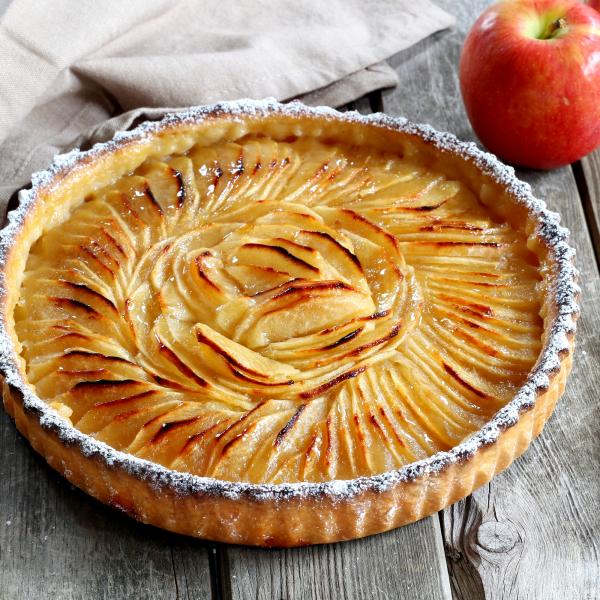
That's not a pie, it's a tart. As am I.
-
OK yeah right, to each their own, you are allowed to eat big pies of course, nothing wrong with that... and I will keep eating tartes instead !
And I shall eat my steak tartare...
mnem
actually, I prefer it Pittsburgh-style... which is both burnt offering and bloody sacrifice. With Worcestershire sauce. -
...the 7151 is no more.
"...is no more...?" As in what... to get it out of the house, you yanked it off the bench and hurled it out the door so violently it did not survive the landing...?
Did you know that the sound of an exploding RIFA is almost as disgusting as the smell? But only almost : My nose, my poor tortured nose!
This does not sound at all like our soft-spoken, well-mannered shrew-disciple... not in the least!!!
mnem

-
You posted too soon Cerebus, already addressed by Dwagon's reply !
.. never reply to a post until you have read them all, because it's moving fast on TEA !
Thanks for the confirmation though !
So both the US and the UK know what a tart is.... if I ever go back to the UK , as a tourist this time, I will order some tart in total piece of mind then, knowing I would actually get what I expect to get !
And what about Australia ? Do you know the difference between a pie and a tart ? Do you eat them over there ??
No, I don't think I will ever go to Australia... too far/expensive to go there, and I hate warm weathers... anything above 20°C is very uncomfortable to me, knocks me out...
-
This is an apple pie in reasonable countries :
I'll send you my address...
For next weekend I'll vote for a tarte tatin. -
Oh hold on a minute, make no mistake, I did NOT make this tarte, it's a Google pic !
I don't even have an oven to cook tartes... but I will, one day... when I get round to working on the kitchen... but for now the priority is building the garage so I can free the living room from all these Tek scopes and (mechanical) workbench and tools... then I can turn my attention to the kitchen and start making tartes and other nice stuff !
Tarte tatin is nice too but I personally find it a bit too "heavy" to digest... It's OK if you take a small portion of it, but I would not eat an entire tarte tatin... but I sure would eat a normal apple tarte, or apricot tarte... slurp slurp...
-
...For next weekend I'll vote for a tarte tatin.
Quote from: WikipediaTarte Tatin
Hmmm... that was actually part of grandmomma's recipe. She cooked the tart apples (Granny Smith, Braeburn) this way, and mixed that concoction with Red/Golden Delicious apples.
The tarte Tatin, named after the Tatin sisters who invented it and served it in their hotel as its signature dish, is a pastry in which the fruit is caramelized in butter and sugar before the tart is baked. It originated in France but has spread to other countries over the years.
mnem
Considering world events of the last decade, I vote for Putin Tartare.
-
Got a box from Germany yesterday.... from a guy called Neomys Sapiens, what a strange name that is ! Doesn't even sound German at all does it ...
Lots of SMA & N type stuff, which was an excuse to use up another one of the 5 pack cheap plastic boxes dad offered me the other day.
Also a big ass low loss 50R N-type cable.... you definitely need to hands to handle that one...
and lots of 0.1" header.. had only a few, now the drawer is full
.. and some other goodies as well, like colourful test leads, bigass crocodile clips...even some merch but from totally different companies so I don't know which one he actually works for !
Maybe none of them...
Danke schön Neomys !
-
Just went through my ribbon cables...
Looks like I have a pretty fair 50/50 split between old 34 pin MFM drive cables and 40 pin IDE ones.
Some IDE cables have a high density / 1.27mm pitch cable, can't remember why that got introduced, what was the point of it over regular 2.54mm / 0.1" cables ?!
MFM connectors are either card edge (older/original style I guess) or some are HE10 (a later revision of the standard I guess ? )
Have one 50 pin cable, I guess for SCSI drives/peripherals.
ST-412 had two cables, control and data.
The narrow one is clearly data for that.
For bakery,
we are generally for open pies but part of the place still has a fish rooster.
We also used to have a flying fish rooster but it's gone now.
For Leboncoin,
I've used it so that first selecting a general term and then following the flow and picking what comes up from below.
Some interesting things have been around but I have a small problem, I don't speak French and Google translator is famous.
Other places seems to always have somebody more in the need.
-
mnem

-
Uh... I don't have your knowledge... didn't even know about this waxjet thing. Or maybe that's the English name for " Sublimation Thermique " ?!

Yes, sublimation it is, it doesn't clog so easily.
If you're in a right place and in a right time you will be given that printer, if they are not gone already.
You can also disconnect its stand so it will fit in a regular sedan.
Stand may be peeking from the trunk but that's a nuance.
OK... might be looking for one of those then.
I met such a printer only once in my life.
I was a student in the UK in Saint-Ives in that little company, doing electronics R&D. Was in 1999/2000.
I remember once, I went in an office where a guy printed me an A3 schematic a sublimation printer, Epson I think. Was a "normal" size printer, not a monster. Fitted just fine on a desk.
Maybe 300mm wide so that it could print A3. Maybe 400 or 600 I don't know it was so long ago... but definitely not a monster on a stand, no it was just laid there on a desk.. I remember being very impressed with the quality of the (colour) print. Back in that day inkjet printers were very shitty, needed fancy expensive paper, tons of ink and 2 hours to print a single full size max quality A4 colour picture. That Epson printer looked so much more advanced in comparison !
Would like one of those ideally...
There were different widths, maybe 50x70cm poster was one target.
The problem is that next width is always "cheaper" and then, in no time, all kind of advertisers start demanding.
Around here one limit was expo wall element width, that's 120cm, so small ones can be a rarity.
Roadside boards brought up the next level, they were finally printed directly to the board, that's the same 120cm but 250cm tall and solid, not exactly for home office.
No idea how those boards are today, seems to be only leds.
Luckily I got rid of my earlier big printer, happened one sunny(summer) day when we had visitors.
It was A3 color Xerox WorkCentre with 2+4+2 wheels and 6000 sheet loader.
Top side of the center part was the printer with pull out iron handle bars for lifting.
So if you take back a bit and accept A3 upper limit those printers are also available practically free.
The catch is that they have a service period, maybe 50k or 100k pages and after that you have to change drums and/or developers.
Of course they are rolling a million or half but finally one service is the last service.
My machine was one of those and I used its last fumes, some times it showed its age, or maybe it was our winter air again.
Upper side with those are that they are for business and so accept pretty thick papers.
You can usually also dismantle them to the bare bones but small washing machine space they will still take.
Their electrical parts are also more than very small, if you think their future, but unluckily quite special and without linear powers.
There are also optical and laser stuff.
-
The cable you call high density are high speed ATA/IDE cables. They have additional 0V conductors so every signal line has 0V conductor either side and between it and the next signal line. This reduces cross-talk and helps maintain a constant impedance, reducing data skew. This allows higher speed data transfer.
I don't think those high speed ATA cables are going to work with HPAK logic analyzers. A special IDC connector is used on the ATA cable, and inside the connector some of the pins are assumed to be ground and are connected together to form the alternating grounds on the 80-conductor ribbon.
They are useful for making custom interface cables for some HPAK logic analysers that use 40 pin 0.1" connectors. It's not as good as the HPAK woven cable but is better than standard ribbon cable.
All the even pins on the logic analyzer's 40-pin header are ground (plus a couple are power ground), which is ok, but there's one oddball ATA ground on pin 19 which is going to conflict with one of the data inputs (D9) on the logic analyzer. D9 will be grounded via the IDE connector, and always show as a "0". -
The only ones on earth that seem incapable of speaking English, are the French.
Methinks this cuts both ways.
Besides, all announcements in the port of Dover and onboard the DFDS ferries from there to Calais and Dunkirk are in English, French and... Polish. Make of that what you will.
https://aporee.org/maps/?loc=50664&snd=57768
4% of people in Britain are native Polish speakers (~2.4 million), more than any other language not native to the UK. In France about 130,000 people speak Polish (ranked around 10th). Perhaps out of the two countries taken together Polish comes next after French and English? (I can't be bothered to do the sums, but it seems likely.)
The traditional foreign language that is taught in most British schools is French. The utility of this is questionable as French stopped being the Lingua Franca quite some time ago replaced by English, and as a basis for extending a native English speaker's grasp of language itself it's a poor choice as maybe 30% of modern English is derived from the Ancient Latin -> Norman French Romance language route. The more autre schools teach German, again an odd choice as Germanic language roots make up most of the rest of English and worldwide it's a real minority language. Some schools teach Spanish. Now we're getting somewhere. There are lots of Spanish speakers in the world and it's sufficiently different to English to make a useful basis for learning something about language itself.
But, in post-modern Britain the most spoken immigrant language at 4% of the population is Polish. (Followed by Punjabi 3.6% and Hindustani 3.5%) French comes in at 0.3%, Spanish 0.2% and German 0.1%. So if you want a useful language you could actually use in England, Polish wins. We should start teaching it in schools and because it's a Slavic language it'd introduce a whole new language group that didn't have Romance or Germanic roots. -
*sigh*
*want*
-
uggaaaahhhh
after some hulking I got it inside ...
Now we know what you do on your days off: