-
How about we put this c******k to rest, rather than everyone taking turns dragging it back up again?
Yes, there's been more than enough off-topic posts today about that one off topic.
Back to TEA:
I scored a Fluke 80K-40 HV probe. According to the manual, it's rated for "1 kV to 40 kV dc or peak ac, 28 kV rms ac." Oddly, it has a sticker on it that says, "Warning: Not authorized for use over 5000 volts." Since this probe is used, I suppose someone other than Fluke may have put that on there.
Anyway, to make sure it isn't borked, I tested it to 1000V DC with my insulation tester. It measured 1GΩ from probe tip to ground and my DMM showed the expected 1000:1 ratio on the probe output. Also, the resistance on the output banana plugs measured 1.1MΩ. Seems OK.
I don't have any plans to go around measuring 40kVDC, but it will be useful to discharge CRTs (rather than shorting them with a screw driver) and verify that HT circuits are de-energized before repairing.
One thing that's not clear to me is the probe's rating starting from 1kV. I was able to correctly measure 250VDC and 500VDC being output by my insulation tester. So, what do you suppose the issue is with voltages below 1kV?
My cheapy Tenma one says the same. I suspect that’s because most people use the meter itself for 1KV and under. It’s probably so you don’t get someone measuring a 9v battery or something with it and complaining.
Edit: Just got paid a not insignificant amount of cash to reboot a PC Need more customers like that. PC is in WC1 though. Thus I had a quick nip in Skoob Books looking for interesting stuff. Nothing interesting EE related. Must go home via new Foyles.
-
I scored a Fluke 80K-40 HV probe. According to the manual, it's rated for "1 kV to 40 kV dc or peak ac, 28 kV rms ac." Oddly, it has a sticker on it that says, "Warning: Not authorized for use over 5000 volts." Since this probe is used, I suppose someone other than Fluke may have put that on there.
That would be some organization's safety people getting all sticker-y... Quote
QuoteAnyway, to make sure it isn't borked, I tested it to 1000V DC with my insulation tester. It measured 1GΩ from probe tip to ground and my DMM showed the expected 1000:1 ratio on the probe output. Also, the resistance on the output banana plugs measured 1.1MΩ. Seems OK.
You can inspect the HV resistor by unscrewing the tip and the black handle from the red part. (Or, at least you can on mine, however it is a fairly old model. I suspect that is the case on all of them since you can buy replacement resistors from Fluke, though they are about the same price as the whole probe. )QuoteI don't have any plans to go around measuring 40kVDC, but it will be useful to discharge CRTs (rather than shorting them with a screw driver) and verify that HT circuits are de-energized before repairing.
For discharging CRTs it would be a bit slow, it's great for measuring CRTs, though. That's why I got mine, though it is certainly handy for other things also. For discharging, the ol' wire on a stick trick on the bench works great for discharging things. You can resistorify it if you need slower discharge than instantaneous POP-SPARK speed, though then you might want more than one speed for big lower voltage stuff and small high voltage stuff.QuoteOne thing that's not clear to me is the probe's rating starting from 1kV. I was able to correctly measure 250VDC and 500VDC being output by my insulation tester. So, what do you suppose the issue is with voltages below 1kV?
No, there is no reason you cannot use it for lower voltages, your readings are just not going to be as accurate as measuring with the meter directly. I've used mine in many situations where the voltage is less than 1000V in places where there might be higher voltages or spikes or whatever, or just to verify that something really is low and the meter can be placed directly on the circuit, etc. I've also used it with a scope to probe things like plasma TV power supplies, PFC or other supplies HV rails, etc., though absolute accuracy would be poor, especially if there is a lower input impedance to whatever instrument you're using it with but at least you can see what is going on to a certain degree.
I think it's just marked that way because at lower voltages there is usually a better method than a giant HV probe. They're nice probes, though. I've been very happy with mine.
-
My cheapy Tenma one says the same. I suspect that’s because most people use the meter itself for 1KV and under. It’s probably so you don’t get someone measuring a 9v battery or something with it and complaining.
Wish I could find some nice rewarding jobs like that it would bring a nice top up to my TE fund
Edit: Just got paid a not insignificant amount of cash to reboot a PC Need more customers like that. PC is in WC1 though. Thus I had a quick nip in Skoob Books looking for interesting stuff. Nothing interesting EE related. Must go home via new Foyles. 
-
Yeah indeed. This one was a good one. A rarity. I overquoted about 3x because I didn’t want to do it and that was fine. Couldn’t turn it down
-
Thus I had a quick nip in Skoob Books looking for interesting stuff. Nothing interesting EE related. Must go home via new Foyles.
The last time I had a look there were a few interesting books in a small section. Nothing like the lost lamented Modern Book Co (or big Heffers in Cambridge).
Have you looked in local university bookshops? Even Blackwells in Oxford isn't as good as it used to be. -
It was pretty dead in Skoob. They had some interesting engineering mathematics books but that was about it. Prices very reasonable.
Foyles I think the best book they had was Troubleshooting Analogue Circuits. But I’m not paying £44 for a copy of it and I already have it anyway. Lots of weird books on radar and missile guidance systems in the same section.
I haven’t looked at any university bookshops since university. Never went in Blackwells. I think the only place I’ve been in Oxford was a kebab van. Heffers was excellent last time I went in there about 25 years ago. Glad to hear it’s still around in some capacity.
-
The last time I brought a technical book in a bookshop was when I was in college, oops sorry, I'm lying, it was about 12 years ago, in Waterstones and it was a book on AutoCad
-
Heffers was excellent last time I went in there about 25 years ago. Glad to hear it’s still around in some capacity.
I last went there in the late 80s.
It was the only shop of any type where I've had an account. ISTR it is part of Blackwells now. -
Lets get it back on track.
Cleaned my bench and cave this week. Moved a bunch of stuff to storage until the spring swap meets. First time I've seen the bench in a couple of years.
Maybe I have a little too much vintage test equipment... Naw.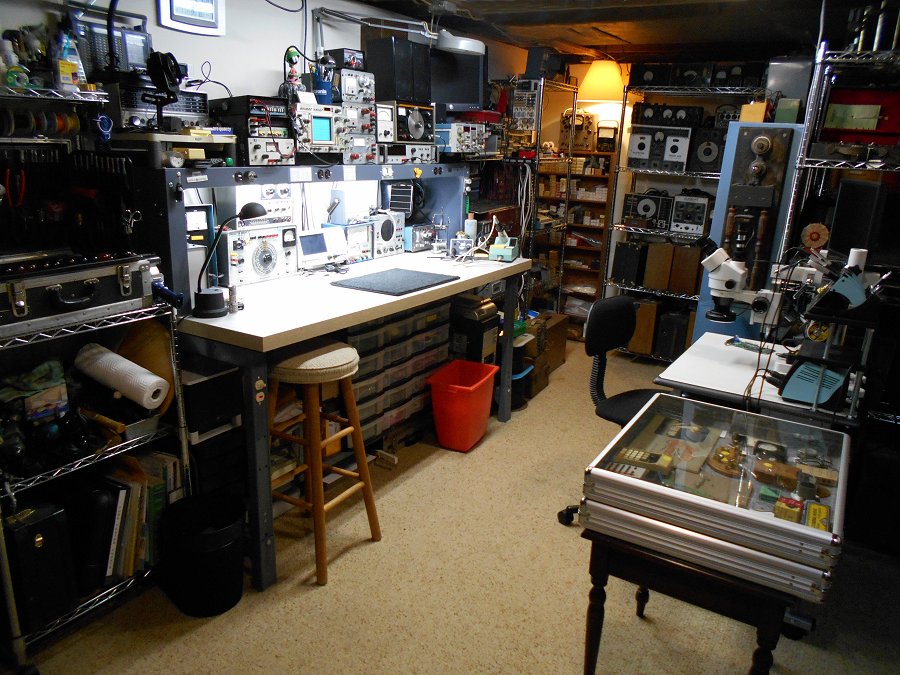
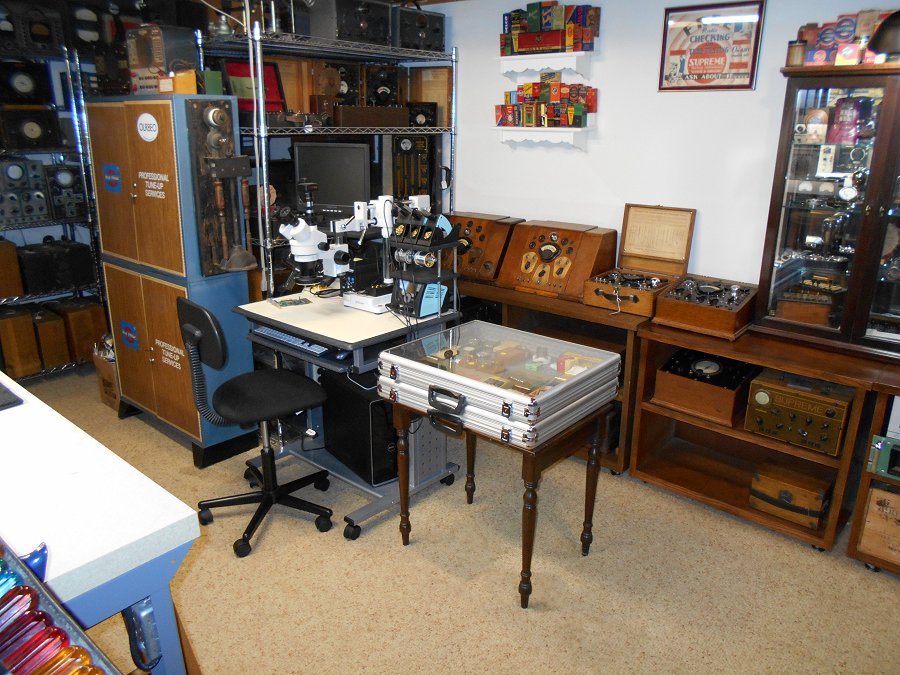
-
That space is entirely too much stuff and too well organized. Get the fuck out out of here with all that not-mess.
Here's a great way feel REAL smart: I was working on a project this evening and I was getting some REALLY off readings on the scope for various measurements and I finally decided to throw in the towel and figure it out tomorrow. That's when I realized that the whole time my DUT was turned off.

If this is the first time you've experienced that, all I can say is "wow".
+1!
That doesn't necessarily imply unusually ordered and tidy working practices, 0culus might just be relatively young, not a target for stair-lift salesmen like so many of us on here.
+1000!
mnem
*Home alone with 2 small children* Pray for me... -
On that shelf.....I see 2 Flukes, either a 465 or 475 with a DM44, a bunch of Power Designs supplies. And what's that SW receiver just to the left of the Flukes? And old Heath or Radio Shack? Can't tell from here.
You have plenty of room for more vintage equipment.
-
Thats a museum in itself
-
Jeezus H Christ A-hoppin' on a pogo stick... is that a photo plate separator I see bolted to the side of that cabinet?

mnem
I am MOOP. -
Thats a museum in itself
Nowhere near a museum, loads more gear to go yet and too much free space. -
Who was off track then?
-
On that shelf.....I see 2 Flukes, either a 465 or 475 with a DM44, a bunch of Power Designs supplies. And what's that SW receiver just to the left of the Flukes? And old Heath or Radio Shack? Can't tell from here.
You have plenty of room for more vintage equipment.
Last time I did an inventory...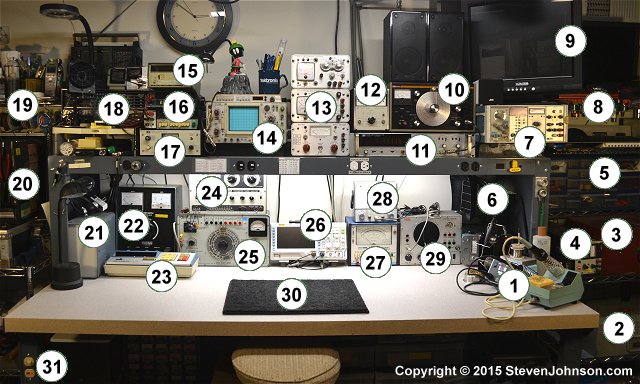
1. Weller WTCPN and WESD51 Soldering Stations
2. Supreme I177 B Military Tube Tester
3. Hickok 6000B Mutual Conductance Tube Tester
4. Kerco High Current DC Power Supply
5. Adapter Storage
6. Weller Soldering Fume Extractor
7. Tektronix 504 Rack with:
Tek FG503 Function Generator
Tek DM501A DMM
Tek DC504 Counter/Timer
Tek PS503A Dual DC Power Supply
8. Tube Socket Adapters
9. Networked Computer
10. B&K E200D Signal Generator
11. HP Nixie Tube Frequency Counter/Timer/DVM
12. HP 400EL AC RMS Voltmeter
13. Power Designs DC Power Supplies (3)
14. Tektronix 465DM Analog Oscilloscope
15. Hewlett Packard 5381A Frequency Counter
16. Fluke 8000A & 8800A DVMs
17. HP 6289A DC Power Supply
18. Hallicrafters S-12 Receiver
19. Wire and supplies
20. Xcelite Tool Kit
21. Isolation Transformer
22. Staco Variac AC Power Supply
23. Remington Nixie Tube Calculator
24. B&K 960 Transistor Radio Tester
25. Sprague TO-5 Capacitor Tester
26. Rigol DS1074Z Digital Oscilloscope
27. Hickok 5720 FET Multi-Meter
28. RCA WV-98C Vacuum Tube Voltmeter
29. Eico 147A Signal Tracer
30. Carpet Square for chassis rotating
31. Bench Master On/Off Switch -
Jeezus H Christ A-hoppin' on a pogo stick... is that a photo plate separator I see bolted to the side of that cabinet?
mnem
I am MOOP.
Nope, it's a Bell Telephone soldering station with two cordless soldering irons for their switch rooms. Use one till it's cold and snap it back in and use the other while the first one heats up again.
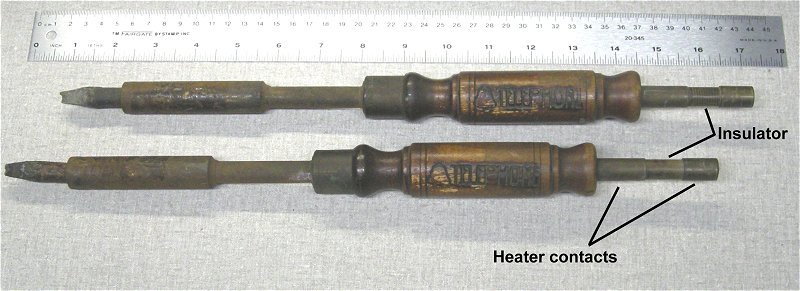
I'm a little whacked... I collect soldering irons.... https://stevenjohnson.com/soldering/index.html -
I scored a Fluke 80K-40 HV probe.
...
One thing that's not clear to me is the probe's rating starting from 1kV. I was able to correctly measure 250VDC and 500VDC being output by my insulation tester. So, what do you suppose the issue is with voltages below 1kV?
My cheapy Tenma one says the same. I suspect that’s because most people use the meter itself for 1KV and under. It’s probably so you don’t get someone measuring a 9v battery or something with it and complaining.
Ah, yes, to protect those who need extra protecting. It had me a bit confused because it's just a resistive divider.QuoteEdit: Just got paid a not insignificant amount of cash to reboot a PC
Need more customers like that.
Yeah, sweet! That's TEA-enabling pricing.Oddly, it has a sticker on it that says, "Warning: Not authorized for use over 5000 volts." Since this probe is used, I suppose someone other than Fluke may have put that on there.
That would be some organization's safety people getting all sticker-y...
Phew! Thanks for the confirmation.QuoteYou can inspect the HV resistor by unscrewing the tip and the black handle from the red part. (Or, at least you can on mine, however it is a fairly old model. I suspect that is the case on all of them since you can buy replacement resistors from Fluke, though they are about the same price as the whole probe.
)
That's what I thought, too. The tip comes off easily, but the body felt glued together. I'll give it another go.QuoteFor discharging CRTs it would be a bit slow, it's great for measuring CRTs, though. That's why I got mine, though it is certainly handy for other things also. For discharging, the ol' wire on a stick trick on the bench works great for discharging things. You can resistorify it if you need slower discharge than instantaneous POP-SPARK speed, though then you might want more than one speed for big lower voltage stuff and small high voltage stuff.
Yeah, I guess it depends how much charge there is to dissipate.QuoteQuoteOne thing that's not clear to me is the probe's rating starting from 1kV. I was able to correctly measure 250VDC and 500VDC being output by my insulation tester. So, what do you suppose the issue is with voltages below 1kV?
No, there is no reason you cannot use it for lower voltages, your readings are just not going to be as accurate as measuring with the meter directly. I've used mine in many situations where the voltage is less than 1000V in places where there might be higher voltages or spikes or whatever, or just to verify that something really is low and the meter can be placed directly on the circuit, etc. I've also used it with a scope to probe things like plasma TV power supplies, PFC or other supplies HV rails, etc., though absolute accuracy would be poor, especially if there is a lower input impedance to whatever instrument you're using it with but at least you can see what is going on to a certain degree.
I think it's just marked that way because at lower voltages there is usually a better method than a giant HV probe. They're nice probes, though. I've been very happy with mine.
Yep, right tool for the job, etc. Same with scope probes. Thanks for the confirmations and clarifications! -
Cleaned my bench and cave this week. Moved a bunch of stuff to storage until the spring swap meets. First time I've seen the bench in a couple of years.
Maybe I have a little too much vintage test equipment... Naw.
Wow! That's an impressive cave. Can it even be called a cave anymore? -
On that shelf.....I see 2 Flukes, either a 465 or 475 with a DM44, a bunch of Power Designs supplies. And what's that SW receiver just to the left of the Flukes? And old Heath or Radio Shack? Can't tell from here.
You have plenty of room for more vintage equipment.
Last time I did an inventory...
1. Weller WTCPN and WESD51 Soldering Stations
2. Supreme I177 B Military Tube Tester
3. Hickok 6000B Mutual Conductance Tube Tester
4. Kerco High Current DC Power Supply
5. Adapter Storage
6. Weller Soldering Fume Extractor
7. Tektronix 504 Rack with:
Tek FG503 Function Generator
Tek DM501A DMM
Tek DC504 Counter/Timer
Tek PS503A Dual DC Power Supply
8. Tube Socket Adapters
9. Networked Computer
10. B&K E200D Signal Generator
11. HP Nixie Tube Frequency Counter/Timer/DVM
12. HP 400EL AC RMS Voltmeter
13. Power Designs DC Power Supplies (3)
14. Tektronix 465DM Analog Oscilloscope
15. Hewlett Packard 5381A Frequency Counter
16. Fluke 8000A & 8800A DVMs
17. HP 6289A DC Power Supply
18. Hallicrafters S-12 Receiver
19. Wire and supplies
20. Xcelite Tool Kit
21. Isolation Transformer
22. Staco Variac AC Power Supply
23. Remington Nixie Tube Calculator
24. B&K 960 Transistor Radio Tester
25. Sprague TO-5 Capacitor Tester
26. Rigol DS1074Z Digital Oscilloscope
27. Hickok 5720 FET Multi-Meter
28. RCA WV-98C Vacuum Tube Voltmeter
29. Eico 147A Signal Tracer
30. Carpet Square for chassis rotating
31. Bench Master On/Off Switch
Now that's a sweet bench setup. Can I ask the provenance of the bench itself? I'm going to be buying/building/cobbling together something better than a table once I have more room. And that's a sweet looking bench.
-
Here's a great way feel REAL smart: I was working on a project this evening and I was getting some REALLY off readings on the scope for various measurements and I finally decided to throw in the towel and figure it out tomorrow. That's when I realized that the whole time my DUT was turned off.
If this is the first time you've experienced that, all I can say is "wow".
That doesn't necessarily imply unusually ordered and tidy working practices, 0culus might just be relatively young, not a target for stair-lift salesmen like so many of us on here.
I'll go with "relatively" and stick with that.
-
Jeezus H Christ A-hoppin' on a pogo stick... is that a photo plate separator I see bolted to the side of that cabinet?
Nope, it's a Bell Telephone soldering station with two cordless soldering irons for their switch rooms. Use one till it's cold and snap it back in and use the other while the first one heats up again.
I remember using red hot pokers, but the one I used was heated on a kitchen gas stove. -
I'll go with "relatively" and stick with that.Here's a great way feel REAL smart: I was working on a project this evening and I was getting some REALLY off readings on the scope for various measurements and I finally decided to throw in the towel and figure it out tomorrow. That's when I realized that the whole time my DUT was turned off.
If this is the first time you've experienced that, all I can say is "wow".
That doesn't necessarily imply unusually ordered and tidy working practices, 0culus might just be relatively young, not a target for stair-lift salesmen like so many of us on here.
I was assuming nobody on this particular thread would be very young, simply because that possibility would be too sad to contemplate. -
I'll go with "relatively" and stick with that.Here's a great way feel REAL smart: I was working on a project this evening and I was getting some REALLY off readings on the scope for various measurements and I finally decided to throw in the towel and figure it out tomorrow. That's when I realized that the whole time my DUT was turned off.
If this is the first time you've experienced that, all I can say is "wow".
That doesn't necessarily imply unusually ordered and tidy working practices, 0culus might just be relatively young, not a target for stair-lift salesmen like so many of us on here.
I was assuming nobody on this particular thread would be very young, simply because that possibility would be too sad to contemplate.
Well, I'm probably below average. Let's just say I'm much younger than many of the nice people in my local ham radio club... -
In the spirit of info sharing and helping others....
https://www.eevblog.com/forum/testgear/tektronix-2465b-oscilloscope-teardown/msg1937605/#msg1937605
I managed to gleam (No, steal) this alternate 2465 Counter/Trigger calibration procedure from the Yahoo Tek Group back several years ago when I was (and no longer) a member. That group was a little disappointing. A large percentage of the members were a bunch of grouchy old bastards who were stingy with the info.
I'm old and I'm grouchy but I'm always willing to share info.