-
Snagged a working Tek 2445
vanilla (no A or B) variant?
edit, I got caught up, nice find, lucky U800 wasn't crisp
I just recapped one of those, it is the nicest scope in the house now. -
Just realized, many of TEA regulars here, own Tek 24x5 A/B/plain, aren't we ?
-
Here...
 [/URL]
Nice one thanks for that. Have the can open. There was some plug damage to the base which appears to have buggered the switch. The bar is intact and no filter or RIFA explosions yet. Refurb it is.
Edit: fan motor is dead. Same one as a Tek 465 by the looks. I have one lying around so no mnem job required

The fan motor service really is quite easy, if the fan is salvageable at all. It took me two afternoons because of the time spent doing the writeup (well, that and allowing the motor can to dry all afternoon in the "solar oven" of my car's dashboard); the single most involved part of the job was desoldering the BL driver PCB off the motor. Everything else was easy-peasy mechanic work. Before you declare the motor dead, check the voltage at the pins the motor pigtail plugs into. Should be ~18V, IIRC... and there's a diode/resistor between V+ and the rail.
Also, that switch is quite repairable, as long as no parts have gone missing. I've torn apart dozens and usually the problem is gummed up grease on the backs of the contact sliders. Cut the melt-swaged pins loose with an X-Acto knife, remove the front spring/ratchet arm wire, carefully pry apart with a knife. When you're done cleaning, you can usually re-swage the pins with the point of a soldering iron, or just the tiniest dot of CA if there's not enough material to work with.
Yeah, its like my old scope, Iwatzu that 4 channels but the the 3rd and 4th only had 2 settings 500mV and 1V on the input, selected via push buttons, still better than just 2 channels though.Well that 2445 sure looks good, are they new BNC's or has it just had a sheltered life. I do like a 4 channel scope with cursors and shit but that one has a fan as well and you hate fans? Did you see it working or did they say it was working?
It's a fake 4 channels, notice that there are only 2 Volts/Div knobs.
Those are what later evolved into "digital" inputs on DSOs. Specifically intended for monitoring TTL/DTL/RS-232 up to 12V-ish P-P while simultaneously troubleshooting some input analog signal.On to the 2445... Main board. U800 probably needs a heatsink
 ...
...
Congrats on the 2445, looks really nice. On U800, my personal opinion only ... leave it as is, but unscrew the two nuts as they serve no purpose at all, and may do more harm than good. (subject to debate/argument)
-> My reasoning ... -> Older alternative one ...
Btw, do not let the scope run without the case on, as the vent holes below will blow air specifically to the U800, without it, it will heat up. Or use big fan blowing the whole A1 board if without the case.
Ditto here.
Ditto also on never running a 24xx with the case off. Put a fan blowing across the bottom if you do, and as med can attest, do NOT stack this scope on top of other gear when in use. Keep it propped up on the bail with lots of free air underneath for a long and happy life.
The ultimate failure with the U800 is separation fracture of the IC from the metal substrate. This is caused either by excessive torque applied to one or both of the nuts at manufacture or during service by parties unknown; back in the day I read several reports that Tek themselves was returning U800 repairs with ONE nut removed and the other torqued down to a lower level. These discussions are lost in the bowels of USENET, I'm afraid.
At this point... my advice is to LEAVE THE FUCKING THING ALONE. If it was going to fracture as a result of those nuts, it would have by now... but the simple act of releasing the preload pressure it has "become accustomed to" (I know this sounds a bit hocus-pocus; but there is sound mechanical engineering principle here) is as likely to cause a fracture as help in any way. If you MUST add a heat-sink, put a couple cheap little aluminum VRM/RAM heat-sinks on there with frag tape. Just make sure you have plenty of clearance height-wise; if you hit that heat-sink with the case while sliding it on, you could create the very fracture damage you're trying to prevent.
If I ever had to do a U800 replacement, I'd probably put it back together with silicone thermal pads underneath to properly sink heat to the big fill underneath (at 87V+ potential, IIRC!!!), and no nuts on the new IC.
But for sure... I would not mess with a working U800's nuts.
I'd say service/replace the fan and recap the PSU as outlined by med and you'll be good to go for another couple decades... I'm a bit jelly and missing my 2465s even more right now.
mnem
This is new... -
Just realized, many of TEA regulars here, own Tek 24x5 A/B/plain, aren't we ?
2465B here. The previous owner did recap the scope, so this should be fine. -
The 1N829 Zener diode is temp compensated and do not need an oven. TC has been measured when the unit was produced and is compensated on the board (can be changed by soldering / unsoldering some solder bridges). The Solartron 7081 (8.5 digits) also has the ref placed on the board like that with no protection. But in the case of the 7081, there's a temperature sensor on the board used to correct the voltage reference dynamically.
Nevertheless, it’s true that the transformer is getting really hot. I always wonder if it was always like that or this is something that appeared over time ?
In term of noise, on my 7061, I had a lot more success when I readjusted the internal clock. The procedure is described briefly at the end of the maintenance manual.
I get 2.91V - 2.97V at TP402, so I should be good there. I know that the Zener current is hand adjusted to match each specific diode to set it to the 0 tempco point, and that's all well and good. What that adjustment can't help is when a temperature differential is created over the diode body or the diode's leads.
The transformer really does get quite warm. With the lid off, I'm measuring over 42°C. Then again, my 7150 gets just as hot, so it's probably quite normal.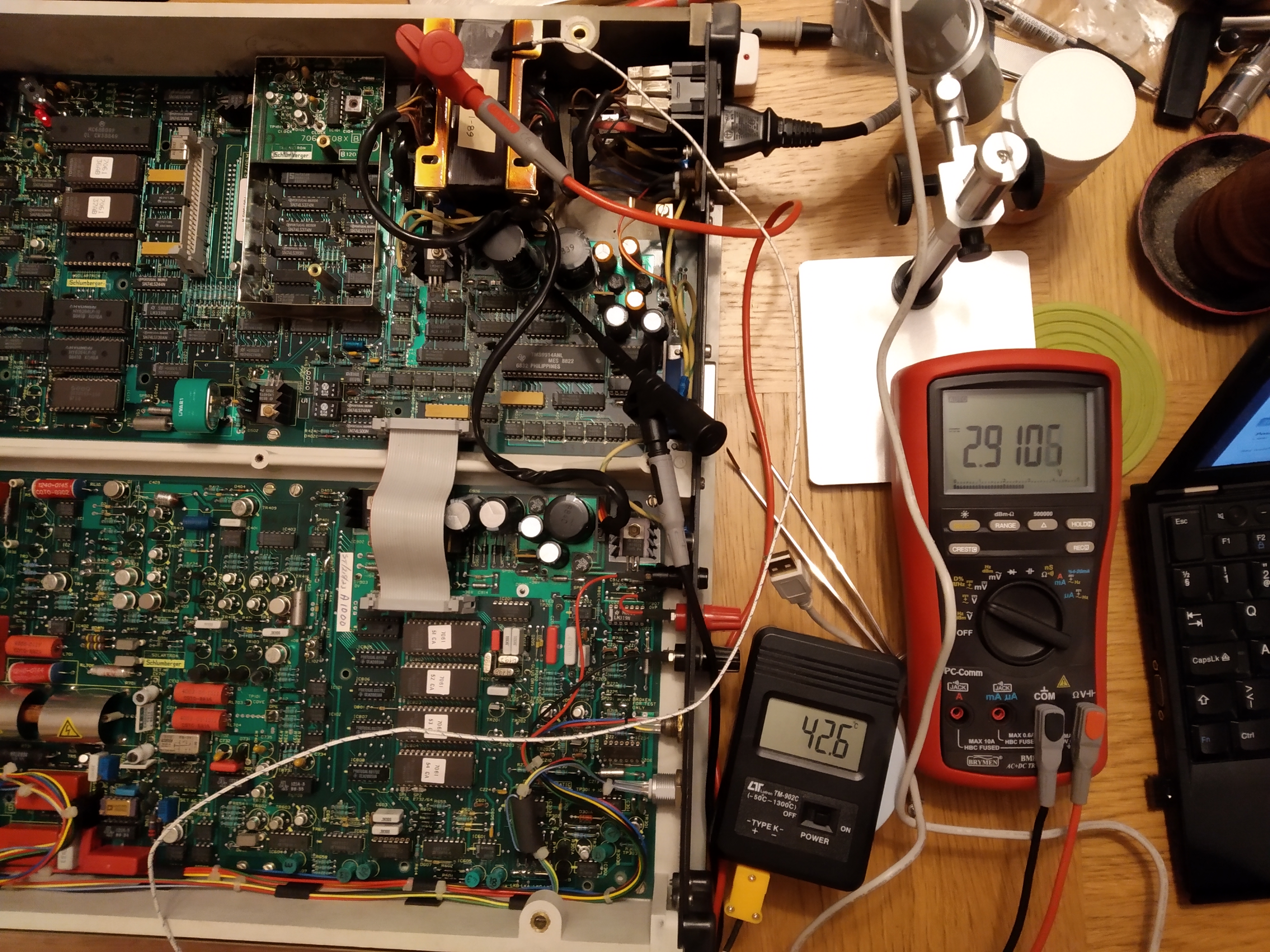 I think I'll see if I can get my thermocouple probe in through the earth screw on the back and see what the temperature looks like around the reference area once the meter is closed again and warmed up.
Have you seen this suspicious-looking solder joint of the 1N829A?
It does look a little suspicious - you have eagle eyes! Looking closer, the leads appear not to have been soldered on the top of the board. My assumption is that they hand soldered the reference after the rest of the PCB had been flow soldered and probably used a heat sink on the top of the PCB while they soldered the legs on the bottom side.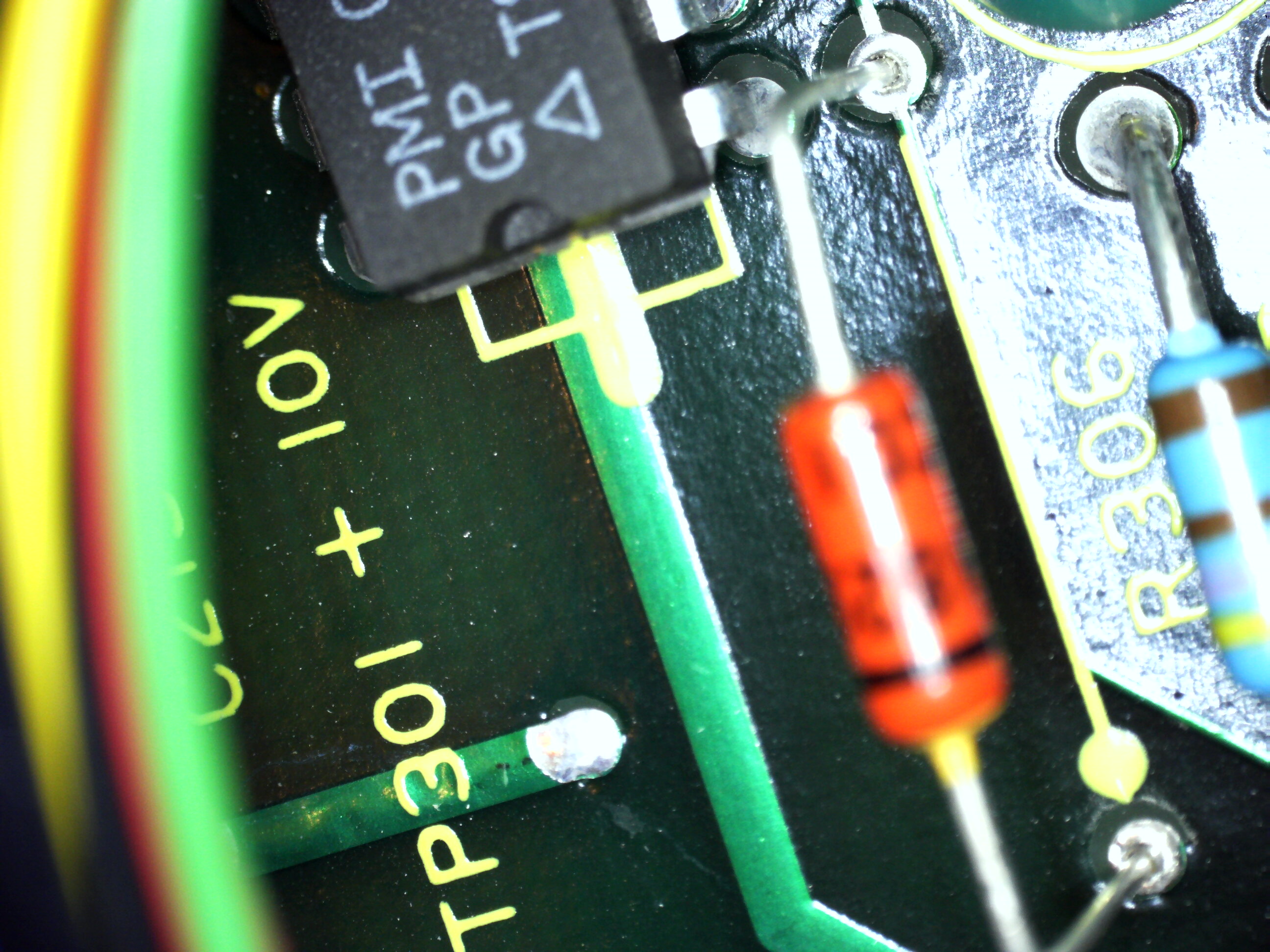 Certainly, given the current reasonable accuracy that the meter exhibits, I don't have any reason to believe that there is any problem with the connections to the reference diode.
It seems to me that while the clock reference procedure is important, grizewald has presented valid empirical evidence that applying insulation around the reference diode improves overall stability.
The only thing I'd be concerned with is his solution; while certainly a valid proof of concept, over the long term a ball of cotton that tends to absorb moisture from the air in direct contact with the diode's leads at a differing voltage potential just screams "electrolysis" at me... as well as potential for disrupting the reference voltage circuit if the cotton develops an oxidation trace as a result.
mnem
-
Ditto also on never running a 24xx with the case off. Put a fan blowing across the bottom if you do, and as med can attest, do NOT stack this scope on top of other gear when in use. Keep it propped up on the bail with lots of free air underneath for a long and happy life.
No, that's the 2430 that had the heat related failures due to improper stacking.....not the 2465.
Everything else I agree....LEAVE U800 ALONE. Do NOT mess with it. -
It seems to me that while the clock reference procedure is important, grizewald has presented valid empirical evidence that applying insulation around the reference diode improves overall stability.
The only thing I'd be concerned with is his solution; while certainly a valid proof of concept, over the long term a ball of cotton that tends to absorb moisture from the air in direct contact with the diode's leads at a differing voltage potential just screams "electrolysis" at me... as well as potential for disrupting the reference voltage circuit if the cotton develops an oxidation trace as a result.
mnem
Wise words mnementh.
The cotton is a "let's see if it makes any difference" kind of mod. I certainly have no intention of leaving it as a permanent fix for just the reasons you mention.
For the permanent fix, I was thinking of digging out some silica thread and making a nice little tea cosy for the diode.
-
It looks a bit like it's a layer of lacquer that's peeling up.
I wonder if it can be fixed by using some artists fixative spray and gently pushing it back down with a small soft brush.
After that you'd want a coat of matte or satin lacquer on top
Thanks - that's the sort of ideas I'm after. Straight to top of list
Probably not a good idea. That fixative spray has very fast evaporating solvents - the whole idea is to minimize the time it has to do damage to a drawing - so it's not likely to stay sticky enough for long enough to press things into place.
It's not clear from the photo what the materials are, and I've never dismantled an HP meter to look. You may be better off with water based materials. One possibility is PVA, another is bookbinder's glue. The later is nothing more complicated than a 50/50 mixture of PVA with wallpaper paste (made up, naturally, not the dry powder)- it has the advantages of having enough tack to be useful, not so much that you can't carefully reposition things, and takes enough time to set to be gentle with things. Once you've got everything together cover with greaseproof paper/baking parchment/silicone paper, some newspaper then a board and stick it in a bookbinder's press, or under a tall stack of books. Leave to dry for a day. If the covering paper sticks at all (it shouldn't) peal it back on itself gently, i.e. pull as close to horizontal as you can. A bit of steam can help if it's really stuck. -
This section is done.

The next major section to do is by the vertical amplifier. As you can see access to the bottom of the cans is impossible unless I start pulling components off the ceramic strips. Not gonna happen. Those cans will be removed completely and replacement caps installed on terminal strips top side. That's a project for another day.
Well, does it work? Sure does. In fact, the +325V now reading exactly, was about +323V before. +500V went from +496V to +499V. Tells me the old capacitors were getting tired.
-
On to the 2445.
Main board. U800 probably needs a heatsink
Don't, or at least measure the temp of the damn thing before getting your monkey wrench out. Then read TekScopes on the subject.
None of my 2465/2445B are more than warm to the touch (but I ought to test that with a fast sweep and minimum holdoff)QuoteEdit: you can't get a scope and not measure some rise time. So here's the HP 3312A's square output into the internal 50 ohm termination of the scope.
Manual quotes 20ns for this so it's looking pretty good.
When are you going to test the 2445's risetime?
-
It looks a bit like it's a layer of lacquer that's peeling up.
I wonder if it can be fixed by using some artists fixative spray and gently pushing it back down with a small soft brush.
After that you'd want a coat of matte or satin lacquer on top
Thanks - that's the sort of ideas I'm after. Straight to top of list
Probably not a good idea. That fixative spray has very fast evaporating solvents - the whole idea is to minimize the time it has to do damage to a drawing - so it's not likely to stay sticky enough for long enough to press things into place.
This
If possible, upon detaching it, do a full scale scanning at a flatbed scanner 1st if possible, worst case scenario should restoration turns into really bad, you can print a new one. -
...Ditto also on never running a 24xx with the case off. Put a fan blowing across the bottom if you do, and as med can attest, do NOT stack this scope on top of other gear when in use. Keep it propped up on the bail with lots of free air underneath for a long and happy life.
No, that's the 2430 that had the heat related failures due to improper stacking.....not the 2465.
Everything else I agree....LEAVE U800 ALONE. Do NOT mess with it.
I know your failure was the hybrid amp on the frontend; I still feel it's a valid comparison and relevant. Related family of scopes; similar common failure mode, same solution:
No letting your 24xx get all hot & bothered spooning with other test gear.It seems to me that while the clock reference procedure is important, grizewald has presented valid empirical evidence that applying insulation around the reference diode improves overall stability.
The only thing I'd be concerned with is his solution; while certainly a valid proof of concept, over the long term a ball of cotton that tends to absorb moisture from the air in direct contact with the diode's leads at a differing voltage potential just screams "electrolysis" at me... as well as potential for disrupting the reference voltage circuit if the cotton develops an oxidation trace as a result.
mnem
Wise words mnementh. The cotton is a "let's see if it makes any difference" kind of mod. I certainly have no intention of leaving it as a permanent fix for just the reasons you mention. For the permanent fix, I was thinking of digging out some silica thread and making a nice little tea cosy for the diode.
Heh... the mental image of you knitting a sock for a diode made me giggle involuntarily.  My wife even stopped watching her detective drama on Netflix long enough to give me the "WTF is with you...?" look; I NEVER giggle.
mnem
*back to the bench* -
It seems to me that while the clock reference procedure is important, grizewald has presented valid empirical evidence that applying insulation around the reference diode improves overall stability.
Thermal insulation to reduce thermal drift. Lock the clock to the mains frequency to reduce power line noise. -
On to the 2445.
Main board. U800 probably needs a heatsink
Don't, or at least measure the temp of the damn thing before getting your monkey wrench out. Then read TekScopes on the subject.
None of my 2465/2445B are more than warm to the touch (but I ought to test that with a fast sweep and minimum holdoff)QuoteEdit: you can't get a scope and not measure some rise time. So here's the HP 3312A's square output into the internal 50 ohm termination of the scope.
Manual quotes 20ns for this so it's looking pretty good.
When are you going to test the 2445's risetime?
Well the scope had been powered up for nearly 5 hours now and is only warm. I’m good with that.
As for 2445 rise time, as soon as I’ve thrown something together that has a fast step. All I have handy is a Jim Williams jobby which is not quite good enough IMHO as it’s just a short pulse.
Edit: just found a whole tube of 74AC14N’s in the cupboard so that may be “this evening”
-
It seems to me that while the clock reference procedure is important, grizewald has presented valid empirical evidence that applying insulation around the reference diode improves overall stability.
Thermal insulation to reduce thermal drift. Lock the clock to the mains frequency to reduce power line noise.
As the "thermal" in question is generated by the device itself, not exactly thermal drift; hence my classifying it as a stability issue. I was trying to point out that the two issues are not an either/or solution as Kosmic's post sortof sounded... however in retrospect, I know Kosmic is generally not that kind of nit-picky, so I agree here in principle.
Do both and you can get your 7061's ppm much lower; this is what volt-nuttery is all about.
mnem
*vicariously enjoying OPVN*
-
Well the scope had been powered up for nearly 5 hours now and is only warm. I’m good with that.
As for 2445 rise time, as soon as I’ve thrown something together that has a fast step. All I have handy is a Jim Williams jobby which is not quite good enough IMHO as it’s just a short pulse.
Edit: just found a whole tube of 74AC14N’s in the cupboard so that may be “this evening”
Welcome back to the dark side. I knew you couldn't stay away.
I am NOT your father.
-
On to the 2445.
Main board. U800 probably needs a heatsink
Don't, or at least measure the temp of the damn thing before getting your monkey wrench out. Then read TekScopes on the subject.
None of my 2465/2445B are more than warm to the touch (but I ought to test that with a fast sweep and minimum holdoff)QuoteEdit: you can't get a scope and not measure some rise time. So here's the HP 3312A's square output into the internal 50 ohm termination of the scope.
Manual quotes 20ns for this so it's looking pretty good.
When are you going to test the 2445's risetime?
Well the scope had been powered up for nearly 5 hours now and is only warm. I’m good with that.
As for 2445 rise time, as soon as I’ve thrown something together that has a fast step. All I have handy is a Jim Williams jobby which is not quite good enough IMHO as it’s just a short pulse.
Edit: just found a whole tube of 74AC14N’s in the cupboard so that may be “this evening”
Try a parallel open stub to get a pulse 2* the stuib length.
I prefer 74lvc1g*; they can give 250ps into 50ohms. That's what you saw today driving the scopes, or see my previous posts about what it looks like on a modern scope. -
I’ve actually got some 74LVC14’s floating around but my eyes aren’t up to that this evening
I may build something decent based on your suggestion next week. Need a non radio project! -
Here's your cookie:Well the scope had been powered up for nearly 5 hours now and is only warm. I’m good with that. As for 2445 rise time, as soon as I’ve thrown something together that has a fast step. All I have handy is a Jim Williams jobby which is not quite good enough IMHO as it’s just a short pulse. Edit: just found a whole tube of 74AC14N’s in the cupboard so that may be “this evening”
Welcome back to the dark side. I knew you couldn't stay away. I am NOT your father. /https://www.thestar.com/content/dam/thestar/life/health_wellness/2017/05/10/the-dish-how-many-calories-are-in-this-giant-chocolate-chip-cookie/le-gourmand-cafe-chocolate-chip-cookie.jpg)

mnem
Fine... here's one for you too.
-
Just realized, many of TEA regulars here, own Tek 24x5 A/B/plain, aren't we ?
Yep, 2 of them. Vanilla 2465 and a 2465 DMS. And a related 2430. -
I’ve actually got some 74LVC14’s floating around but my eyes aren’t up to that this evening
I may build something decent based on your suggestion next week. Need a non radio project!
You need very good decoupling. Work out the di/dt into 50ohms, then the induced voltage due to any stray inductance v=Ldi/dt. The numbers aren't small! -
 Just stumbled across this while looking at arcade joysticks on fleaBay: eBay auction: #132490173176 Not sure if it's valuable as HAM gear or not; just thought I'd bring it to the attention of those who are into aggravated aether.
mnem
*back to the bench*
-
it`s working. Next action will be in april.
-
Just stumbled across this while looking at arcade joysticks on fleaBay: eBay auction: #132490173176 Not sure if it's valuable as HAM gear or not; just thought I'd bring it to the attention of those who are into aggravated aether.
mnem
*back to the bench*
most jurisdictions rather frown on unlicensed 3M operation -
Just stumbled across this while looking at arcade joysticks on fleaBay: eBay auction: #132490173176 Not sure if it's valuable as HAM gear or not; just thought I'd bring it to the attention of those who are into aggravated aether.
mnem
*back to the bench*
Nothing about input or output impedance and also: https://www.jhhhhjonline.com/index.php?main_page=product_info&products_id=372552