Those things do really work? I've always wondered...
For electrical welding too or only for gas?
yes
this technology changed everything, a must have if you weld
Those things do really work? I've always wondered...
For electrical welding too or only for gas?
The one I now have is fantastic - wish I'd spent the money years ago when taking classes in welding - would have made it much easier. In their 'off' state, they are a good shade for gas welding; when turned on they lighten somewhat from that until they're triggered by the arc, at which point they darken to between something like an 8 to a 13 or so, depending on the setting. Be sure to get one with multiple sensors - my first one had only one and would sometimes go light if I blocked the sensor's view of the arc while working.
-Pat
While playing background videos while I get some of these scopes repaired, cal'd, and back in their cases, I stumbled on a really cool video showing the making of a custom nixie tube for Keysight. I don't think I've seen anyone post it here in the past 5 weeks, so here it is:
Those things do really work? I've always wondered...
For electrical welding too or only for gas?
The one I now have is fantastic - wish I'd spent the money years ago when taking classes in welding - would have made it much easier. In their 'off' state, they are a good shade for gas welding; when turned on they lighten somewhat from that until they're triggered by the arc, at which point they darken to between something like an 8 to a 13 or so, depending on the setting. Be sure to get one with multiple sensors - my first one had only one and would sometimes go light if I blocked the sensor's view of the arc while working.
-Pat
Yep that's a trap for the uninitiated when welding in tight spaces and exactly why I haven't thrown away the flip front visor yet.
The first auto darkeners I saw must have been nearly 20 yrs back and cost a bloody bomb but now as cheap as chips and a perfectly good one is less than a 'branded' flip front. IIRC the one I use now cost ~60 NZ Pesos, say $35 US.
When you get into a good sized job the convenience and time saving they offer pay for themselves quick.

Starting the arc is where they really shine as when the rods coating is touching the work and the arc proper hasn't started you can still see the tiny spark of the coating conducting before the arc starts. This alone makes arc welding more relaxing as you don't get the sticks and such when trying to strike an arc.
So ticking off the list of jobs to get outta the way today which included a soothing rubbish bonfire (gotta help with some gloBULL warming for freezing Med and the great white north) the hypnotic bit of watching a bonfire was interrupted with CLACK CLACK CLACK !

Yeah know exactly what that was .....a good short in the electric fence.
Having the trusty 4 wheel horse with chainsaw and other assorted tools aboard we betta sort this out as winter is approaching and it can only get worse in our NZ wet winter.
It turned out to be 400m away

yet it sounded just 50 !
15 pic attempts to capture a 3ms short finally got one.

Jumping some 10mm/3/8" it's a bit scary without something insulated so the claw on my 24oz rubber handled Estwing chipped a bit of bark away to quieten it for now but I need dream up a proper fix rather than cut the NZ native White Pine (Dacrycarpus dacrydioides or
Kahikatea) down. Yep when I set the fence out some 25 yrs ago sufficient room for the tree to grow wasn't considered/allowed.

-group-therapy-thread/?action=dlattach;attach=973208)
Some sort of standoff insulator between the wire and the tree. But obviously that's a temporary measure. You'll have to decide. Cut down the tree or move the fence.
Quick & dirty solution is to nail a short section of 2x4 to the tree, with regular fencepost insulators right at each end so they act as a standoff. Maintain as needed when you make the rounds tending fence; will typically last 5-10 years per installation. Most farmers will consider that a better expenditure of time than moving fenceposts before they need replacement due to rot; ranchers with idle hands on the payroll sometimes feel otherwise.

mnem
"On the farm, you don't get up and go to work in the morning. You get up and you're surrounded by it." ~grand-dad
Those things do really work? I've always wondered...
For electrical welding too or only for gas?
The one I now have is fantastic - wish I'd spent the money years ago when taking classes in welding - would have made it much easier. In their 'off' state, they are a good shade for gas welding; when turned on they lighten somewhat from that until they're triggered by the arc, at which point they darken to between something like an 8 to a 13 or so, depending on the setting. Be sure to get one with multiple sensors - my first one had only one and would sometimes go light if I blocked the sensor's view of the arc while working.
-Pat
I got my first auto-darkening helmet over 30 years ago; Speedglas helmets were crazy expensive and still untrusted, so I bought one of the competing voice-activated models. Still fucking expensive, fucking heavy with 4 AA batteries, fucking tiny 1.5 x 4 in objective, and fucking ate batteries if you forgot to turn it off-off.
I trained it to activate on
"Fuck you!".

In all honesty, except for overhead & close quarters work I still preferred my old FibreMetal flip-front; light, comfortable, had a big 4 x 5 objective, and they know how to make a hinge that "pops" perfectly every time. I've had several arc-activated helmets & hoods since, but I still close my eyes when I strike the arc out of habit.

mnem
*currently having my brain molested by Fusion360*
I've had several arc-activated helmets & hoods since, but I still close my eyes when I strike the arc out of habit.
Those must have been as slow tinting as hell to have you form a habit like that ....bugger that !
You're right about early ones, their vision widow was pretty small and some buddies helmets had furking batteries too....stuff that, as it's not like being at the bench where batteries are normally within reach.
I've had this cheap auto darkener for ~7 yrs since I lost everything in a workshop fire and don't even think it has blatteries instead it has a PV panel atop the viewing window which while not monstrous is still larger than a normal flip front. I've been pretty happy with it after needing 2 shades of lenses for arc and MIG in a flip front while with a auto helmet you just wind in more darkness.
Quick & dirty solution is to nail a short section of 2x4 to the tree, with regular fencepost insulators right at each end so they act as a standoff.
Yep, something along those lines is part of the plan. Still it needs fixing to the tree as the fence is running up a hill so an oversize hole top and bottom for long galv tex screws will allow the tree to grow and gently push the wires away yet keep it in place.
mnem
"On the farm, you don't get up and go to work in the morning. You get up and you're surrounded by it." ~grand-dad
AY-MEN to that ! Never a moment to be bored as there's ALWAYS something to do.
I just got back from the Px and the grocery; peeked in to hear Pat & Saskia gabbling about old vs new DSOs and found FireFlump didn't wanna talk to my mic, so I bailed. meh.
mnem
*toddles off to go walkies with the kiddles*
Sometimes it might be just like the forum itself, topics that you feel you can contribute to and other times something that dosen't float your boat and thus can add basically very little if anything to the discussion 
Yeah, there’s that and I got there late, after everybody but the usual suspects had toddled off. I’ll usually just lurk & listen while I do other work; Saskia can talk the ears off a brass monkey when she gets to rambling, but it’s always a good story so I don’t realize how much time has passed until the dwagon’s belly starts grumbling.
mnem

Those things do really work? I've always wondered...
For electrical welding too or only for gas?
The one I now have is fantastic - wish I'd spent the money years ago when taking classes in welding - would have made it much easier. In their 'off' state, they are a good shade for gas welding; when turned on they lighten somewhat from that until they're triggered by the arc, at which point they darken to between something like an 8 to a 13 or so, depending on the setting. Be sure to get one with multiple sensors - my first one had only one and would sometimes go light if I blocked the sensor's view of the arc while working.
-Pat
Yep that's a trap for the uninitiated when welding in tight spaces and exactly why I haven't thrown away the flip front visor yet.
The first auto darkeners I saw must have been nearly 20 yrs back and cost a bloody bomb but now as cheap as chips and a perfectly good one is less than a 'branded' flip front. IIRC the one I use now cost ~60 NZ Pesos, say $35 US.
When you get into a good sized job the convenience and time saving they offer pay for themselves quick.
Starting the arc is where they really shine as when the rods coating is touching the work and the arc proper hasn't started you can still see the tiny spark of the coating conducting before the arc starts. This alone makes arc welding more relaxing as you don't get the sticks and such when trying to strike an arc.
Fitting...as the technology reminds me of the PLZT (lead zirconium titanate) flash goggles that were used by aircrew to protect against flashblindness from nuclear weapons. Nevertheless, it was standard practice to slide an eyepatch over one eye under the goggle before your drop, so that one eye would remain usable in case of the goggles malfunctioning. I do not know if this was only used when they were new or if it was kept up after.
I own a different type of goggles which are using rotating polarized filters. You can adjust them by a knob over your nose from nearly clear to a degree of attenuation where you will not see anything on a bright day. They are also of military origin, but they came handy when working steel mill control systems for Siemens, as you could dim the view to the point where you could look at white hot metal and actually see something. But they are not rated for welding.
I've had several arc-activated helmets & hoods since, but I still close my eyes when I strike the arc out of habit.
Those must have been as slow tinting as hell to have you form a habit like that ....bugger that !
You're right about early ones, their vision widow was pretty small and some buddies helmets had furking batteries too....stuff that, as it's not like being at the bench where batteries are normally within reach.
I've had this cheap auto darkener for ~7 yrs since I lost everything in a workshop fire and don't even think it has blatteries instead it has a PV panel atop the viewing window which while not monstrous is still larger than a normal flip front. I've been pretty happy with it after needing 2 shades of lenses for arc and MIG in a flip front while with a auto helmet you just wind in more darkness.
Well, the blink as you strike thing was a habit developed with the old FibreMetal helmet; you’d flip the helmet up and position to strike, then blink and jerk your head a little as you heard the arc so the helmet pops down. Once you learn, it becomes second nature; maybe 1/4 second or so that you’re welding blind.
Easy to do horizontal & vertical in most situations while standing or working on a bench; when you have to do “in situ” welding is where it can be an assache... especially if you get out of the habit of using the flip visor because you’re working in the shop for long stints, like railing contracts & such.
I never got out of the habit because I never fully trusted the manufacturer’s claims of safety; just because your rods & cones can’t sense the light, doesn’t mean the retina isn’t being exposed.
The newer helmets have a small rechargeable battery in them that is maintained by the PV cell, that means even if you use it regularly the helmet will have a finite lifespan before it dies. I have no idea if there is any kind of regulation as to what, if any, failsafes these cheap helmets must have.
mnem
*knocks self unconscious with a post maul*
I just got back from the Px and the grocery; peeked in to hear Pat & Saskia gabbling about old vs new DSOs and found FireFlump didn't wanna talk to my mic, so I bailed. meh.
mnem
*toddles off to go walkies with the kiddles*
Interesting topic, especially as I was quite amazed to hear MNEMs faint praise for the much maligned 2430.
This scope was even wrongly described as an A/D hybrid akin to the 2335, which it isn't, because it is always sampling. After having used a slower DSO, it was the scope giving me the 'WHOA, that is what a DSO can do' effect back when I encountered it first. Tek 2430/2440 remains as my backup and it is the scope that you can expect me to operate even when half asleep. We just got very intimate over the time and I know where is what and what to expect. Apart from the known vulnerability of cooking chips when the fan fails, it is one of Tektronix major strikes.
Well, the blink as you strike thing was a habit developed with the old FibreMetal helmet; you’d flip the helmet up and position to strike, then blink and jerk your head a little as you heard the arc so the helmet pops down. Once you learn, it becomes second nature; maybe 1/4 second or so that you’re welding blind.
Ah OK, gottcha. Yep that was my MO too after finding it was simpler than flicking the flip front lense down.
I never got out of the habit ..........
I did real quick and only flick a helmet back now for fiddly setups. Found auto helmets great for MIG and especially TIG where you don't wanna touch the TIG electrode to work for the risk of contaminating it.
Pre tinted as they may be there's still enough visibility to see your handpiece tip whatever type it may be all the way down to your work without touching it and the arc to light without even striking it.
Raining here now and the day nearly done so zero chance of getting the scoop close to the shed to make a start but there's always the morrow.....it ain't going nowhere.
Dammit, I need to move to somewhere with cheaper shipping from the US 
How can no-one be bidding on this? It's beauuuuutifulllll  https://www.ebay.co.uk/itm/HP-3437A-System-Voltmeter/264698971453
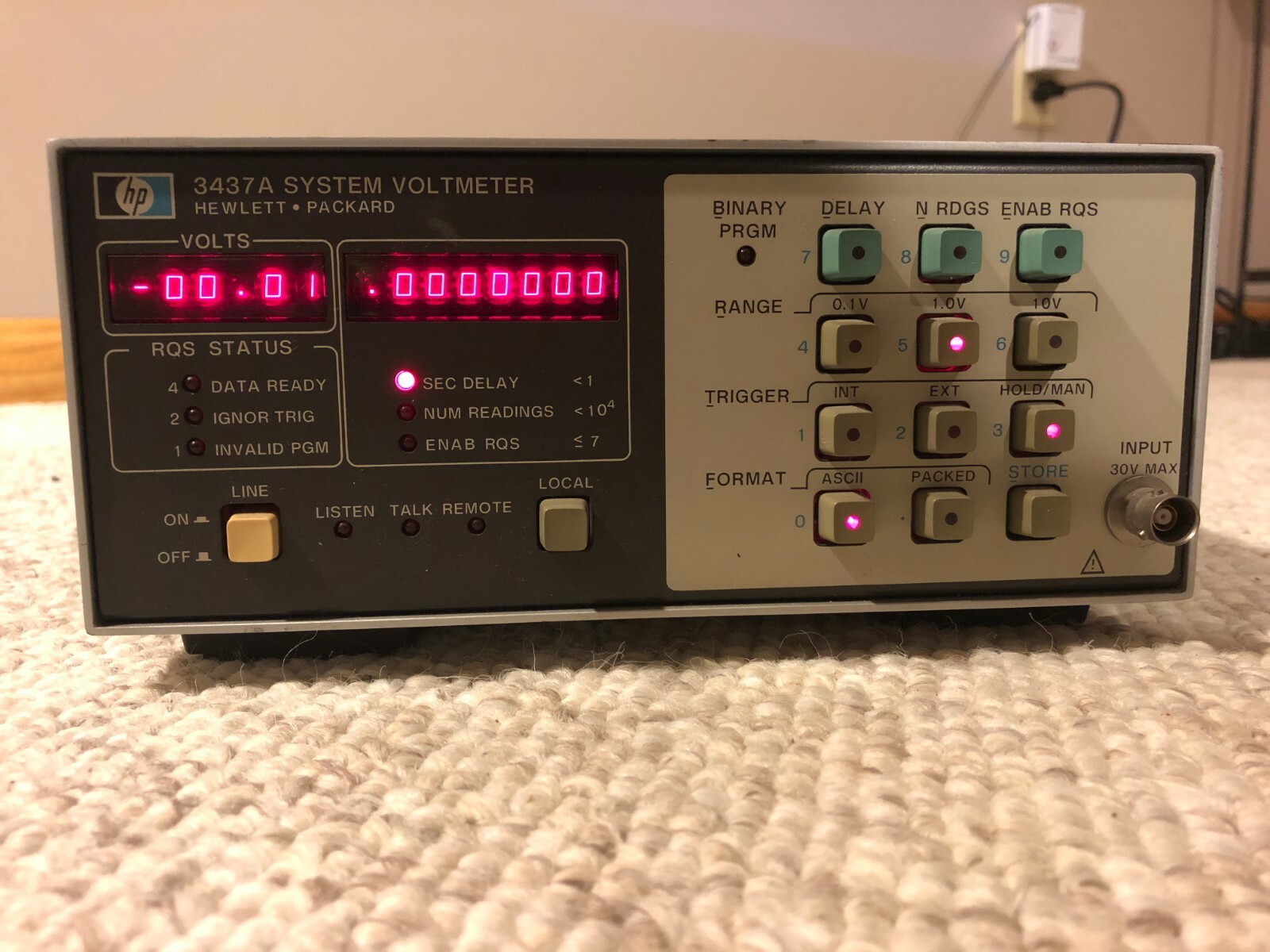
These are rather useless nowadays. It's an extension to analogue oscilloscopes and you need one with Z-axis input.
I've got two cheaply over the years and also the necessary Triax Lug and some Triax cable to make an adapter for measurements, but it's in the TE stack still because every digital oscilloscope today has measurement functions that do better and are more versatile than this.
On the other hand, the display has a really nice look and because the pushbuttons are not plastic-welded to the pcb these systems voltmeters are good for spare parts..
Another thing to do if you want to use them is the annoyingly loud fan that I instantly replaced on my first unit after I got it. A standard fan does the job, but one has to find a suited supply for it on his own because the original fan has a multiphase motor with external driver circuit.. (Don't remember what type of fan I used, 12V, 24V, no idea
)
Those things do really work? I've always wondered...
For electrical welding too or only for gas?
They definitely work. You don't need that level of protection for gas, so I'm usually only wearing classic goggles for gas, but always full PPE including auto-shield for arc. I'm much better with the stick welder than with oxyacetylene, but that does not say much.
In both cases, since I've more or less frequently used a soldering iron for a bit above 30 years it actually helped me with some of the learning around welding. Even if one's off by 500 or 1000 degrees (real, Swedish degrees, Celsius was professor in astronomy in Uppsala) metal floats and solidifies in similar ways. Just other metals!
Oxy is my weapon of choice - as it was available - I am useless on stick welding - I have tried a well set up friend's MIG and liked it - never tried TIG - but I can't justify getting a good TIG setup for the little I would use it.
I still have the inherited oxy-acet regulators - the local gas supply company used to charge 'rent' on the cylinders - up to $300/yr - highway robbery. You can now get disposable oxy-acet set ups - terrible regulators but usable for the little stuff I use it for.
As a young lad managed to give myself 'zinc fume fever' - my GP wasn't aware of it (residential area) but the guys at my father's Uni metal workshop all had a good laugh!
I just got back from the Px and the grocery; peeked in to hear Pat & Saskia gabbling about old vs new DSOs and found FireFlump didn't wanna talk to my mic, so I bailed. meh.
mnem
*toddles off to go walkies with the kiddles*
Interesting topic, especially as I was quite amazed to hear MNEMs faint praise for the much maligned 2430.
This scope was even wrongly described as an A/D hybrid akin to the 2335, which it isn't, because it is always sampling. After having used a slower DSO, it was the scope giving me the 'WHOA, that is what a DSO can do' effect back when I encountered it first. Tek 2430/2440 remains as my backup and it is the scope that you can expect me to operate even when half asleep. We just got very intimate over the time and I know where is what and what to expect. Apart from the known vulnerability of cooking chips when the fan fails, it is one of Tektronix major strikes.
Yes, I found out the hard way that the CCD hybrids in the 2430 are extremely sensitive to overheating and once cooked they are trash. There are 2 ways to kill them. Operating the scope with the bottom vent holes blocked and operating the scope out of the case for long periods and not having a fan blowing on those hybrids. I destroyed 3 of them before I figured out what was going on. Luckily I was able to find replacements on Ebay for a reasonable price and I have 1 good spare. But ever since those incidences as long as you observe these precautions (not blocking vents and keep scope in case) there have not been any additional failures. There is a good reason this scope has an unusually large and somewhat noisy fan.
Perhaps you can answer a question that puzzles me. In Acquire mode and the "Repetition" turned off a 10MHz square wave looks terrible. From what I can figure out the scope is in "real time" mode but it apparently limits it's B/W to 40MHz which explains the roll off. But with "Repetition" turned on and max sample rate of 256 the result is an accurate and beautiful square wave. Why the limited B/W in real time mode?


Jupiter 2000 was the FG I took to university with me. I was the only one with a lab in the halls
I could only afford to take some pliers/cutters, multimeter, and a homebrew 8038 oscillator.
I never used the oscillator since I could use those in the university labs.
I still have the multimeter, but don't use it.
45 years later, I use the cutters and pliers daily


